
Executive Development Programme in Assessing Fish Behavior for Effective Passage Design
Master fish behavior assessment to optimize passage design, ensuring enhanced aquatic connectivity and improved ecosystem sustainability for effective infrastructure planning.
Executive Development Programme in Assessing Fish Behavior for Effective Passage Design
About This Course
This intensive Executive Development Programme equips hydrologists, civil engineers, and environmental consultants with the specialized expertise required to design fish passage infrastructure that truly supports aquatic ecosystem connectivity. You will master advanced methodologies for observing and interpreting complex fish behavioral patterns, such as upstream migration triggers, velocity preferences, and stress responses, within controlled and natural flow environments. The curriculum integrates cutting-edge hydrodynamic modeling with real-world biological data, ensuring you can translate intricate behavioral insights into practical, engineering-driven solutions for dams, culverts, and weirs. Participants will engage directly with case studies from major global restoration projects to understand how precise behavioral assessment prevents costly design failures and enhances ecological integrity.
You will develop critical competencies in deploying non-invasive monitoring technologies, including high-speed videography and acoustic telemetry, to capture detailed movement metrics of diverse fish species. The training emphasizes rigorous data analysis techniques that allow you to quantify passage success rates and identify specific hydraulic barriers that impede migration. You will learn to synthesize biological requirements with structural constraints, creating evidence-based design parameters that accommodate varying flow conditions and seasonal migration patterns. This hands-on approach ensures you can confidently evaluate existing infrastructure and propose targeted modifications that maximize passage efficiency while minimizing construction impacts on surrounding habitats.
Completing this programme significantly elevates your professional standing in the competitive fields of environmental engineering and conservation planning. You will gain the authority to lead high-stakes infrastructure projects that require strict adherence to ecological regulations and sustainability standards. Employers value your ability to bridge the gap between
What You Will Learn
Transform your approach to aquatic infrastructure by mastering the subtle language of fish behavior. This Executive Development Programme bridges the critical gap between biological science and engineering design, equipping you with the expertise to create passage systems that truly work for migrating species. You will move beyond standard compliance metrics to understand the nuanced decision-making processes of fish as they navigate complex hydraulic environments.
The curriculum dives deep into behavioral hydrodynamics, exploring how turbulence, velocity, and light influence movement patterns. You will analyze real-world case studies of successful and failed passage designs, learning to identify key bottlenecks that hinder migration. Interactive modules cover advanced monitoring techniques, including acoustic telemetry and high-speed video analysis, allowing you to gather precise data on fish interactions with structures like fish ladders, elevators, and bypass channels. You will also examine the physiological stress responses of different species, ensuring your designs prioritize animal welfare alongside engineering efficiency.
Graduates apply these specialized skills immediately in the field. You will lead multidisciplinary teams to evaluate existing infrastructure, propose evidence-based modifications, and design new passages that minimize ecological disruption. Your ability to interpret behavioral data translates into more effective conservation strategies and compliant, sustainable projects. This expertise opens doors to senior roles in environmental consulting, government regulatory agencies, and large-scale infrastructure firms. You will position yourself as a vital link between ecological preservation and development goals. Whether you aim to advise on major dam removals or optimize urban waterway systems, this programme provides the actionable insights needed to drive meaningful change.
Course Benefits
Industry-Aligned Curriculum
Developed with industry leaders for job-ready skills
Globally Recognised Certificate
Recognised by employers across 180+ countries
Flexible Online Learning
Study at your own pace with lifetime access
Instant Access
Start learning immediately, no application process
Constantly Updated Content
Latest industry trends and best practices
Career Advancement
87% report measurable career progression within 6 months
What This Course Covers
- Ethology Fundamentals: Introduces key fish behavior concepts and biological drivers influencing movement.: Hydraulic Interactions: Examines how flow velocity, turbulence, and pressure affect fish swimming capabilities.
- Passage Architecture: Analyzes the design principles of fish ladders, locks, and bypass systems.: Observation Techniques: Covers non-invasive monitoring tools such as underwater video and acoustic telemetry.
- Data Interpretation: Teaches methods for quantifying passage efficiency and behavioral success metrics.: Design Optimization: Focuses on applying behavioral insights to refine engineering solutions for better outcomes.
Everything You Get With This Course
Course Facts
**Audience-based insights for engineers and conservationists.
Basic ecology knowledge; no advanced math required.
Design humane, efficient fish passages with confidence.
Empower your career with practical skills that bridge science and engineering. This program equips you to solve real-world challenges, ensuring sustainable infrastructure that supports aquatic life. Join us to transform your expertise into meaningful impact, creating safer pathways for fish while advancing your professional growth in environmental design.
Ready to Advance Your Career?
Join thousands of professionals who have transformed their careers with LSBR UK
Why This Course Is Right for You
Investing in the Executive Development Programme in Assessing Fish Behavior for Effective Passage Design transforms your professional trajectory by bridging the critical gap between ecological theory and practical engineering. This specialized training equips you with the tools to create infrastructure that truly supports aquatic life, making you an invaluable asset in sustainable development projects.
You will master advanced behavioral analytics, allowing you to interpret complex fish movement patterns with precision. This deep understanding enables you to design passage systems that significantly improve survival rates for migrating species, directly enhancing the ecological success of your projects.
The curriculum emphasizes data-driven decision-making, teaching you to integrate real-time monitoring technologies into your designs. This skill set makes you highly competitive in the job market, as firms increasingly seek experts who can optimize infrastructure efficiency while meeting stringent environmental regulations.
You will gain strategic leadership capabilities tailored for interdisciplinary teams. By learning to communicate complex biological data to engineers and policymakers, you become a vital liaison who ensures projects are both technically sound and ecologically responsible.
Participants build a robust professional network with industry leaders and conservation experts. These connections open doors to high-impact collaborations and leadership roles in organizations dedicated to sustainable water resource management.
Embracing this programme positions you at the forefront of conservation engineering. You will not only refine your technical expertise but also champion meaningful environmental stewardship in your career.
3-4 Weeks
Study at your own pace
Course Brochure
Download our comprehensive course brochure with all details
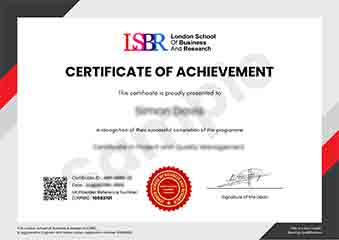
Sample Certificate
Preview the certificate you'll receive upon successful completion of this program.
Get Free Course Info
Receive detailed course information, curriculum breakdown, and career outcomes straight to your inbox.
Employer Sponsored?
Many employers cover professional development costs. Request a corporate invoice and we'll handle the rest. Bulk enrollment discounts available for teams of 3+.
How You Earn Your Certificate
Four simple steps to your professionally recognised qualification
Enroll & Get Instant Access
Complete your enrollment and access course materials immediately
Study at Your Own Pace
Work through the modules on your schedule, from anywhere in the world
Complete Assessments
Demonstrate your knowledge through practical, real-world assessments
Receive Your Certificate
Get your official LSBR UK certificate, recognised across 180+ countries
Real Results from Real Learners
Our graduates consistently report measurable career growth and professional advancement after completing their programmes.
Reviews from Our Learners
Hear from our students about their experience with the Executive Development Programme in Assessing Fish Behavior for Effective Passage Design at LSBR UK - Executive Education.
Charlotte Williams
United Kingdom"The deep dive into hydrodynamic cues and species-specific migration patterns provided a robust theoretical foundation that immediately translated into actionable design strategies. I now feel confident in applying these behavioral insights to create more efficient and humane fish passage structures, which has significantly enhanced my professional credibility in environmental engineering."
Rahul Singh
India"Mastering the nuances of fish behavior has completely transformed my approach to designing fish-friendly infrastructure, allowing me to create solutions that are both ecologically sound and engineeringly robust. This specialized knowledge has directly accelerated my career progression, positioning me as a go-to expert for complex passage projects within the renewable energy sector."
Emma Tremblay
Canada"The logical progression of modules seamlessly integrated theoretical principles with practical case studies, making complex behavioral data accessible and actionable. This structured approach significantly enhanced my ability to design fish passages that are both scientifically sound and effective in real-world conservation scenarios."
Need more time to decide?
Join 23,000+ professionals who advanced their careers. Enroll today and start learning immediately.
Enroll NowSecure payment • Instant access • Certificate included