
Advanced Certificate in Conservation Geography and Mathematical Methods
This advanced certificate equips learners with specialized skills in conservation geography and mathematical methods, enhancing analytical and problem-solving abilities for environmental stewardship.
Advanced Certificate in Conservation Geography and Mathematical Methods
About This Course
The Advanced Certificate in Conservation Geography and Mathematical Methods is designed for professionals and students with a background in geography, ecology, or related fields who aspire to enhance their expertise in conservation strategies and apply advanced mathematical techniques to solve complex environmental challenges. This program integrates cutting-edge geographical information systems (GIS), remote sensing, and quantitative methods, providing learners with a robust foundation in the spatial analysis of conservation issues. By combining these analytical tools with mathematical methodologies such as statistical analysis, optimization, and predictive modeling, participants will gain the skills necessary to effectively manage and conserve natural resources.
Through this program, learners will develop a deep understanding of spatial data analysis, learn to apply sophisticated GIS and remote sensing technologies for environmental monitoring, and master the use of advanced statistical and mathematical models to forecast environmental changes and evaluate conservation outcomes. Participants will also gain proficiency in using programming languages like Python for data manipulation and analysis, and learn to interpret and communicate the results of their analyses effectively. These skills are essential for addressing the complexities of modern conservation challenges and contribute to the sustainable management of natural resources.
The career impact of this program is significant, preparing graduates for roles in government agencies, non-profit organizations, research institutions, and private consulting firms. Graduates will be well-equipped to design and implement conservation strategies, conduct environmental impact assessments, and participate in policy development. They will also be capable of leading interdisciplinary teams and using data-driven approaches to inform conservation decisions, thereby contributing to global efforts in environmental sustainability and biodiversity protection.
What You Will Learn
The Advanced Certificate in Conservation Geography and Mathematical Methods is a pioneering program designed for environmental enthusiasts and professionals seeking to integrate cutting-edge mathematical techniques with geographic data to address global conservation challenges. This program equips students with a robust foundation in geographic information systems (GIS), remote sensing, and advanced statistical methods, enabling them to analyze and interpret complex environmental data.
Key topics include biodiversity assessment, climate change impacts, habitat fragmentation analysis, and predictive modeling for ecosystem services. Students will learn how to apply these skills to develop conservation strategies, monitor environmental changes, and support policy-making in sustainable development contexts. The program emphasizes hands-on learning through practical projects and fieldwork, ensuring graduates are well-prepared to tackle real-world conservation issues.
Graduates of this program are ideally suited for careers in environmental consulting, government agencies, non-profit organizations, and research institutions. They can work on projects such as wildlife corridor planning, sustainable land use management, and carbon offset initiatives. The interdisciplinary nature of the program ensures that students acquire versatile skills that are in high demand in the environmental sector, opening doors to diverse career paths and contributing significantly to global conservation efforts.
Course Benefits
Industry-Aligned Curriculum
Developed with industry leaders for job-ready skills
Globally Recognised Certificate
Recognised by employers across 180+ countries
Flexible Online Learning
Study at your own pace with lifetime access
Instant Access
Start learning immediately, no application process
Constantly Updated Content
Latest industry trends and best practices
Career Advancement
87% report measurable career progression within 6 months
What This Course Covers
- Spatial Analysis: Introduces techniques for analyzing geographic data.: Ecological Modeling: Focuses on mathematical models in ecological contexts.
- Remote Sensing: Covers the use of satellite and aerial imagery.: GIS Integration: Explains the application of Geographic Information Systems.
- Statistical Methods: Teaches advanced statistical techniques for data analysis.: Case Studies: Examines real-world conservation projects using geographic and mathematical methods.
Everything You Get With This Course
Course Facts
Audience: Environmental scientists, conservationists, geographers
Prerequisites: Bachelor’s degree, basic math skills
Outcomes: Advanced GIS, spatial analysis, conservation strategies
Ready to Advance Your Career?
Join thousands of professionals who have transformed their careers with LSBR UK
Why This Course Is Right for You
Enhance Analytical Skills: The Advanced Certificate in Conservation Geography and Mathematical Methods equips professionals with robust analytical tools, enabling them to tackle complex environmental challenges using quantitative and qualitative data. This skill set is crucial in fields like wildlife management and habitat conservation, where precise analysis of spatial and temporal data informs effective conservation strategies.
Career Diversification: This certificate opens up diverse career paths, including in government agencies, non-profits, and private sectors. By blending geography and mathematics, it prepares professionals for roles that require interdisciplinary expertise, such as environmental policy analysts, GIS specialists, and conservation scientists.
Improved Decision-Making: The program’s focus on mathematical methods and geographic information systems (GIS) helps professionals make evidence-based decisions in conservation efforts. For example, predictive models can forecast the impact of climate change on ecosystems, guiding policy and action to mitigate adverse effects.
Global Impact: With a strong foundation in conservation geography and mathematical methods, professionals can contribute to global conservation initiatives. The skills gained allow for the development and implementation of large-scale projects that address pressing environmental issues, such as biodiversity loss and sustainable land use, with a broader, more impactful perspective.
3-4 Weeks
Study at your own pace
Course Brochure
Download our comprehensive course brochure with all details
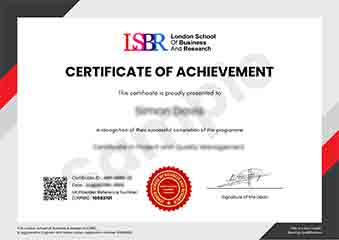
Sample Certificate
Preview the certificate you'll receive upon successful completion of this program.
Get Free Course Info
Receive detailed course information, curriculum breakdown, and career outcomes straight to your inbox.
Employer Sponsored?
Many employers cover professional development costs. Request a corporate invoice and we'll handle the rest. Bulk enrollment discounts available for teams of 3+.
How You Earn Your Certificate
Four simple steps to your professionally recognised qualification
Enroll & Get Instant Access
Complete your enrollment and access course materials immediately
Study at Your Own Pace
Work through the modules on your schedule, from anywhere in the world
Complete Assessments
Demonstrate your knowledge through practical, real-world assessments
Receive Your Certificate
Get your official LSBR UK certificate, recognised across 180+ countries
Real Results from Real Learners
Our graduates consistently report measurable career growth and professional advancement after completing their programmes.
Reviews from Our Learners
Hear from our students about their experience with the Advanced Certificate in Conservation Geography and Mathematical Methods at LSBR UK - Executive Education.
James Thompson
United Kingdom"The course content is incredibly comprehensive, providing a deep dive into the intersection of conservation and mathematical methods, which has equipped me with valuable analytical tools for real-world conservation challenges. I've gained practical skills that are directly applicable to my fieldwork, enhancing my ability to model and predict ecological impacts effectively."
Wei Ming Tan
Singapore"This course has been instrumental in bridging the gap between theoretical knowledge and practical applications in conservation geography. It has equipped me with advanced mathematical tools that are directly applicable in my field, significantly enhancing my career prospects and making me a more valuable asset to any conservation team."
Kavya Reddy
India"The course structure is meticulously organized, providing a seamless transition from theoretical concepts to practical applications in conservation geography and mathematical methods, which has significantly enhanced my understanding and prepared me for real-world challenges."
Need more time to decide?
Join 23,000+ professionals who advanced their careers. Enroll today and start learning immediately.
Enroll NowSecure payment • Instant access • Certificate included