
Advanced Certificate in Experimental Techniques for Flow Instability
This certificate equips professionals with advanced skills in experimental techniques for analyzing and mitigating flow instability, enhancing research and industrial applications.
Advanced Certificate in Experimental Techniques for Flow Instability
About This Course
The Advanced Certificate in Experimental Techniques for Flow Instability is designed for professionals and students in the fields of mechanical engineering, fluid dynamics, and related disciplines who seek to enhance their expertise in experimental methods and analysis techniques for understanding and managing flow instability. This program focuses on advanced experimental techniques, including laser Doppler velocimetry, hot-wire anemometry, and particle image velocimetry, providing hands-on experience and theoretical knowledge necessary to conduct cutting-edge research in fluid dynamics.
Participants will develop a comprehensive set of skills, including proficiency in advanced instrumentation, data acquisition systems, and post-processing software. They will gain a deep understanding of the theoretical foundations of flow instability, including turbulence, transition mechanisms, and control strategies. The program emphasizes practical application through laboratory experiments and analysis, ensuring that learners can apply their knowledge to real-world problems in industries such as aerospace, automotive, and environmental engineering.
The career impact of this program is significant, as it equips graduates with the advanced experimental skills and knowledge necessary to contribute to innovation in flow instability research and application. Graduates can pursue careers as research scientists, engineers, and technical specialists in academia, industry, or government agencies. The program also prepares learners for further academic pursuits, such as pursuing a master's or doctoral degree in fluid dynamics or related fields.
What You Will Learn
The Advanced Certificate in Experimental Techniques for Flow Instability is designed for professionals seeking to advance their expertise in fluid dynamics and flow instability. This comprehensive programme equips you with the skills necessary to conduct cutting-edge experiments that can lead to breakthroughs in a variety of fields, including aerospace engineering, environmental science, and materials science.
Key topics covered include advanced fluid mechanics, experimental design, data acquisition and analysis, and the latest in instrumentation technology. You will learn to apply these techniques to understand and mitigate flow instabilities, a critical aspect of fluid dynamics that impacts everything from aircraft design to energy efficiency in industrial processes.
Graduates of this programme will be well-prepared to work in research and development roles, contributing to the design and optimization of systems that rely on fluid flow. You will also be equipped to pursue careers in academia, where you can conduct cutting-edge research and mentor the next generation of engineers and scientists.
Upon completion, you will have the skills to design and execute experiments that can lead to innovations in flow control, enhance the efficiency of fluid systems, and contribute to the development of new technologies. Whether your goal is to advance your current career or transition into a research-oriented role, this programme provides you with the knowledge and practical skills needed to excel.
Course Benefits
Industry-Aligned Curriculum
Developed with industry leaders for job-ready skills
Globally Recognised Certificate
Recognised by employers across 180+ countries
Flexible Online Learning
Study at your own pace with lifetime access
Instant Access
Start learning immediately, no application process
Constantly Updated Content
Latest industry trends and best practices
Career Advancement
87% report measurable career progression within 6 months
What This Course Covers
- Linear Stability Theory: Analyzes the mathematical models used to predict flow instability.: Turbulence Modeling: Discusses the methods for simulating and understanding turbulent flows.
- Experimental Setup Design: Focuses on the planning and construction of experimental setups.: Data Acquisition Techniques: Covers the methods for collecting and processing experimental data.
- Data Analysis and Visualization: Teaches statistical analysis and graphical representation of experimental results.: Case Studies: Examines real-world applications and case studies of flow instability techniques.
Everything You Get With This Course
Course Facts
Audience: Engineers, researchers, PhD students
Prerequisites: Basic understanding of fluid dynamics
Outcomes: Proficient in flow visualization techniques
Ready to Advance Your Career?
Join thousands of professionals who have transformed their careers with LSBR UK
Why This Course Is Right for You
Enhance Expertise: Obtaining an Advanced Certificate in Experimental Techniques for Flow Instability equips professionals with specialized knowledge and practical skills in fluid dynamics. This is crucial for roles in aerospace, automotive, and mechanical engineering where understanding and controlling flow instabilities are paramount. For instance, aerospace engineers can better design aircraft to minimize drag and improve fuel efficiency by applying these techniques.
Career Advancement: The certificate can significantly boost career progression by making professionals more competitive in the job market. It demonstrates a deep commitment to professional development and a high level of technical proficiency, which are highly valued in industries like manufacturing and research. For example, it can lead to leadership roles in R&D departments where flow stability is a critical factor.
Innovation and Problem-Solving: The certificate provides advanced experimental methods and tools for analyzing and mitigating flow instabilities. This not only enhances problem-solving skills but also encourages innovative approaches to engineering challenges. For instance, engineers can use these techniques to develop new materials or designs that improve system performance under various flow conditions.
3-4 Weeks
Study at your own pace
Course Brochure
Download our comprehensive course brochure with all details
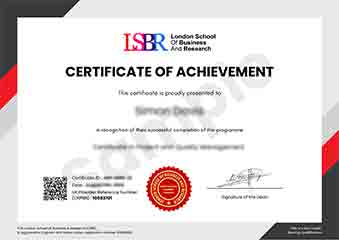
Sample Certificate
Preview the certificate you'll receive upon successful completion of this program.
Get Free Course Info
Receive detailed course information, curriculum breakdown, and career outcomes straight to your inbox.
Employer Sponsored?
Many employers cover professional development costs. Request a corporate invoice and we'll handle the rest. Bulk enrollment discounts available for teams of 3+.
How You Earn Your Certificate
Four simple steps to your professionally recognised qualification
Enroll & Get Instant Access
Complete your enrollment and access course materials immediately
Study at Your Own Pace
Work through the modules on your schedule, from anywhere in the world
Complete Assessments
Demonstrate your knowledge through practical, real-world assessments
Receive Your Certificate
Get your official LSBR UK certificate, recognised across 180+ countries
Real Results from Real Learners
Our graduates consistently report measurable career growth and professional advancement after completing their programmes.
Reviews from Our Learners
Hear from our students about their experience with the Advanced Certificate in Experimental Techniques for Flow Instability at LSBR UK - Executive Education.
Sophie Brown
United Kingdom"The course content is incredibly thorough, providing a deep understanding of flow instability techniques that have directly enhanced my practical skills in experimental analysis. Gaining hands-on experience with advanced equipment has significantly boosted my career prospects in fluid dynamics research."
Anna Schmidt
Germany"This course has been instrumental in enhancing my ability to analyze complex flow instabilities in industrial processes, making me a more valuable asset in my current role and opening up new opportunities in the field of fluid dynamics. The practical applications and hands-on techniques taught have directly contributed to improving the efficiency of our operations, which is a significant boost to my career prospects."
Fatimah Ibrahim
Malaysia"The course structure is well-organized, providing a comprehensive overview of experimental techniques for flow instability that seamlessly bridges theoretical concepts with practical applications, significantly enhancing my understanding and professional growth in the field."
Need more time to decide?
Join 23,000+ professionals who advanced their careers. Enroll today and start learning immediately.
Enroll NowSecure payment • Instant access • Certificate included