
Advanced Certificate in Microbe Plant Symbiosis
Enhance expertise in microbe-plant interactions, boosting crop yields and sustainable agriculture practices.
Advanced Certificate in Microbe Plant Symbiosis
Programme Overview
The Advanced Certificate in Microbe Plant Symbiosis is a comprehensive programme that delves into the complex relationships between microorganisms and plants, covering topics such as mycorrhizal associations, nitrogen-fixing bacteria, and plant defence mechanisms. This programme is designed for professionals and researchers in the fields of plant biology, microbiology, ecology, and agriculture who seek to deepen their understanding of the intricate interactions between plants and microorganisms.
Through a combination of lectures, case studies, and laboratory experiments, learners will develop practical skills in microbiological and molecular techniques, including DNA sequencing, gene expression analysis, and bioinformatics. They will also gain knowledge of the latest research and developments in the field, enabling them to critically evaluate the role of microbe-plant symbiosis in shaping plant growth, productivity, and ecosystem functioning.
Upon completion of the programme, learners will be equipped to apply their expertise in a range of professional settings, from agricultural research and development to environmental conservation and biotechnology. They will be able to design and implement innovative solutions that harness the power of microbe-plant symbiosis to improve crop yields, enhance plant resilience, and promote sustainable ecosystem management.
What You'll Learn
The Advanced Certificate in Microbe Plant Symbiosis is a cutting-edge programme designed to equip professionals with in-depth knowledge of the complex interactions between microorganisms and plants. This expertise is highly valued in today's professional landscape, where understanding and harnessing these relationships can improve crop yields, enhance plant resilience, and promote sustainable agriculture practices.
Key topics covered include the molecular mechanisms underlying microbe-plant interactions, the role of soil microbiota in plant nutrition, and the application of microbial inoculants in agricultural settings. Students develop competencies in microbiological and molecular techniques, data analysis, and experimental design, as well as the ability to critically evaluate the latest research in the field.
Graduates of this programme apply their skills in real-world settings, such as developing novel biofertilizers, designing integrated pest management strategies, and optimizing soil health for improved crop performance. They work in various industries, including agriculture, horticulture, and environmental conservation, where their expertise informs evidence-based decision-making and drives innovation.
By completing the Advanced Certificate in Microbe Plant Symbiosis, professionals can accelerate their career advancement in roles such as research scientist, agricultural consultant, or sustainability specialist. They can also pursue leadership positions in industries focused on sustainable agriculture, biotechnology, and environmental stewardship, where their advanced knowledge of microbe-plant symbiosis can drive business growth and improve environmental outcomes.
Programme Highlights
Industry-Aligned Curriculum
Developed with industry leaders for job-ready skills
Globally Recognised Certificate
Recognised by employers across 180+ countries
Flexible Online Learning
Study at your own pace with lifetime access
Instant Access
Start learning immediately, no application process
Constantly Updated Content
Latest industry trends and best practices
Career Advancement
87% report measurable career progression within 6 months
Topics Covered
- Introduction to Symbiosis: Microbes interact with plants.
- Mycorrhizal Associations: Fungi help plant nutrition.
- Nitrogen Fixation: Bacteria fix atmospheric nitrogen.
- Plant Pathogen Interactions: Microbes cause plant diseases.
- Symbiotic Nitrogen Fixation: Rhizobia fix nitrogen symbiotically.
- Microbial Biotechnology: Microbes improve plant growth.
What You Get When You Enroll
Key Facts
Target Audience: Researchers, scientists, and students in microbiology, botany, and environmental science fields.
Prerequisites: No formal prerequisites required, but basic knowledge of biology and ecology is beneficial.
Learning Outcomes:
Analyze the mechanisms of microbe-plant symbiosis.
Identify the benefits and applications of microbe-plant interactions.
Evaluate the role of microbe-plant symbiosis in ecosystem functioning.
Design experiments to study microbe-plant relationships.
Apply knowledge of microbe-plant symbiosis to real-world problems.
Assessment Method: Quiz-based assessment to evaluate understanding of course material.
Certification: Industry-recognised digital certificate awarded upon successful completion of the course.
Ready to Advance Your Career?
Join thousands of professionals who have transformed their careers with LSBR UK
Why This Course
The 'Advanced Certificate in Microbe Plant Symbiosis' programme offers a unique opportunity for professionals to delve into the intricate relationships between microorganisms and plants, unlocking new avenues for sustainable agriculture and environmental management. By choosing this programme, professionals can gain a competitive edge in their careers and contribute to the development of innovative solutions for a more sustainable future.
Specialized knowledge and skills: The programme provides in-depth training on the complex interactions between microorganisms and plants, enabling professionals to develop specialized knowledge and skills in this area. This expertise can be applied to improve crop yields, enhance plant disease resistance, and promote sustainable soil management, leading to enhanced career prospects in agricultural research, extension services, or environmental consulting. Professionals can expect to work on projects that involve designing and implementing microbe-based solutions for sustainable agriculture, making a tangible impact on the environment and food security.
Industry relevance and applications: The programme's focus on microbe-plant symbiosis has significant implications for various industries, including agriculture, horticulture, and environmental conservation. Professionals can expect to learn about the latest advances in microbial technology, including biotechnology, biofertilizers, and biopesticides, and how these can be applied to improve agricultural productivity and reduce environmental degradation. By understanding the complex relationships between microorganisms and plants, professionals can develop innovative solutions for sustainable agriculture, such as using microbe-based products to enhance soil fertility and reduce chemical fertilizer use.
Career advancement and networking opportunities: The
3-4 Weeks
Study at your own pace
Course Brochure
Download our comprehensive course brochure with all details
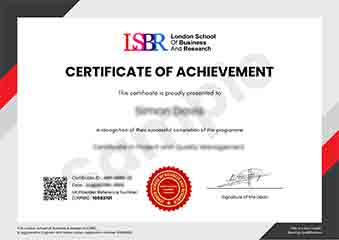
Sample Certificate
Preview the certificate you'll receive upon successful completion of this program.
Get Free Course Info
Receive detailed course information, curriculum breakdown, and career outcomes straight to your inbox.
Employer Sponsored?
Many employers cover professional development costs. Request a corporate invoice and we'll handle the rest. Bulk enrollment discounts available for teams of 3+.
Your Path to Certification
Four simple steps to your professionally recognised qualification
Enroll & Get Instant Access
Complete your enrollment and access course materials immediately
Study at Your Own Pace
Work through the modules on your schedule, from anywhere in the world
Complete Assessments
Demonstrate your knowledge through practical, real-world assessments
Receive Your Certificate
Get your official LSBR UK certificate, recognised across 180+ countries
Join Thousands Who Transformed Their Careers
Our graduates consistently report measurable career growth and professional advancement after completing their programmes.
What People Say About Us
Hear from our students about their experience with the Advanced Certificate in Microbe Plant Symbiosis at LSBR UK - Executive Education.
Oliver Davies
United Kingdom"The course material was incredibly comprehensive, covering a wide range of topics from the fundamentals of microbe-plant interactions to the latest advances in symbiotic relationships, which greatly enhanced my understanding of this complex field. Through hands-on lab sessions and interactive modules, I gained valuable practical skills in microbiological techniques and plant-microbe analysis, which I believe will be highly beneficial in my future career. The knowledge and skills I acquired have not only deepened my appreciation for the intricate relationships between microbes and plants but also opened up new avenues for research and professional exploration."
Kai Wen Ng
Singapore"The Advanced Certificate in Microbe Plant Symbiosis has been a game-changer for my career, equipping me with a deep understanding of the complex relationships between microorganisms and plants, and enabling me to develop innovative solutions for sustainable agriculture and environmental conservation. This course has significantly enhanced my skills in microbiome analysis and plant-microbe interaction, making me a more competitive candidate in the industry and opening up new opportunities for career advancement. By applying the knowledge and skills gained from this course, I have been able to drive meaningful impact in my work, contributing to the development of more resilient and productive ecosystems."
Ahmad Rahman
Malaysia"The course structure was well-organized, allowing me to seamlessly transition between topics and gain a deeper understanding of the complex relationships between microbes and plants. I appreciated the comprehensive content, which not only covered the fundamentals of microbe plant symbiosis but also explored its real-world applications, providing me with a broader perspective on the field. Through this course, I gained valuable knowledge that has significantly enhanced my professional growth and ability to approach problems in a more informed and innovative way."
Still deciding?
Join 23,000+ professionals who advanced their careers. Enroll today and start learning immediately.
Enroll NowSecure payment • Instant access • Certificate included