
Advanced Certificate in Named Entity Recognition: Extracting Meaning
Master Named Entity Recognition (NER) techniques to extract and classify key information from text, enhancing data analysis and natural language processing skills.
Advanced Certificate in Named Entity Recognition: Extracting Meaning
Programme Overview
The 'Advanced Certificate in Named Entity Recognition: Extracting Meaning' targets data scientists, linguists, and AI enthusiasts. Moreover, it benefits professionals aiming to enhance their natural language processing (NLP) skills. First, you will dive into the fundamentals of NER. Next, you will learn to implement NER models using Python. You will also gain hands-on experience with real-world datasets.
Firstly, you will explore advanced techniques for improving NER performance. Later, you will focus on evaluating and optimizing NER models. Finally, you will tackle complex scenarios, such as handling multilingual text and low-resource languages. Also, you will work on a capstone project to apply what you've learned. Consequently, you will graduate with practical skills and a strong portfolio piece.
What You'll Learn
Dive into the future of data extraction with our 'Advanced Certificate in Named Entity Recognition: Extracting Meaning.' First, you'll master the art of identifying and categorizing key information. Then, you'll learn to apply this to real-world problems. Moreover, you'll gain hands-on experience with cutting-edge tools. As a result, you'll be prepared for high-demand roles in data science, AI, and natural language processing. Additionally, you'll learn to bridge the gap between raw data and meaningful insights. Furthermore, you'll enhance your career prospects. This course features expert-led instruction, practical projects, and a supportive learning community. Don't miss this opportunity. Enroll today and unlock the power of Named Entity Recognition.
Programme Highlights
Industry-Aligned Curriculum
Developed with industry leaders to ensure practical, job-ready skills valued by employers worldwide.
Expert Faculty
Learn from experienced professionals with real-world expertise in your chosen field.
Flexible Learning
Study at your own pace, from anywhere in the world, with our flexible online platform.
Industry Focus
Practical, real-world knowledge designed to meet the demands of today's competitive job market.
Latest Curriculum
Stay ahead with constantly updated content reflecting the latest industry trends and best practices.
Career Advancement
Unlock new opportunities with a globally recognized qualification respected by employers.
Topics Covered
- Introduction to Named Entity Recognition: An overview of NER, its applications, and key concepts.
- Techniques for NER: Explore rule-based, machine learning, and deep learning techniques.
- Data Preprocessing for NER: Understand the importance and methods of data cleaning and preparation.
- Evaluation Metrics for NER: Learn about precision, recall, F1-score, and other relevant metrics.
- Advanced Models for NER: Dive into state-of-the-art models like BERT, RoBERTa, and SpaCy.
- Domain-Specific NER: Adapt NER techniques to specialized domains like healthcare or finance.
Key Facts
Audience:
This is an ideal course for:
Data scientists seeking to enhance their skills.
Professionals in data analysis and linguistics.
Anyone interested in natural language processing.
Prerequisites:
First, you should have:
Basic programming skills, such as Python.
Foundational knowledge of machine learning.
Familiarity with statistics and algorithms.
Outcomes:
After this course, you will:
Confidently recognize and classify entities in text.
Develop and evaluate NER models.
Understand practical applications of NER.
Prepare for advanced NLP courses.
Why This Course
Master In-Demand Skills: First, learners will gain expertise in Named Entity Recognition (NER). This is a powerful technique in Natural Language Processing (NLP). Thus, they can extract and classify key information from text.
Hands-On Projects: Next, the course offers practical projects. Learners will actively apply what they learn. Therefore, they will gain real-world experience. This makes them more competitive in the job market.
Career Advancement: Additionally, this certificate can boost your career. Employers value NER skills in data science and AI roles. Hence, learners can pursue exciting opportunities in these fields.
Programme Title
Advanced Certificate in Named Entity Recognition: Extracting Meaning
Course Brochure
Download our comprehensive course brochure with all details
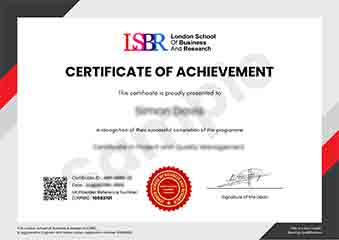
Sample Certificate
Preview the certificate you'll receive upon successful completion of this program.
Pay as an Employer
Request an invoice for your company to pay for this course. Perfect for corporate training and professional development.
What People Say About Us
Hear from our students about their experience with the Advanced Certificate in Named Entity Recognition: Extracting Meaning at LSBR UK - Executive Education.
Sophie Brown
United Kingdom"The course content was incredibly comprehensive, covering a wide range of topics from basic concepts to advanced techniques in Named Entity Recognition. I particularly appreciated the hands-on exercises that allowed me to apply what I learned directly to real-world datasets, which has significantly enhanced my practical skills and made me more confident in my ability to extract meaningful insights from unstructured data."
Arjun Patel
India"The Advanced Certificate in Named Entity Recognition: Extracting Meaning has been instrumental in enhancing my ability to extract and utilize meaningful data from unstructured text, a skill that has significantly improved my performance in data analysis roles. The course's focus on practical applications has made me more confident in tackling real-world projects, leading to notable advancements in my career."
Klaus Mueller
Germany"The course structure was exceptionally well-organized, with each module building logically on the previous one, making complex topics in Named Entity Recognition accessible and engaging. The comprehensive content not only deepened my understanding of the subject but also provided practical insights into real-world applications, significantly enhancing my professional growth in the field of data science."