
Advanced Certificate in Risk Assessment Using Mathematical Models
Elevate your risk assessment skills with mathematical models; earn an Advanced Certificate for enhanced analytical capabilities and decision-making.
Advanced Certificate in Risk Assessment Using Mathematical Models
Programme Overview
The Advanced Certificate in Risk Assessment Using Mathematical Models is designed for professionals in fields such as finance, engineering, and healthcare who require a deep understanding of how to apply mathematical models to assess and mitigate risks. This program equips participants with a robust framework for identifying, analyzing, and managing risks through the use of advanced statistical and computational methods. It covers a range of topics including probability theory, stochastic processes, regression analysis, and machine learning techniques, all tailored to real-world risk assessment scenarios.
Learners will develop key skills in quantitative analysis, risk modeling, and data interpretation. They will gain expertise in using software tools and programming languages such as Python and R for risk simulation and analysis. The program also focuses on practical application, ensuring that students can effectively apply mathematical models to complex business and technical challenges, enhancing their ability to make informed decisions and develop strategic risk management plans.
This program significantly impacts careers by preparing participants to lead in risk management roles, whether in corporate finance, project management, or technical consulting. Graduates are well-positioned to take on leadership positions where they can implement sophisticated risk assessment strategies, improve organizational resilience, and contribute to the development of innovative risk mitigation solutions.
What You'll Learn
The Advanced Certificate in Risk Assessment Using Mathematical Models is a comprehensive, month program designed to equip professionals with advanced skills in applying mathematical models to evaluate and mitigate risks. This program is ideal for those in fields such as finance, engineering, healthcare, and environmental science, where precise risk assessment is critical.
Key topics include probability theory, statistical analysis, risk modeling techniques, and the application of machine learning in predictive analytics. Participants will learn to develop and implement mathematical models to forecast risks, evaluate potential impacts, and devise effective mitigation strategies.
Graduates are well-prepared to apply these skills in real-world scenarios, such as predicting financial market trends, assessing structural integrity in construction projects, and managing environmental risks. The curriculum is tailored to enhance analytical thinking and decision-making, equipping professionals with the ability to make informed choices under uncertainty.
This program opens doors to a variety of career opportunities, including risk analyst, quantitative analyst, data scientist, and project manager. Graduates can also pursue advanced studies in mathematics, statistics, or related fields. The program's focus on practical applications ensures that participants are not only academically well-rounded but also industry-ready, making them valuable assets in any organization that requires robust risk management strategies.
Programme Highlights
Industry-Aligned Curriculum
Developed with industry leaders for job-ready skills
Globally Recognised Certificate
Recognised by employers across 180+ countries
Flexible Online Learning
Study at your own pace with lifetime access
Instant Access
Start learning immediately, no application process
Constantly Updated Content
Latest industry trends and best practices
Career Advancement
87% report measurable career progression within 6 months
Topics Covered
- Risk Assessment Frameworks: Introduces the systematic approach to risk assessment.: Probability Theory: Covers fundamental concepts and applications in risk.
- Statistical Methods: Explores techniques for data analysis and inference.: Modeling Techniques: Discusses various models used in risk assessment.
- Case Studies: Analyzes real-world scenarios using mathematical models.: Report Writing: Teaches best practices for documenting risk assessments.
What You Get When You Enroll
Key Facts
For working professionals in risk management
No prior experience required
Understand statistical methods for risk assessment
Develop skills in using mathematical models
Apply models to real-world scenarios
Gain certification in risk assessment techniques
Ready to Advance Your Career?
Join thousands of professionals who have transformed their careers with LSBR UK
Why This Course
Enhanced Risk Management Skills: Professional certification in risk assessment using mathematical models equips individuals with advanced analytical tools and techniques. This enables them to perform more sophisticated risk assessments, which can lead to better decision-making and more effective risk management strategies in various industries, such as finance, healthcare, and engineering.
Increased Career Opportunities: Obtaining this certification can open up new career paths and increase job opportunities. Employers value professionals who can leverage mathematical models to assess and mitigate risks. This certification can distinguish candidates in a competitive job market, making them more attractive to companies that require advanced risk management capabilities.
Industry-Standard Knowledge: The certificate ensures that professionals are up-to-date with the latest methodologies and best practices in risk assessment. This knowledge is crucial for staying competitive and ensuring that one's work meets industry standards. For example, understanding and applying advanced statistical methods can help in identifying and managing complex risks that might not be apparent with traditional approaches.
Improved Professional Development: Gaining this certification fosters continuous learning and professional growth. It encourages professionals to deepen their understanding of mathematical models and their applications in risk assessment. Regular updates to the curriculum ensure that the skills and knowledge remain relevant and cutting-edge, contributing to a lifelong learning mindset.
3-4 Weeks
Study at your own pace
Course Brochure
Download our comprehensive course brochure with all details
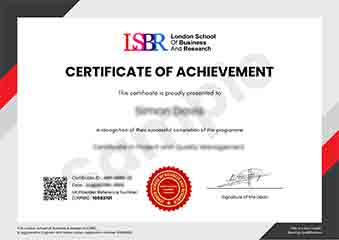
Sample Certificate
Preview the certificate you'll receive upon successful completion of this program.
Get Free Course Info
Receive detailed course information, curriculum breakdown, and career outcomes straight to your inbox.
Employer Sponsored?
Many employers cover professional development costs. Request a corporate invoice and we'll handle the rest. Bulk enrollment discounts available for teams of 3+.
Your Path to Certification
Four simple steps to your professionally recognised qualification
Enroll & Get Instant Access
Complete your enrollment and access course materials immediately
Study at Your Own Pace
Work through the modules on your schedule, from anywhere in the world
Complete Assessments
Demonstrate your knowledge through practical, real-world assessments
Receive Your Certificate
Get your official LSBR UK certificate, recognised across 180+ countries
Join Thousands Who Transformed Their Careers
Our graduates consistently report measurable career growth and professional advancement after completing their programmes.
What People Say About Us
Hear from our students about their experience with the Advanced Certificate in Risk Assessment Using Mathematical Models at LSBR UK - Executive Education.
Charlotte Williams
United Kingdom"The course content was incredibly thorough, providing a deep understanding of risk assessment through mathematical models, which has significantly enhanced my analytical skills. I now feel better equipped to tackle complex risk scenarios in my field."
Muhammad Hassan
Malaysia"The Advanced Certificate in Risk Assessment Using Mathematical Models has significantly enhanced my ability to apply sophisticated risk assessment techniques in real-world scenarios, making me a more valuable asset in my organization and opening up new career opportunities in the field of quantitative risk analysis."
Arjun Patel
India"The course structure is well-organized, providing a clear path from foundational concepts to advanced applications of risk assessment using mathematical models, which has significantly enhanced my ability to apply these techniques in real-world scenarios."
Still deciding?
Join 23,000+ professionals who advanced their careers. Enroll today and start learning immediately.
Enroll NowSecure payment • Instant access • Certificate included