
Advanced Certificate in Spatial Statistics for Disease Mapping
Elevate skills in spatial statistics for disease mapping; gain advanced knowledge, analytical tools, and real-world applications for public health impact.
Advanced Certificate in Spatial Statistics for Disease Mapping
Programme Overview
The Advanced Certificate in Spatial Statistics for Disease Mapping is designed for public health professionals, epidemiologists, researchers, and data analysts seeking to enhance their ability to analyze and interpret spatial and temporal patterns of diseases. This program equips learners with advanced statistical techniques and software tools, including geospatial analysis, spatial autocorrelation, and disease clustering, tailored to address complex health data challenges.
Learners will develop robust skills in applying advanced spatial statistical methods to map and analyze disease distributions, predict disease spread, and inform public health interventions. Key knowledge areas include understanding spatial data structures, implementing geostatistical models, and using software tools such as R, ArcGIS, and SaTScan for data analysis. By the end of the program, participants will be proficient in analyzing spatiotemporal disease patterns, interpreting statistical models, and communicating findings effectively to stakeholders.
The program has a significant impact on learners' career trajectories, preparing them for advanced roles in public health, epidemiology, and health informatics. Graduates are well-equipped to contribute to disease surveillance, policy development, and the evaluation of public health interventions, making them valuable assets in health organizations, research institutions, and governmental health departments.
What You'll Learn
The Advanced Certificate in Spatial Statistics for Disease Mapping is a transformative program designed for public health professionals, epidemiologists, and researchers seeking to harness the power of spatial statistics in understanding and mitigating the spread of diseases. This program equips learners with advanced skills in analyzing and mapping spatial patterns of disease occurrences, employing cutting-edge statistical methodologies and software tools. Key topics include geospatial data analysis, geographic information systems (GIS), statistical modeling, and spatial interpolation techniques.
Participants will gain hands-on experience using software such as R and ArcGIS to create detailed disease maps and perform spatial analyses. These skills are invaluable for identifying disease clusters, understanding spatial risk factors, and informing public health policies and interventions. Graduates will be well-prepared to analyze complex spatial data, contribute to epidemiological studies, and support public health decision-making processes.
This program opens doors to a range of career opportunities, including roles in public health agencies, research institutions, and consultancy firms. Graduates can work as disease mapping specialists, spatial analysts, or public health researchers, contributing to the development of evidence-based strategies to improve health outcomes and address public health challenges at local, national, and global scales.
Programme Highlights
Industry-Aligned Curriculum
Developed with industry leaders for job-ready skills
Globally Recognised Certificate
Recognised by employers across 180+ countries
Flexible Online Learning
Study at your own pace with lifetime access
Instant Access
Start learning immediately, no application process
Constantly Updated Content
Latest industry trends and best practices
Career Advancement
87% report measurable career progression within 6 months
Topics Covered
- Introduction to Spatial Statistics: Provides an overview of spatial statistics and its importance in disease mapping.: Geostatistical Analysis: Covers techniques for analyzing spatially continuous data.
- Spatial Point Pattern Analysis: Explores methods for analyzing spatially discrete data.: Disease Mapping Techniques: Introduces various methods for mapping disease rates and risks.
- Spatial Regression Models: Discusses regression models that incorporate spatial effects.: Advanced Topics in Spatial Statistics: Delves into specialized topics such as spatial clustering and spatial econometrics.
What You Get When You Enroll
Key Facts
For data analysts, GIS specialists
Basic statistics, GIS software knowledge
Analyze spatial disease patterns
Apply statistical models to disease mapping
Interpret spatial epidemiology results
Ready to Advance Your Career?
Join thousands of professionals who have transformed their careers with LSBR UK
Why This Course
Enhance Career Opportunities: Professionals in public health, epidemiology, and environmental science can significantly boost their employability by obtaining an Advanced Certificate in Spatial Statistics for Disease Mapping. This certification equips them with specialized skills needed for analyzing geospatial data, a critical tool in understanding disease patterns and trends, which is crucial for effective public health interventions.
Develop Advanced Analytical Skills: The program focuses on advanced statistical methods and software tools such as ArcGIS and R, which are essential for spatial analysis. Graduates will be proficient in mapping disease outbreaks, predicting disease spread, and making informed decisions based on spatial data, leading to more precise public health strategies.
Strengthen Research Capabilities: By acquiring this certificate, professionals can conduct sophisticated spatial statistical analyses, contributing to robust research findings. This skill is particularly valuable in academia, where spatial data analysis is increasingly important for understanding complex health issues. It also enhances the ability to publish high-impact research papers, advancing the field of public health and environmental science.
3-4 Weeks
Study at your own pace
Course Brochure
Download our comprehensive course brochure with all details
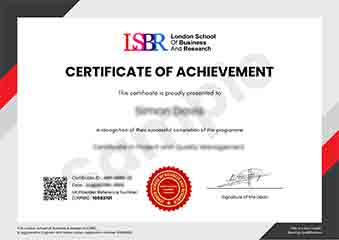
Sample Certificate
Preview the certificate you'll receive upon successful completion of this program.
Get Free Course Info
Receive detailed course information, curriculum breakdown, and career outcomes straight to your inbox.
Employer Sponsored?
Many employers cover professional development costs. Request a corporate invoice and we'll handle the rest. Bulk enrollment discounts available for teams of 3+.
Your Path to Certification
Four simple steps to your professionally recognised qualification
Enroll & Get Instant Access
Complete your enrollment and access course materials immediately
Study at Your Own Pace
Work through the modules on your schedule, from anywhere in the world
Complete Assessments
Demonstrate your knowledge through practical, real-world assessments
Receive Your Certificate
Get your official LSBR UK certificate, recognised across 180+ countries
Join Thousands Who Transformed Their Careers
Our graduates consistently report measurable career growth and professional advancement after completing their programmes.
What People Say About Us
Hear from our students about their experience with the Advanced Certificate in Spatial Statistics for Disease Mapping at LSBR UK - Executive Education.
Sophie Brown
United Kingdom"The course content was incredibly thorough and well-organized, providing a solid foundation in spatial statistics that has been invaluable for my work in public health. I've gained practical skills in disease mapping that I can directly apply to real-world scenarios, enhancing my ability to analyze and interpret spatial data effectively."
Jack Thompson
Australia"This course has significantly enhanced my ability to analyze and interpret spatial data, which is crucial for disease mapping. It has opened up new opportunities in my field, allowing me to contribute more effectively to public health initiatives."
Ruby McKenzie
Australia"The course structure is meticulously organized, providing a seamless transition from foundational concepts to advanced techniques in spatial statistics, which greatly enhances understanding and application in disease mapping. The comprehensive content, coupled with real-world examples, has significantly broadened my perspective and prepared me for more complex analytical challenges in public health."
Still deciding?
Join 23,000+ professionals who advanced their careers. Enroll today and start learning immediately.
Enroll NowSecure payment • Instant access • Certificate included