
Advanced Certificate in Spatial Statistics for Disease Outbreak Analysis
Gain expert skills in spatial statistics to model, predict, and control disease outbreaks, enhancing public‑health decision
Advanced Certificate in Spatial Statistics for Disease Outbreak Analysis
About This Course
This intensive programme equips public health professionals, epidemiologists, and data scientists with the rigorous statistical tools needed to detect, analyze, and respond to disease outbreaks. You will master spatial statistical techniques, including cluster detection algorithms and risk mapping, to transform raw geospatial data into actionable intelligence. The curriculum targets practitioners in government health agencies, international NGOs, and research institutions who require advanced analytical capabilities for real-time surveillance. You will engage with complex datasets from recent global health crises to understand the nuances of spatial autocorrelation and temporal trends.
Learners develop proficiency in using specialized software such as R and SaTScan to model disease spread and identify high-risk zones with precision. You will gain deep knowledge of Bayesian hierarchical models and conditional autoregressive priors to account for population heterogeneity in outbreak investigations. The course emphasizes the interpretation of spatial scan statistics to distinguish random noise from significant epidemiological clusters. You will also learn to communicate complex statistical findings effectively to non-technical stakeholders through clear visualizations and concise reports.
Completing this certificate positions you for leadership roles in spatial epidemiology and infectious disease control. You will enhance your employability by demonstrating expertise in cutting-edge analytical methods that are critical for modern public health infrastructure. Graduates often secure positions as senior analysts or consultants, driving evidence-based policy decisions during health emergencies. Your ability to quantify spatial risk factors will directly contribute to more efficient resource allocation and targeted intervention strategies. This qualification validates your commitment to advancing global health security through rigorous data science.
What You Will Learn
Epidemics move fast, and public health professionals need tools that keep pace. The Advanced Certificate in Spatial Statistics for Disease Outbreak Analysis equips you with the quantitative expertise to track, predict, and mitigate health crises effectively. You will master the art of turning complex geographic data into actionable intelligence, a skill set that is increasingly vital in our interconnected world. This programme bridges the gap between theoretical statistics and real-world epidemiological challenges, ensuring you are ready to make immediate impacts.
You will dive deep into geospatial modeling, Bayesian inference, and spatio-temporal cluster detection. Our curriculum emphasizes hands-on application using industry-standard software like R and Python, allowing you to visualize disease spread patterns and identify high-risk zones with precision. You will learn to integrate diverse data sources, from satellite imagery to hospital admission records, creating robust models that withstand scrutiny. These techniques are not just academic exercises; they are the backbone of modern surveillance systems used by leading health organizations globally.
Graduates apply these skills to design targeted intervention strategies, optimize resource allocation during emergencies, and evaluate the effectiveness of public health policies. By understanding the spatial dynamics of disease, you help communities stay safer and more resilient. Career opportunities abound for those who complete this certificate. You might join government health agencies, international NGOs like the WHO or CDC, or private epidemiological consulting firms. Roles range from spatial epidemiologist to data scientist specializing in public health. Whether you aim to lead outbreak response teams or advise on long-term health infrastructure,
Course Benefits
Industry-Aligned Curriculum
Developed with industry leaders for job-ready skills
Globally Recognised Certificate
Recognised by employers across 180+ countries
Flexible Online Learning
Study at your own pace with lifetime access
Instant Access
Start learning immediately, no application process
Constantly Updated Content
Latest industry trends and best practices
Career Advancement
87% report measurable career progression within 6 months
What This Course Covers
- Spatial Data Infrastructure: Establishes the foundational knowledge of geospatial data formats, coordinate reference systems, and database management for epidemiological records.: Spatial Point Pattern Analysis Introduces statistical techniques for analyzing the distribution of disease cases, including Ripley’s K function and nearest-neighbor analysis.
- Spatial Autocorrelation and Clustering Details methods for detecting non-random spatial patterns, such as Global Moran’s I, Local Indicators of Spatial Association (LISA), and Getis-Ord Gi*.: Bayesian Disease Mapping Explores hierarchical Bayesian models, including the BYM model, for smoothing disease rates and mapping relative risks across small areas.
- Space-Time Interaction Analysis Examines methods for detecting spatiotemporal clusters and trends, utilizing techniques like the Kulldorff space-time scan statistic and space-time K functions.: Advanced Modeling and Prediction Covers complex regression models, such as geographically weighted regression and machine learning approaches, for predicting outbreak risks and evaluating interventions.
Everything You Get With This Course
Course Facts
Audience: Public health professionals eager to boost their data skills.
Prerequisites: Basic statistics knowledge and comfort using R software.
Outcomes: Master spatial techniques to track and stop outbreaks.
Ready to Advance Your Career?
Join thousands of professionals who have transformed their careers with LSBR UK
Why This Course Is Right for You
Embarking on a career in public health requires more than just passion; it demands precise analytical tools to protect communities. The Advanced Certificate in Spatial Statistics for Disease Outbreak Analysis equips you with the exact technical proficiency needed to thrive in this critical field. Here is why this program is the perfect next step for your professional journey.
You will master cutting-edge GIS software and R programming, allowing you to visualize complex epidemiological data with clarity. This technical fluency makes you indispensable to health departments and NGOs that rely on accurate mapping to allocate resources during crises.
The curriculum emphasizes predictive modeling techniques, enabling you to forecast outbreak trajectories before they escalate. This proactive capability positions you as a strategic advisor rather than just a data analyst, significantly increasing your value to policy-making teams.
You gain specialized expertise in interpreting spatial clusters, which directly translates to faster, more effective intervention strategies. Employers prioritize candidates who can turn raw geographic data into actionable health insights, and this certificate proves you can do exactly that.
The program connects you with a network of epidemiologists and data scientists, opening doors to collaborations and job opportunities in global health organizations. This community support accelerates your career growth by providing mentorship and real-world project experience.
Investing in this certificate signals your commitment to excellence. You are not just learning statistics; you are gaining the power to save lives through smarter, data-driven decisions. Take this confident step toward a impactful and rewarding career today.
3-4 Weeks
Study at your own pace
Course Brochure
Download our comprehensive course brochure with all details
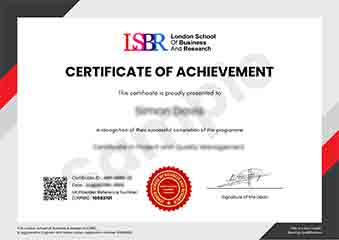
Sample Certificate
Preview the certificate you'll receive upon successful completion of this program.
Get Free Course Info
Receive detailed course information, curriculum breakdown, and career outcomes straight to your inbox.
Employer Sponsored?
Many employers cover professional development costs. Request a corporate invoice and we'll handle the rest. Bulk enrollment discounts available for teams of 3+.
How You Earn Your Certificate
Four simple steps to your professionally recognised qualification
Enroll & Get Instant Access
Complete your enrollment and access course materials immediately
Study at Your Own Pace
Work through the modules on your schedule, from anywhere in the world
Complete Assessments
Demonstrate your knowledge through practical, real-world assessments
Receive Your Certificate
Get your official LSBR UK certificate, recognised across 180+ countries
Real Results from Real Learners
Our graduates consistently report measurable career growth and professional advancement after completing their programmes.
Reviews from Our Learners
Hear from our students about their experience with the Advanced Certificate in Spatial Statistics for Disease Outbreak Analysis at LSBR UK - Executive Education.
Sophie Brown
United Kingdom"The course material was exceptionally well‑structured, covering everything from spatial autocorrelation to Bayesian disease mapping with clear, real‑world examples. I left with hands‑on experience using GIS and R to model outbreak patterns, which has already opened doors to more advanced analytics roles in public health."
James Thompson
United Kingdom"The advanced certificate gave me a hands‑on toolkit for mapping disease spread, from Bayesian hierarchical models to real‑time GIS dashboards, which immediately translated into actionable insights for my public‑health agency. Since completing the program, I’ve been promoted to lead the outbreak analytics team and now regularly advise regional health departments on data‑driven intervention strategies."
Connor O'Brien
Canada"The modular layout of the program made it easy to build on each concept, and the seamless progression from basic spatial models to advanced outbreak simulations kept me engaged throughout. The comprehensive content, packed with real-world case studies, gave me practical tools I can immediately apply to public‑health projects and has already boosted my confidence in tackling complex disease‑mapping challenges."
Need more time to decide?
Join 23,000+ professionals who advanced their careers. Enroll today and start learning immediately.
Enroll NowSecure payment • Instant access • Certificate included