
Advanced Certificate in Species Tree Estimation and Analysis
This advanced certificate equips learners with sophisticated methods for species tree estimation and analysis, enhancing phylogenetic inference skills.
Advanced Certificate in Species Tree Estimation and Analysis
Programme Overview
The Advanced Certificate in Species Tree Estimation and Analysis is designed to equip learners with advanced computational and analytical skills required for reconstructing and interpreting species trees, which are fundamental for understanding evolutionary relationships among species. This program is ideal for biologists, evolutionary biologists, bioinformaticians, and researchers in genomics who seek to enhance their expertise in phylogenetics and molecular evolution. Participants will gain a comprehensive understanding of the latest methodologies and tools used in species tree estimation, including Bayesian and maximum likelihood approaches, as well as the application of next-generation sequencing data for phylogenomic analyses.
Students will develop key skills in data analysis, including the use of specialized software such as RAxML, BEAST, and PhyML, for constructing and evaluating species trees. They will also learn to critically assess the quality and reliability of phylogenetic trees, interpret complex evolutionary signals, and apply computational techniques to address specific research questions in evolutionary biology. The curriculum is structured to provide hands-on experience with real-world datasets, ensuring that learners can apply their knowledge to diverse biological contexts.
Career-wise, this program significantly enhances the professional profile of graduates. It prepares them for roles in academia, research institutions, and industry, where they can contribute to cutting-edge research in evolutionary biology, molecular ecology, and conservation genetics. Graduates will be well-equipped to lead projects involving complex data analysis, collaborate on interdisciplinary research, and publish findings in leading scientific journals, making them valuable assets in their respective fields.
What You'll Learn
The Advanced Certificate in Species Tree Estimation and Analysis is designed for biologists, geneticists, and researchers seeking to enhance their skills in phylogenetic inference and species tree estimation. This program equips participants with advanced computational tools and statistical methods used in the field of evolutionary biology. Key topics include maximum likelihood and Bayesian inference, phylogenetic network analysis, and the integration of genomic data into species tree estimation.
Graduates of this program can apply their skills in diverse settings, from academic research institutions to conservation organizations. They are well-prepared to contribute to projects that require sophisticated phylogenetic analysis, such as understanding the evolutionary history of species, reconstructing species trees from large genomic datasets, and developing conservation strategies based on evolutionary relationships.
Upon completion, participants will be adept at using software like RAxML, BEAST, and PhyloBayes, and will have the ability to critically assess and interpret complex phylogenetic data. This program opens doors to careers in academia, government, and industry, including roles such as phylogenetic analyst, evolutionary biologist, and conservation biologist. By providing a robust foundation in species tree estimation and analysis, this certificate ensures that graduates are at the forefront of evolutionary biology research and practice.
Programme Highlights
Industry-Aligned Curriculum
Developed with industry leaders for job-ready skills
Globally Recognised Certificate
Recognised by employers across 180+ countries
Flexible Online Learning
Study at your own pace with lifetime access
Instant Access
Start learning immediately, no application process
Constantly Updated Content
Latest industry trends and best practices
Career Advancement
87% report measurable career progression within 6 months
Topics Covered
- Phylogenetic Theory: Covers the core principles and key terminology.: Maximum Likelihood Methods: Explores practical techniques used in real-world settings.
- Bayesian Inference: Discusses advanced statistical methods and their applications.: Concatenation vs. Coalescent: Examines the differences and appropriate usage of these methods.
- Gene Tree Reconstruction: Focuses on techniques for estimating gene trees.: Species Tree Methods: Introduces various algorithms and software tools for species tree estimation.
What You Get When You Enroll
Key Facts
Audience: Biologists, phylogeneticists, data scientists
Prerequisites: Basic knowledge of statistics, phylogenetics
Outcomes: Proficient in species tree estimation, analysis tools
Ready to Advance Your Career?
Join thousands of professionals who have transformed their careers with LSBR UK
Why This Course
Enhanced Analytical Skills: The Advanced Certificate in Species Tree Estimation and Analysis equips professionals with advanced computational tools and methods, such as Bayesian and maximum likelihood methods, which are crucial for analyzing complex evolutionary relationships. This proficiency can significantly enhance career prospects in fields requiring robust genetic and evolutionary data analysis, such as bioinformatics, conservation biology, and molecular phylogenetics.
Career Advancement: By specializing in species tree estimation, professionals can stand out in their field. For instance, in academia, this certificate can lead to research positions or faculty roles where complex evolutionary analyses are required. In industry, especially in biotech and pharmaceutical sectors, it can open doors to roles like evolutionary biologist or genetic analyst, where understanding species relationships is critical for developing new products.
Data-Driven Decision Making: The course focuses on practical applications, enabling professionals to interpret large datasets efficiently. This skill is invaluable in making informed decisions based on accurate evolutionary insights. For example, in conservation efforts, understanding species relationships can guide targeted interventions to protect biodiversity, while in medical research, it can aid in the development of treatments based on evolutionary principles.
Interdisciplinary Collaborations: The advanced knowledge gained can foster collaborations across various disciplines. Professionals can work more effectively with geneticists, ecologists, and environmental scientists, enhancing the impact of their research and facilitating interdisciplinary projects that tackle complex biological questions.
3-4 Weeks
Study at your own pace
Course Brochure
Download our comprehensive course brochure with all details
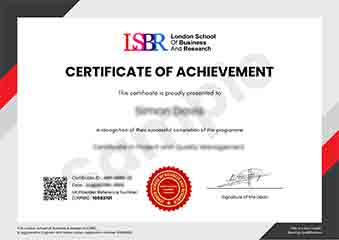
Sample Certificate
Preview the certificate you'll receive upon successful completion of this program.
Get Free Course Info
Receive detailed course information, curriculum breakdown, and career outcomes straight to your inbox.
Employer Sponsored?
Many employers cover professional development costs. Request a corporate invoice and we'll handle the rest. Bulk enrollment discounts available for teams of 3+.
Your Path to Certification
Four simple steps to your professionally recognised qualification
Enroll & Get Instant Access
Complete your enrollment and access course materials immediately
Study at Your Own Pace
Work through the modules on your schedule, from anywhere in the world
Complete Assessments
Demonstrate your knowledge through practical, real-world assessments
Receive Your Certificate
Get your official LSBR UK certificate, recognised across 180+ countries
Join Thousands Who Transformed Their Careers
Our graduates consistently report measurable career growth and professional advancement after completing their programmes.
What People Say About Us
Hear from our students about their experience with the Advanced Certificate in Species Tree Estimation and Analysis at LSBR UK - Executive Education.
Oliver Davies
United Kingdom"The course content was comprehensive and well-structured, providing a deep understanding of species tree estimation methods. I gained significant practical skills that will be invaluable for my career in bioinformatics, particularly in analyzing complex genetic data."
Ahmad Rahman
Malaysia"This course has been instrumental in enhancing my ability to estimate and analyze species trees, making my skills highly relevant in the field of bioinformatics. It has opened up new career opportunities and allowed me to contribute more effectively to collaborative research projects."
Kai Wen Ng
Singapore"The course structure is well-organized, providing a comprehensive overview of species tree estimation techniques that directly enhance my ability to analyze complex biological data, opening up new avenues for professional growth in my field."
Still deciding?
Join 23,000+ professionals who advanced their careers. Enroll today and start learning immediately.
Enroll NowSecure payment • Instant access • Certificate included