
Advanced Certificate in Statistical Analysis of Air Quality Data
This certificate equips professionals with advanced skills in analyzing air quality data, enhancing decision-making and policy formulation.
Advanced Certificate in Statistical Analysis of Air Quality Data
About This Course
The Advanced Certificate in Statistical Analysis of Air Quality Data is designed for environmental scientists, data analysts, and policymakers who seek to enhance their analytical skills in the context of air quality. This program provides a comprehensive curriculum that includes advanced statistical methodologies, data visualization techniques, and environmental policy frameworks. Participants learn to apply statistical models to analyze air quality data, interpret results, and communicate findings effectively to inform policy and environmental management practices.
Key skills and knowledge developed through this program include proficiency in statistical software such as R and Python, expertise in time-series analysis, spatial statistics, and machine learning algorithms for environmental data. Learners also gain experience in data quality control, data integration from multiple sources, and the use of Geographic Information Systems (GIS) to visualize and analyze air quality trends. This comprehensive skill set equips graduates with the ability to contribute to the development of evidence-based policies and to make informed decisions in the field of air quality management.
The career impact of this program is significant, as graduates are well-prepared to take on roles in government agencies, non-profit organizations, research institutions, and private sector companies focused on environmental sustainability. They are equipped to lead projects that involve the analysis of large datasets, the development of predictive models, and the evaluation of environmental policies, thereby contributing to the improvement of air quality and public health.
What You Will Learn
The Advanced Certificate in Statistical Analysis of Air Quality Data equips participants with the knowledge and skills needed to analyze and interpret complex air quality data. This program is designed for professionals in environmental science, public health, and policy, as well as those in industries with significant environmental impact. With a focus on advanced statistical methods, participants will learn to use R and Python for data analysis, leverage spatial and temporal data visualization techniques, and apply machine learning algorithms to predict air quality trends.
Key topics include statistical inference, regression analysis, time series analysis, and spatial statistics, all tailored to air quality datasets. Graduates will be adept at analyzing data from various sources, including satellite imagery, ground-based sensors, and environmental monitoring networks. They will employ these skills to assess the impact of pollutants on human health and the environment, develop predictive models for air quality management, and inform policy decisions.
This program prepares graduates for careers in governmental agencies, non-profits, consulting firms, and research institutions. Potential roles include air quality analyst, environmental scientist, data analyst, and policy advisor. Graduates will also be well-positioned to pursue further studies in environmental science, public health, or data science.
The curriculum is informed by current environmental challenges and data from global air quality initiatives, ensuring that participants are at the forefront of air quality research and management. By the end of the program, participants will have the tools to make meaningful contributions to reducing air pollution and improving public health.
Course Benefits
Industry-Aligned Curriculum
Developed with industry leaders for job-ready skills
Globally Recognised Certificate
Recognised by employers across 180+ countries
Flexible Online Learning
Study at your own pace with lifetime access
Instant Access
Start learning immediately, no application process
Constantly Updated Content
Latest industry trends and best practices
Career Advancement
87% report measurable career progression within 6 months
What This Course Covers
- Data Collection and Management: Focuses on methods and tools for collecting and managing air quality data.: Statistical Foundations: Covers essential statistical concepts and techniques for data analysis.
- Air Quality Models: Introduces various models used to predict and analyze air quality.: Data Visualization: Teaches how to effectively visualize air quality data for better understanding and communication.
- Advanced Analytics: Explores advanced statistical methods for in-depth air quality analysis.: Case Studies: Analyzes real-world scenarios to apply learned techniques in practical settings.
Everything You Get With This Course
Course Facts
Ideal for environmental scientists, data analysts
Prerequisites: Basic statistics, Excel proficiency
Outcomes: Analyze air quality data effectively
Develop predictive models for air quality
Interpret statistical results in environmental contexts
Ready to Advance Your Career?
Join thousands of professionals who have transformed their careers with LSBR UK
Why This Course Is Right for You
Enhanced Analytical Skills: The Advanced Certificate in Statistical Analysis of Air Quality Data equips professionals with advanced statistical techniques and tools, such as regression analysis and time series analysis, which are crucial for interpreting complex air quality data. This skill set enables analysts to identify trends, predict future scenarios, and make informed decisions based on empirical evidence.
Career Advancement: By obtaining this certificate, professionals can differentiate themselves in the job market, especially in fields related to environmental science, public health, and urban planning. The certificate is particularly valuable for roles that require deep analysis of environmental data, such as air quality monitoring, policy development, and environmental impact assessments.
Regulatory Compliance: Understanding and applying statistical methods to air quality data ensures compliance with environmental regulations and standards. This certificate provides the necessary knowledge to meet regulatory requirements, conduct internal audits, and prepare reports that meet industry standards, thereby reducing legal risks and enhancing organizational credibility.
Research Contributions: For researchers and academics, this certificate is essential for conducting rigorous and credible studies on air pollution. It allows professionals to publish findings in reputable journals, contribute to scientific discourse, and inform policy-making with robust statistical analyses. This can lead to breakthroughs in understanding air quality impacts on health and the environment.
3-4 Weeks
Study at your own pace
Course Brochure
Download our comprehensive course brochure with all details
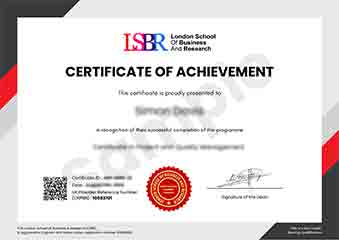
Sample Certificate
Preview the certificate you'll receive upon successful completion of this program.
Get Free Course Info
Receive detailed course information, curriculum breakdown, and career outcomes straight to your inbox.
Employer Sponsored?
Many employers cover professional development costs. Request a corporate invoice and we'll handle the rest. Bulk enrollment discounts available for teams of 3+.
How You Earn Your Certificate
Four simple steps to your professionally recognised qualification
Enroll & Get Instant Access
Complete your enrollment and access course materials immediately
Study at Your Own Pace
Work through the modules on your schedule, from anywhere in the world
Complete Assessments
Demonstrate your knowledge through practical, real-world assessments
Receive Your Certificate
Get your official LSBR UK certificate, recognised across 180+ countries
Real Results from Real Learners
Our graduates consistently report measurable career growth and professional advancement after completing their programmes.
Reviews from Our Learners
Hear from our students about their experience with the Advanced Certificate in Statistical Analysis of Air Quality Data at LSBR UK - Executive Education.
James Thompson
United Kingdom"The course content is incredibly thorough and well-structured, providing a solid foundation in statistical analysis techniques specifically applicable to air quality data. Gaining proficiency in these methods has significantly enhanced my ability to analyze environmental data effectively, which is incredibly valuable for my career in environmental science."
Mei Ling Wong
Singapore"This course has been instrumental in enhancing my ability to analyze and interpret air quality data, making my skills highly relevant in the environmental consulting industry. It has opened up new opportunities for me to take on more complex projects and has significantly boosted my career prospects."
Wei Ming Tan
Singapore"The course structure is well-organized, providing a comprehensive overview of statistical analysis techniques specifically tailored for air quality data, which has significantly enhanced my ability to interpret and analyze real-world environmental data effectively."
Need more time to decide?
Join 23,000+ professionals who advanced their careers. Enroll today and start learning immediately.
Enroll NowSecure payment • Instant access • Certificate included