
Certificate in Applied Mathematics in Cultural Heritage
This certificate equips students with advanced mathematical skills to preserve and analyze cultural heritage data and artifacts.
Certificate in Applied Mathematics in Cultural Heritage
Programme Overview
The Certificate in Applied Mathematics in Cultural Heritage is designed for professionals and students who wish to enhance their analytical and mathematical skills to preserve and manage cultural heritage sites and artifacts. This program integrates advanced mathematical techniques with the preservation and restoration of cultural heritage, including the use of D modeling, data analysis, and computational methods to study and protect historical artifacts and sites. The curriculum is tailored for archaeologists, conservators, historians, and mathematicians seeking to apply quantitative methods to the challenges of cultural heritage management.
Participants will develop a robust set of skills, including the use of statistical analysis to interpret data from archaeological sites, the application of geometric and topological methods in D modeling and reconstruction, and the use of computational techniques for the conservation and restoration of materials. They will also gain expertise in the use of Geographic Information Systems (GIS) for spatial analysis and the integration of computational models with physical conservation practices. The program aims to provide learners with a comprehensive understanding of how mathematical and computational tools can be effectively utilized to enhance the preservation and understanding of cultural heritage.
Upon completion, graduates of this program will be well-equipped to secure roles in cultural heritage organizations, museums, and research institutions, where they can apply their skills in data analysis, modeling, and conservation to contribute to the sustainable management and preservation of cultural heritage. Their expertise will be particularly valuable in projects that involve the digital documentation of heritage sites, predictive modeling for conservation, and the development of educational tools and resources for public engagement with cultural heritage.
What You'll Learn
The Certificate in Applied Mathematics in Cultural Heritage is a transformative educational journey designed to empower professionals and enthusiasts with the skills to preserve and enhance our rich cultural heritage through the lens of mathematical analysis. This program blends advanced mathematical techniques with the nuanced world of cultural heritage, offering a unique blend that is both innovative and practical.
Key topics include the application of linear algebra, statistics, and machine learning in the analysis and restoration of artifacts, documents, and historical sites. Students learn how to use mathematical models to predict the degradation of materials, optimize conservation efforts, and manage large datasets related to cultural heritage sites.
Graduates of this program are equipped to tackle real-world challenges. They can apply their skills in archaeological sites, museums, and historical archives, contributing to the preservation of cultural heritage by developing predictive models, analyzing data for conservation needs, and implementing efficient management strategies.
Career opportunities are diverse and promising. Graduates can pursue roles as cultural heritage data analysts, conservation mathematicians, or digital humanities specialists. They may also find themselves working with government agencies, non-profits, or private institutions dedicated to the preservation and study of cultural heritage. This program not only enhances your technical skills but also fosters a deep understanding of the cultural significance of our shared heritage, making it a valuable asset in today’s data-driven world.
Programme Highlights
Industry-Aligned Curriculum
Developed with industry leaders for job-ready skills
Globally Recognised Certificate
Recognised by employers across 180+ countries
Flexible Online Learning
Study at your own pace with lifetime access
Instant Access
Start learning immediately, no application process
Constantly Updated Content
Latest industry trends and best practices
Career Advancement
87% report measurable career progression within 6 months
Topics Covered
- Historical Data Analysis: Focuses on statistical methods for analyzing historical data.: Image Processing Techniques: Teaches algorithms and software tools for image enhancement and restoration.
- Structural Analysis: Covers mathematical models and methods for analyzing the structural integrity of heritage sites.: Material Science Fundamentals: Introduces the mathematical aspects of material science relevant to cultural heritage.
- Geographic Information Systems (GIS): Explores GIS tools and techniques for mapping and analyzing cultural heritage sites.: Conservation Planning: Uses mathematical models to develop effective conservation and management plans for heritage sites.
What You Get When You Enroll
Key Facts
Audience: Heritage professionals, mathematicians, students
Prerequisites: Basic math, cultural heritage knowledge
Outcomes: Analyze heritage data, apply mathematical models, preserve artifacts digitally
Ready to Advance Your Career?
Join thousands of professionals who have transformed their careers with LSBR UK
Why This Course
Enhance Analytical Skills: The Certificate in Applied Mathematics in Cultural Heritage equips professionals with advanced analytical tools and techniques. This is crucial for assessing and preserving historical artifacts and sites, where precise measurements and data analysis are essential. For instance, professionals can use statistical methods to predict the rate of deterioration of ancient buildings, allowing for timely conservation measures.
Improve Digital Preservation Techniques: The program focuses on applying mathematical concepts to digital heritage preservation. This knowledge is vital for creating and maintaining databases of cultural assets, ensuring that information is stored and accessed accurately. For example, professionals can develop algorithms to enhance the quality of digitized ancient manuscripts, making them more accessible and preserving their integrity.
Strengthen Heritage Management: The certificate provides skills in quantitative analysis, which can be applied to heritage management. This includes understanding visitor flow patterns, assessing the economic impact of cultural sites, and optimizing resource allocation. For instance, professionals can use mathematical models to predict the number of visitors a site can handle without damage, helping to balance tourism and conservation efforts effectively.
3-4 Weeks
Study at your own pace
Course Brochure
Download our comprehensive course brochure with all details
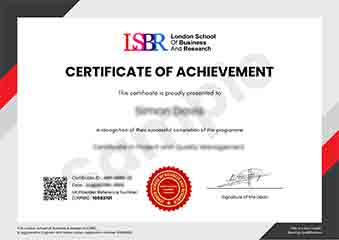
Sample Certificate
Preview the certificate you'll receive upon successful completion of this program.
Get Free Course Info
Receive detailed course information, curriculum breakdown, and career outcomes straight to your inbox.
Employer Sponsored?
Many employers cover professional development costs. Request a corporate invoice and we'll handle the rest. Bulk enrollment discounts available for teams of 3+.
Your Path to Certification
Four simple steps to your professionally recognised qualification
Enroll & Get Instant Access
Complete your enrollment and access course materials immediately
Study at Your Own Pace
Work through the modules on your schedule, from anywhere in the world
Complete Assessments
Demonstrate your knowledge through practical, real-world assessments
Receive Your Certificate
Get your official LSBR UK certificate, recognised across 180+ countries
Join Thousands Who Transformed Their Careers
Our graduates consistently report measurable career growth and professional advancement after completing their programmes.
What People Say About Us
Hear from our students about their experience with the Certificate in Applied Mathematics in Cultural Heritage at LSBR UK - Executive Education.
Charlotte Williams
United Kingdom"The course provided a robust foundation in applying mathematical concepts to real-world problems in cultural heritage, enhancing my analytical skills and deepening my understanding of how math can preserve historical artifacts. It was incredibly beneficial for gaining practical skills that are directly applicable in the field, making me more confident in my ability to contribute to preservation projects."
Muhammad Hassan
Malaysia"The certificate in Applied Mathematics in Cultural Heritage has been incredibly valuable, equipping me with the tools to analyze and preserve historical artifacts using advanced mathematical techniques. This knowledge has opened up new career opportunities in the field of cultural preservation, making my expertise more sought after and enhancing my ability to contribute to significant conservation projects."
Ruby McKenzie
Australia"The course structure is well-organized, providing a comprehensive overview of mathematical techniques applied to cultural heritage, which has significantly enhanced my understanding and analytical skills in this field."
Still deciding?
Join 23,000+ professionals who advanced their careers. Enroll today and start learning immediately.
Enroll NowSecure payment • Instant access • Certificate included