
Certificate in Fluid Dynamics and Turbulence Modeling Fundamentals
Master fluid dynamics and turbulence modeling to enhance simulation accuracy, optimize engineering designs, and solve complex flow challenges effectively.
Certificate in Fluid Dynamics and Turbulence Modeling Fundamentals
About This Course
The Certificate in Fluid Dynamics and Turbulence Modeling Fundamentals equips engineers, researchers, and data scientists with the rigorous theoretical and computational tools necessary to analyze complex flow phenomena. This intensive program targets professionals seeking to bridge the gap between classical fluid mechanics and modern computational fluid dynamics (CFD) applications. Participants will explore Navier-Stokes equations, boundary layer theory, and the critical distinctions between laminar and turbulent regimes. The curriculum demands a strong foundation in calculus and physics, ensuring that learners can confidently tackle real-world engineering challenges involving aerodynamics, hydrodynamics, and thermal management systems.
Learners will master the implementation of Reynolds-Averaged Navier-Stokes (RANS) models and Large Eddy Simulation (LES) techniques using industry-standard software platforms. You will develop the ability to validate numerical results against experimental data, ensuring accuracy in high-stakes design processes. The course emphasizes mesh independence studies, turbulence intensity calculations, and the selection of appropriate closure models for specific flow scenarios. By completing advanced computational labs, you will gain hands-on experience in troubleshooting convergence issues and optimizing simulation parameters for computational efficiency and precision.
Earning this certificate significantly enhances your employability in aerospace, automotive, energy, and environmental sectors where fluid behavior dictates system performance. Employers value candidates who can independently verify CFD results and propose data-driven design improvements. This qualification positions you for senior roles in simulation engineering, R&D leadership, and technical consulting. You will join a community of experts capable of reducing physical
What You Will Learn
Unlock the secrets of fluid behavior with our Certificate in Fluid Dynamics and Turbulence Modeling Fundamentals. This intensive programme bridges the gap between theoretical physics and practical engineering, offering you the precise tools needed to solve complex flow problems. You will master the Navier-Stokes equations, understand boundary layer theory, and dive deep into Reynolds-averaged Navier-Stokes (RANS) models. Our curriculum emphasizes computational fluid dynamics (CFD) techniques, ensuring you gain hands-on experience with industry-standard software while developing a robust understanding of turbulence closure models and grid independence studies.
Why choose this certificate? Because modern engineering demands precision. Whether you are optimizing aerodynamic drag for a new vehicle design or improving heat exchange efficiency in industrial reactors, your ability to predict fluid behavior accurately sets you apart. You will learn to validate simulation results against experimental data, a critical skill that ensures reliability and safety in high-stakes environments.
Graduates of this programme step into roles with confidence. You will find yourself driving innovation in aerospace, automotive, energy, and environmental sectors. Imagine designing quieter aircraft wings, more efficient wind turbines, or advanced medical devices that rely on precise microfluidic control. Employers value candidates who can translate complex mathematical concepts into actionable engineering solutions. This certificate serves as a powerful credential, demonstrating your expertise to potential employers and opening doors to senior positions in R&D, simulation engineering, and technical leadership.
Join a community of ambitious professionals ready to elevate their careers. We provide mentorship,
Course Benefits
Industry-Aligned Curriculum
Developed with industry leaders for job-ready skills
Globally Recognised Certificate
Recognised by employers across 180+ countries
Flexible Online Learning
Study at your own pace with lifetime access
Instant Access
Start learning immediately, no application process
Constantly Updated Content
Latest industry trends and best practices
Career Advancement
87% report measurable career progression within 6 months
What This Course Covers
- Introduction to Fluid Mechanics: Establishes the fundamental laws of conservation of mass, momentum, and energy governing fluid flow.: Governing Equations and Dimensional Analysis: Derives the Navier-Stokes equations and applies Buckingham Pi theorem for scaling and similarity.
- Laminar Flow and Boundary Layer Theory: Analyzes viscous flow regimes, Reynolds number effects, and the development of boundary layers.: Transition to Turbulence and Statistical Description: Examines the onset of instability, turbulence characteristics, and Reynolds-averaged Navier-Stokes (RANS) equations.
- Turbulence Modeling Techniques: Explores zero-equation, one-equation, and two-equation models including k-epsilon and k-omega formulations.: Computational Fluid Dynamics Applications: Integrates theoretical knowledge with numerical methods to solve practical turbulence problems using CFD software.
Everything You Get With This Course
Course Facts
Audience: Engineers and data scientists eager to master flow physics.
Prerequisites: Basic calculus and introductory physics knowledge required.
Outcomes: Build confidence in applying turbulence models to real projects.
You are ready to elevate your technical skills. This certificate bridges theory and practice, empowering you to tackle complex fluid challenges with clarity. Join a community of driven professionals who value precision and innovation. Your journey toward expertise starts here, with clear, actionable insights designed for your career growth.
Ready to Advance Your Career?
Join thousands of professionals who have transformed their careers with LSBR UK
Why This Course Is Right for You
Pursuing the Certificate in Fluid Dynamics and Turbulence Modeling Fundamentals opens exciting doors for engineers and scientists ready to deepen their technical expertise. This program bridges the gap between theoretical knowledge and practical application, ensuring you stay competitive in a rapidly evolving industry. Here is why this certification deserves your attention.
You will master advanced computational tools essential for modern design. By learning to simulate complex flow behaviors, you gain the ability to predict performance with high accuracy. This skill set is invaluable for roles in aerospace, automotive, and energy sectors, where precision directly impacts safety and efficiency.
The curriculum focuses heavily on turbulence modeling techniques that solve real-world problems. Understanding these models allows you to optimize systems for reduced drag and improved heat transfer. Such expertise makes you a sought-after candidate for senior engineering positions that require innovative problem-solving capabilities.
You build a strong foundation in numerical methods and validation strategies. This rigorous training ensures your simulations are reliable and trustworthy. Employers value professionals who can critically assess data and justify design choices with robust evidence, leading to greater confidence in your project leadership abilities.
The certificate enhances your professional credibility through recognized industry standards. Completing this program signals your commitment to continuous learning and technical excellence. It distinguishes you from peers who lack formal training in these critical areas, accelerating your path to management or specialized research roles.
Embrace this opportunity to transform your career trajectory. Your dedication to mastering these fundamentals will yield tangible results in your professional journey
3-4 Weeks
Study at your own pace
Course Brochure
Download our comprehensive course brochure with all details
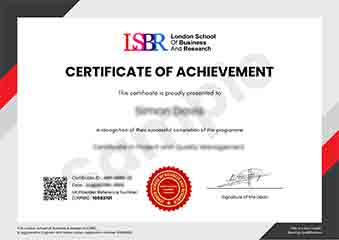
Sample Certificate
Preview the certificate you'll receive upon successful completion of this program.
Get Free Course Info
Receive detailed course information, curriculum breakdown, and career outcomes straight to your inbox.
Employer Sponsored?
Many employers cover professional development costs. Request a corporate invoice and we'll handle the rest. Bulk enrollment discounts available for teams of 3+.
How You Earn Your Certificate
Four simple steps to your professionally recognised qualification
Enroll & Get Instant Access
Complete your enrollment and access course materials immediately
Study at Your Own Pace
Work through the modules on your schedule, from anywhere in the world
Complete Assessments
Demonstrate your knowledge through practical, real-world assessments
Receive Your Certificate
Get your official LSBR UK certificate, recognised across 180+ countries
Real Results from Real Learners
Our graduates consistently report measurable career growth and professional advancement after completing their programmes.
Reviews from Our Learners
Hear from our students about their experience with the Certificate in Fluid Dynamics and Turbulence Modeling Fundamentals at LSBR UK - Executive Education.
Charlotte Williams
United Kingdom"The deep dive into turbulence modeling concepts finally bridged the gap between theoretical fluid dynamics and real-world simulation challenges. I now feel confident applying these advanced numerical methods to complex engineering problems, which has significantly boosted my technical credibility in the industry."
Brandon Wilson
United States"Mastering turbulence modeling techniques that directly translate to real-world engineering challenges, significantly boosting my confidence in handling complex fluid dynamics simulations. This certification has been a pivotal step in my career, enabling me to take on more advanced roles and deliver precise, industry-ready solutions."
Wei Ming Tan
Singapore"The logical progression from fundamental fluid mechanics to advanced turbulence modeling provided a solid foundation that made complex concepts much easier to grasp. This structured approach not only clarified theoretical gaps but also equipped me with practical insights directly applicable to my engineering projects."
Need more time to decide?
Join 23,000+ professionals who advanced their careers. Enroll today and start learning immediately.
Enroll NowSecure payment • Instant access • Certificate included