
Certificate in Fractal Geometry in Aquatic Systems
Gain expertise in applying fractal geometry to analyze and solve complex aquatic system challenges.
Certificate in Fractal Geometry in Aquatic Systems
Programme Overview
The Certificate in Fractal Geometry in Aquatic Systems is designed for professionals in environmental science, ecology, and water resource management who seek to enhance their understanding of complex aquatic systems through the lens of fractal geometry. This program offers an in-depth exploration of the application of fractal theory to the study of aquatic environments, including rivers, lakes, and estuaries. Learners will delve into the mathematical principles of fractals and their relevance to understanding patterns and processes in aquatic ecosystems. The program also integrates practical applications, such as the analysis of water flow, sediment transport, and habitat complexity, providing a robust framework for addressing real-world challenges in aquatic science.
The key skills and knowledge developed in this program include a comprehensive understanding of fractal geometry, proficiency in analyzing and interpreting fractal patterns in aquatic systems, and the ability to apply fractal concepts to ecological and environmental management strategies. Learners will gain expertise in using advanced software tools for fractal analysis and will be able to integrate fractal geometry into their existing knowledge base of aquatic ecosystems. This program not only equips professionals with cutting-edge analytical techniques but also fosters a deeper appreciation for the intricate, self-similar patterns that govern aquatic environments.
The Certificate in Fractal Geometry in Aquatic Systems has a significant impact on career advancement, particularly for professionals aiming to lead innovative research or policy initiatives in environmental science. Graduates will be well-positioned to contribute to interdisciplinary projects that require a nuanced understanding of complex systems, and to develop new methodologies for
What You'll Learn
Explore the mesmerizing world of fractal geometry and its profound impact on aquatic systems with our Certificate in Fractal Geometry in Aquatic Systems. This innovative program equips you with advanced mathematical tools and practical knowledge to analyze complex natural phenomena in aquatic environments, from coastlines to river networks. Through a blend of theoretical courses and hands-on projects, you'll delve into the self-similar patterns that govern water dynamics, ecological interactions, and the structure of marine and freshwater ecosystems.
Key topics include the mathematical foundations of fractals, their applications in modeling fluid dynamics, and the use of fractal geometry in understanding biodiversity and ecosystem resilience. You'll learn to apply these concepts using state-of-the-art software and analytical techniques, preparing you for roles that require a deep understanding of aquatic systems.
Graduates of this program are well-suited for careers in environmental consulting, oceanography, fisheries management, and conservation biology. They can also contribute to the fields of water resource management, climate change research, and environmental policy. With the increasing importance of sustainable practices in aquatic ecosystems, professionals with expertise in fractal geometry are in high demand, bridging the gap between mathematical theory and practical ecological solutions.
Programme Highlights
Industry-Aligned Curriculum
Developed with industry leaders for job-ready skills
Globally Recognised Certificate
Recognised by employers across 180+ countries
Flexible Online Learning
Study at your own pace with lifetime access
Instant Access
Start learning immediately, no application process
Constantly Updated Content
Latest industry trends and best practices
Career Advancement
87% report measurable career progression within 6 months
Topics Covered
- Iterative Processes: Covers the core principles of iteration and their role in fractal geometry.: Self-Similarity: Explores the concept of self-similarity and its importance in aquatic systems.
- Dimensional Analysis: Discusses the calculation and interpretation of fractal dimensions.: Basin Dynamics: Analyzes the dynamics of aquatic basins using fractal geometry.
- Coastal Morphodynamics: Investigates the evolution and behavior of coastal systems through fractal perspectives.: Computational Techniques: Introduces software and tools for modeling fractal structures in aquatic environments.
What You Get When You Enroll
Key Facts
Audience: Environmental scientists, mathematicians
Prerequisites: Basic calculus, algebra
Outcomes: Understand fractal geometry, analyze aquatic systems
Ready to Advance Your Career?
Join thousands of professionals who have transformed their careers with LSBR UK
Why This Course
Enhanced Analytical Skills: Professionals in fields like hydrology, environmental science, and oceanography can significantly benefit from understanding fractal geometry in aquatic systems. This certification provides a deeper insight into the complex patterns and structures of water bodies, enhancing analytical and problem-solving skills needed for advanced research and practical applications.
Career Advancement Opportunities: With the increasing emphasis on understanding and managing natural resources sustainably, professionals equipped with a certificate in fractal geometry can stand out. This knowledge is crucial for developing models that predict changes in aquatic ecosystems, making them valuable in academia, research institutions, and governmental agencies.
Innovative Problem Solving: The principles of fractal geometry offer a unique lens to view and analyze environmental issues. This certification equips professionals with the tools to approach challenges such as water pollution and climate change with innovative solutions. For instance, understanding the fractal nature of river networks can help in designing more efficient water management systems.
Interdisciplinary Collaboration: Knowledge of fractal geometry in aquatic systems fosters collaboration across disciplines. Professionals can bridge gaps between mathematicians, physicists, and environmental scientists, contributing to holistic approaches to solving complex environmental problems. This interdisciplinary approach is increasingly valued in modern research and development settings.
3-4 Weeks
Study at your own pace
Course Brochure
Download our comprehensive course brochure with all details
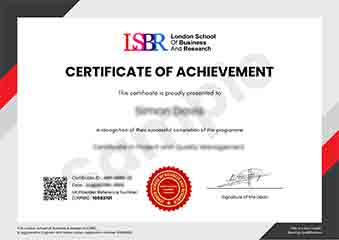
Sample Certificate
Preview the certificate you'll receive upon successful completion of this program.
Get Free Course Info
Receive detailed course information, curriculum breakdown, and career outcomes straight to your inbox.
Employer Sponsored?
Many employers cover professional development costs. Request a corporate invoice and we'll handle the rest. Bulk enrollment discounts available for teams of 3+.
Your Path to Certification
Four simple steps to your professionally recognised qualification
Enroll & Get Instant Access
Complete your enrollment and access course materials immediately
Study at Your Own Pace
Work through the modules on your schedule, from anywhere in the world
Complete Assessments
Demonstrate your knowledge through practical, real-world assessments
Receive Your Certificate
Get your official LSBR UK certificate, recognised across 180+ countries
Join Thousands Who Transformed Their Careers
Our graduates consistently report measurable career growth and professional advancement after completing their programmes.
What People Say About Us
Hear from our students about their experience with the Certificate in Fractal Geometry in Aquatic Systems at LSBR UK - Executive Education.
Sophie Brown
United Kingdom"The course provided an in-depth exploration of fractal geometry and its applications in aquatic systems, equipping me with valuable analytical tools to understand complex natural phenomena. Gaining this knowledge has opened up new avenues in my research, particularly in modeling aquatic ecosystems more accurately."
Klaus Mueller
Germany"This course has been instrumental in bridging the gap between theoretical fractal geometry and its practical applications in aquatic systems, significantly enhancing my ability to analyze and model complex environmental data. It has not only deepened my understanding but also opened up new career opportunities in environmental consulting and research."
Sophie Brown
United Kingdom"The course structure was well-organized, providing a clear path from basic concepts to advanced applications in aquatic systems, which significantly enhanced my understanding and appreciation of fractal geometry in real-world scenarios. It opened up new avenues for professional growth in environmental science and data analysis."
Still deciding?
Join 23,000+ professionals who advanced their careers. Enroll today and start learning immediately.
Enroll NowSecure payment • Instant access • Certificate included