
Certificate in Instrumentation for Food Safety and Quality Control
This certificate equips professionals with essential skills in instrumentation for ensuring food safety and quality control.
Certificate in Instrumentation for Food Safety and Quality Control
About This Course
The Certificate in Instrumentation for Food Safety and Quality Control is designed to provide comprehensive training in the use of advanced instrumentation for ensuring food safety and maintaining high-quality standards in food processing and storage. This program is ideal for professionals in the food industry, including food safety officers, quality assurance managers, laboratory technicians, and food scientists, who seek to enhance their technical skills and knowledge in this specialized field.
Learners will develop a robust understanding of key instrumentation techniques such as spectroscopy, chromatography, and microbial detection methods, which are essential for identifying contaminants and ensuring compliance with food safety regulations. They will also gain proficiency in using advanced data analysis tools and software to interpret test results and make informed decisions. Furthermore, the program includes hands-on training sessions to reinforce theoretical knowledge with practical applications, ensuring learners can effectively implement quality control measures in real-world settings.
Upon completion, participants will be well-equipped to contribute to the critical role of maintaining food safety and quality, potentially leading to enhanced career opportunities in managerial roles, research positions, or specialized technical positions within the food industry. The skills acquired will enable them to address emerging challenges in food safety and quality control, ensuring the provision of safe and high-quality food products to consumers.
What You Will Learn
The Certificate in Instrumentation for Food Safety and Quality Control is a specialized program designed to equip professionals with the latest knowledge and skills in food safety and quality assurance. This program leverages advanced instrumentation techniques to ensure that the food industry meets stringent safety and quality standards. Key topics include the principles of food safety, microbiological analysis, chemical analysis, and the use of modern instruments for quality control. Participants will learn how to use state-of-the-art equipment to detect contaminants, assess nutritional content, and ensure compliance with international food safety regulations.
Graduates of this program are well-prepared to apply their skills in various roles within the food and beverage industry, such as quality control technicians, food safety officers, and laboratory analysts. They will be adept at using instrumentation to monitor and maintain the safety and quality of food products throughout the supply chain, from raw materials to final products. The program includes hands-on training and practical assessments, ensuring that graduates can confidently implement their knowledge in real-world settings.
Career opportunities for graduates abound in manufacturing plants, processing facilities, regulatory agencies, and research institutions. With the growing emphasis on food safety and quality, professionals with this certificate can contribute significantly to enhancing public health and ensuring the integrity of the global food supply.
Course Benefits
Industry-Aligned Curriculum
Developed with industry leaders for job-ready skills
Globally Recognised Certificate
Recognised by employers across 180+ countries
Flexible Online Learning
Study at your own pace with lifetime access
Instant Access
Start learning immediately, no application process
Constantly Updated Content
Latest industry trends and best practices
Career Advancement
87% report measurable career progression within 6 months
What This Course Covers
- Introduction to Food Safety: Introduces fundamental concepts and regulatory frameworks.: Instrumentation Fundamentals: Explains basic principles of instrumentation technology.
- Analytical Techniques: Covers various methods for food analysis.: Quality Control Practices: Discusses strategies for maintaining food quality.
- Hazard Analysis: Focuses on identifying and mitigating food safety hazards.: Calibration and Maintenance: Teaches proper calibration and maintenance of instruments.
Everything You Get With This Course
Course Facts
Target professionals in food industry
No specific prerequisites required
Understand food safety regulations
Develop skills in quality control
Learn to use food safety instrumentation
Enhance ability to implement safety protocols
Ready to Advance Your Career?
Join thousands of professionals who have transformed their careers with LSBR UK
Why This Course Is Right for You
Enhanced Career Opportunities: Obtaining the Certificate in Instrumentation for Food Safety and Quality Control can significantly enhance career prospects in the food industry. This credential empowers professionals with the knowledge and skills needed to operate and maintain advanced food safety and quality control instruments, making them more competitive in the job market.
Improved Technical Skills: The certificate program equips participants with hands-on experience in using modern analytical instruments for food safety testing. This includes techniques such as microbiological testing, chemical analysis, and physical property measurement. These skills are crucial for ensuring that food products meet stringent safety and quality standards.
Regulatory Compliance: In the food industry, adherence to regulatory standards is paramount. The certificate provides in-depth understanding of current food safety regulations and guidelines. Professionals can apply this knowledge to develop and implement effective quality control programs that comply with local and international food safety regulations, thereby reducing the risk of non-compliance and potential legal issues.
Increased Professional Confidence: Gaining a certificate in this field boosts professionals' confidence in their ability to contribute to food safety and quality control initiatives. This enhanced confidence can lead to more proactive involvement in critical food safety projects and better decision-making in ensuring product safety and consumer trust.
3-4 Weeks
Study at your own pace
Course Brochure
Download our comprehensive course brochure with all details
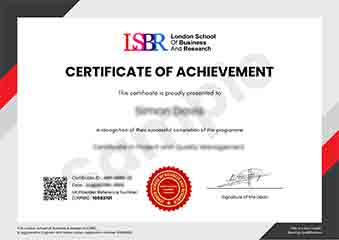
Sample Certificate
Preview the certificate you'll receive upon successful completion of this program.
Get Free Course Info
Receive detailed course information, curriculum breakdown, and career outcomes straight to your inbox.
Employer Sponsored?
Many employers cover professional development costs. Request a corporate invoice and we'll handle the rest. Bulk enrollment discounts available for teams of 3+.
How You Earn Your Certificate
Four simple steps to your professionally recognised qualification
Enroll & Get Instant Access
Complete your enrollment and access course materials immediately
Study at Your Own Pace
Work through the modules on your schedule, from anywhere in the world
Complete Assessments
Demonstrate your knowledge through practical, real-world assessments
Receive Your Certificate
Get your official LSBR UK certificate, recognised across 180+ countries
Real Results from Real Learners
Our graduates consistently report measurable career growth and professional advancement after completing their programmes.
Reviews from Our Learners
Hear from our students about their experience with the Certificate in Instrumentation for Food Safety and Quality Control at LSBR UK - Executive Education.
James Thompson
United Kingdom"The course content was incredibly thorough, covering all the essential aspects of instrumentation for food safety and quality control. Gaining hands-on experience with various instruments significantly enhanced my practical skills, making me more confident in my ability to ensure food safety in a professional setting."
Isabella Dubois
Canada"This certificate course has been instrumental in enhancing my understanding of how instrumentation plays a crucial role in ensuring food safety and quality control. It has not only equipped me with practical skills but also opened up new career opportunities in the food industry."
Kavya Reddy
India"The course structure is well-organized, providing a clear path from basic concepts to advanced applications in food safety and quality control, which has significantly enhanced my understanding and practical skills in the field."
Need more time to decide?
Join 23,000+ professionals who advanced their careers. Enroll today and start learning immediately.
Enroll NowSecure payment • Instant access • Certificate included