
Certificate in Mathematical Modeling for Engineers
Gain cutting-edge mathematical modeling for engineers knowledge through hands-on learning and real-world case studies. Start your journey to excellence.
Certificate in Mathematical Modeling for Engineers
About This Course
The 'Certificate in Mathematical Modeling for Engineers' is designed to equip engineers with the advanced skills necessary to apply mathematical modeling techniques to complex engineering problems. This program is tailored for practicing engineers, recent engineering graduates, and professionals in related fields who seek to enhance their analytical capabilities and problem-solving skills. The curriculum covers a wide array of topics, including differential equations, optimization techniques, numerical methods, and stochastic modeling, among others, providing a robust foundation in mathematical modeling principles and practices.
Learners will develop key skills such as formulating and solving mathematical models for engineering applications, conducting rigorous data analysis, and leveraging computational tools for model simulation and validation. They will also gain proficiency in using software and programming languages commonly employed in mathematical modeling, such as MATLAB, Python, and R. These skills are essential for addressing real-world engineering challenges, driving innovation, and making informed decisions based on quantitative analysis.
The certificate has a substantial impact on career advancement, enabling engineers to tackle more complex projects and contribute more effectively to multidisciplinary teams. Graduates are well-prepared to pursue leadership roles, engage in research and development, and enhance their expertise in specialized areas like systems engineering, data science, and computational engineering. The ability to model and predict system behavior accurately is crucial for improving product design, optimizing processes, and ensuring system reliability in various industries, from automotive to aerospace and beyond.
What You Will Learn
The Certificate in Mathematical Modeling for Engineers is designed to equip professionals with advanced mathematical tools essential for solving complex engineering problems. This program is invaluable for those looking to enhance their analytical and problem-solving skills, integrating mathematical theories with practical engineering applications.
Key topics covered include differential equations, optimization techniques, numerical methods, and statistical analysis. Students learn to model real-world scenarios, from fluid dynamics and heat transfer to structural mechanics and electrical circuits, using software tools like MATLAB and Python. The curriculum emphasizes hands-on projects and case studies, allowing participants to apply mathematical models to design and optimize systems.
Graduates of this program are well-prepared for roles in research and development, where they can innovate and solve complex engineering challenges. They may also pursue careers in data analysis, operations research, and financial engineering, leveraging their skills to drive technological advancements and business growth. Whether in academia, industry, or consulting, this certificate provides a robust foundation for a diverse range of career opportunities, fostering a deeper understanding of the interplay between mathematics and engineering.
Course Benefits
Industry-Aligned Curriculum
Developed with industry leaders for job-ready skills
Globally Recognised Certificate
Recognised by employers across 180+ countries
Flexible Online Learning
Study at your own pace with lifetime access
Instant Access
Start learning immediately, no application process
Constantly Updated Content
Latest industry trends and best practices
Career Advancement
87% report measurable career progression within 6 months
What This Course Covers
- Introduction to Mathematical Modeling: Introduces the concept of mathematical modeling and its importance in engineering.: Discrete and Continuous Models: Discusses the differences and applications of discrete and continuous models.
- Optimization Techniques: Covers various optimization methods and their use in solving engineering problems.: Probability and Statistics in Modeling: Explores the role of probability and statistics in modeling real-world systems.
- Computational Methods: Teaches numerical methods and their application in solving mathematical models.: Case Studies in Modeling: Analyzes real-world engineering problems using mathematical modeling techniques.
Everything You Get With This Course
Course Facts
Targeted at engineering students and professionals
No specific prerequisites required
Develops skills in mathematical modeling techniques
Enhances problem-solving with mathematical tools
Suitable for career advancement in engineering
Ready to Advance Your Career?
Join thousands of professionals who have transformed their careers with LSBR UK
Why This Course Is Right for You
Enhanced Problem-Solving Skills: The Certificate in Mathematical Modeling for Engineers equips professionals with advanced analytical tools and techniques, enabling them to tackle complex engineering problems more effectively. This capability is crucial in industries where innovation and precision are key, such as aerospace and automotive.
Improved Career Opportunities: By acquiring this certificate, engineers can expand their job prospects across various sectors. For instance, a civil engineer with modeling skills can manage infrastructure projects more efficiently, while an electrical engineer with these skills can contribute to cutting-edge renewable energy projects.
Increased Market Value: The demand for engineers proficient in mathematical modeling is on the rise, as companies increasingly rely on data-driven decision-making. According to recent industry reports, professionals with these skills command higher salaries and are more likely to be sought after for leadership roles within their organizations.
Better Project Outcomes: Engineers with a strong foundation in mathematical modeling can optimize project timelines and costs. For example, they can predict and mitigate potential risks early in the design phase, leading to more successful project completions and client satisfaction.
3-4 Weeks
Study at your own pace
Course Brochure
Download our comprehensive course brochure with all details
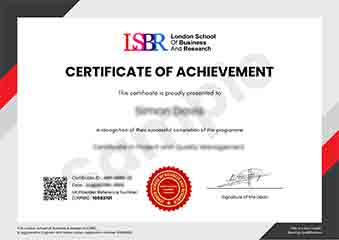
Sample Certificate
Preview the certificate you'll receive upon successful completion of this program.
Get Free Course Info
Receive detailed course information, curriculum breakdown, and career outcomes straight to your inbox.
Employer Sponsored?
Many employers cover professional development costs. Request a corporate invoice and we'll handle the rest. Bulk enrollment discounts available for teams of 3+.
How You Earn Your Certificate
Four simple steps to your professionally recognised qualification
Enroll & Get Instant Access
Complete your enrollment and access course materials immediately
Study at Your Own Pace
Work through the modules on your schedule, from anywhere in the world
Complete Assessments
Demonstrate your knowledge through practical, real-world assessments
Receive Your Certificate
Get your official LSBR UK certificate, recognised across 180+ countries
Real Results from Real Learners
Our graduates consistently report measurable career growth and professional advancement after completing their programmes.
Reviews from Our Learners
Hear from our students about their experience with the Certificate in Mathematical Modeling for Engineers at LSBR UK - Executive Education.
Charlotte Williams
United Kingdom"The course content was incredibly thorough, providing a solid foundation in mathematical modeling techniques that are directly applicable to real-world engineering problems. Gaining these skills has significantly enhanced my ability to approach complex engineering challenges with a structured and analytical mindset."
Klaus Mueller
Germany"This certificate has been incredibly valuable, equipping me with advanced mathematical modeling skills that are directly applicable in my engineering role. It has opened up new opportunities for more complex projects and has significantly enhanced my problem-solving capabilities in the field."
Hans Weber
Germany"The course structure is well-organized, providing a clear path from foundational concepts to advanced applications in engineering problems. It offers a comprehensive understanding of mathematical modeling techniques that have direct real-world applications, enhancing my ability to solve complex engineering challenges."
Need more time to decide?
Join 23,000+ professionals who advanced their careers. Enroll today and start learning immediately.
Enroll NowSecure payment • Instant access • Certificate included