
Executive Development Programme in Building Simulation Models with Mathematical Tools
This programme equips executives with advanced skills in building simulation models using mathematical tools, enhancing strategic decision-making and operational efficiency.
Executive Development Programme in Building Simulation Models with Mathematical Tools
Programme Overview
The Executive Development Programme in Building Simulation Models with Mathematical Tools is designed for senior leaders and technical professionals in the construction, engineering, and design industries who seek to enhance their expertise in predictive modeling and simulation techniques. This program equips participants with advanced knowledge in mathematical modeling, statistical analysis, and software tools essential for optimizing building performance, sustainability, and energy efficiency. Throughout the course, learners will engage with cutting-edge methodologies and technologies, including computational fluid dynamics, thermodynamics, and machine learning algorithms, tailored to the specific needs of building simulation.
Key skills and knowledge gained include proficiency in using industry-standard software for building energy simulation, such as Energy Plus and TRNSYS, as well as a deep understanding of the underlying mathematical principles. Participants will also develop expertise in data-driven modeling techniques, enabling them to interpret complex data sets and make informed decisions based on predictive analytics. By the end of the program, learners will be adept at applying these tools to real-world scenarios, thereby optimizing the performance and sustainability of buildings.
This program has a significant impact on participants' careers, offering them the ability to lead innovation in their organizations and contribute to the development of more sustainable and energy-efficient building designs. Graduates will be well-prepared to take on leadership roles in green building initiatives, research and development projects, and strategic planning for sustainable urban development. The program also enhances their ability to mentor and train other professionals in the field, fostering a culture of continuous improvement and innovation.
What You'll Learn
The Executive Development Programme in Building Simulation Models with Mathematical Tools is designed for professionals looking to enhance their capabilities in the field of building performance analysis. This comprehensive program equips participants with advanced knowledge and practical skills in developing and applying simulation models using cutting-edge mathematical tools. Key topics include advanced simulation software, statistical analysis, and predictive modeling techniques.
Graduates of this program will be well-prepared to apply their skills in a variety of sectors, including architecture, engineering, and sustainability consulting. They will be able to optimize building performance, reduce energy consumption, and enhance occupant comfort through the use of sophisticated simulation models. This program also fosters a deeper understanding of the environmental impacts of building design and operation, enabling participants to make informed decisions that contribute to sustainable development.
Career opportunities for program alumni are extensive, ranging from project management roles in construction firms to data analysis positions in green building consultancy firms. Graduates can also pursue advanced research and development positions in the field of building science. The program’s rigorous curriculum, combined with real-world case studies and industry partnerships, ensures that participants are well-equipped to lead innovation in the built environment.
Programme Highlights
Industry-Aligned Curriculum
Developed with industry leaders for job-ready skills
Globally Recognised Certificate
Recognised by employers across 180+ countries
Flexible Online Learning
Study at your own pace with lifetime access
Instant Access
Start learning immediately, no application process
Constantly Updated Content
Latest industry trends and best practices
Career Advancement
87% report measurable career progression within 6 months
Topics Covered
- Introduction to Building Simulation: Introduces the concept of building simulation and its importance in energy efficiency.: Mathematical Foundations: Covers essential mathematical concepts and tools.
- Modeling Techniques: Explores various modeling techniques used in building simulation.: Software Tools: Familiarizes participants with popular building simulation software.
- Case Studies: Analyzes real-world applications and case studies.: Optimization and Analytics: Teaches how to use optimization techniques and analytics in building simulation.
What You Get When You Enroll
Key Facts
Audience: Senior managers, technical leads
Prerequisites: Basic understanding of simulation, mathematical skills
Outcomes: Expertise in building simulation models, enhanced analytical skills
Ready to Advance Your Career?
Join thousands of professionals who have transformed their careers with LSBR UK
Why This Course
Enhanced Problem-Solving Skills: Participating in an Executive Development Programme in Building Simulation Models with Mathematical Tools can significantly enhance critical thinking and problem-solving skills. This program equips professionals with advanced mathematical tools and simulation techniques, enabling them to analyze complex building systems more effectively. For instance, understanding and applying differential equations and statistical models can help predict energy consumption and environmental impacts, leading to more sustainable building designs.
Career Advancement Opportunities: Acquiring expertise in building simulation models can open up new career pathways. This program not only deepens knowledge in architectural and engineering fields but also positions professionals as leaders in green technology and sustainable development. Graduates can take on roles such as sustainability consultants, environmental engineers, or research scientists, where the demand for specialized skills in building simulations is growing.
Improved Project Management: The program focuses on practical applications, offering hands-on experience in creating and managing simulation models. This experience is invaluable for project management, as it teaches how to integrate simulation tools into real-world projects, optimize workflows, and ensure that projects meet environmental standards and regulatory requirements. For example, professionals can use simulation models to identify the most efficient HVAC systems, reducing costs and improving building performance.
3-4 Weeks
Study at your own pace
Course Brochure
Download our comprehensive course brochure with all details
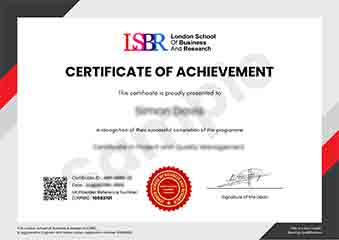
Sample Certificate
Preview the certificate you'll receive upon successful completion of this program.
Get Free Course Info
Receive detailed course information, curriculum breakdown, and career outcomes straight to your inbox.
Employer Sponsored?
Many employers cover professional development costs. Request a corporate invoice and we'll handle the rest. Bulk enrollment discounts available for teams of 3+.
Your Path to Certification
Four simple steps to your professionally recognised qualification
Enroll & Get Instant Access
Complete your enrollment and access course materials immediately
Study at Your Own Pace
Work through the modules on your schedule, from anywhere in the world
Complete Assessments
Demonstrate your knowledge through practical, real-world assessments
Receive Your Certificate
Get your official LSBR UK certificate, recognised across 180+ countries
Join Thousands Who Transformed Their Careers
Our graduates consistently report measurable career growth and professional advancement after completing their programmes.
What People Say About Us
Hear from our students about their experience with the Executive Development Programme in Building Simulation Models with Mathematical Tools at LSBR UK - Executive Education.
Charlotte Williams
United Kingdom"The course provided high-quality, detailed material that significantly enhanced my ability to build simulation models using mathematical tools, which has already proven invaluable in my current role. I gained practical skills that I can directly apply to real-world problems, making the learning experience both rewarding and relevant."
Wei Ming Tan
Singapore"This course has significantly enhanced my ability to apply mathematical tools in building simulation models, making my work more precise and industry-relevant. It has opened up new opportunities for career advancement in my field."
Connor O'Brien
Canada"The course is well-organized, with a clear progression from foundational concepts to advanced topics in building simulation models, which greatly enhances my understanding and practical skills. The comprehensive content and real-world applications have provided me with valuable insights and tools for professional growth in my field."
Still deciding?
Join 23,000+ professionals who advanced their careers. Enroll today and start learning immediately.
Enroll NowSecure payment • Instant access • Certificate included