
Executive Development Programme in Calculus for Computational Physics
Unlock career potential with comprehensive calculus for computational physics training. Prepare for advancement and new challenges.
Executive Development Programme in Calculus for Computational Physics
About This Course
The Executive Development Programme in Calculus for Computational Physics is designed for professionals in the computational physics domain who seek to deepen their understanding of advanced calculus and its application in computational methodologies. This program is tailored for scientists, engineers, and researchers who are looking to enhance their analytical and problem-solving skills, particularly in the context of complex physical systems and data-driven computational models.
Participants will develop a robust set of skills in advanced calculus, including differential equations, vector calculus, and numerical methods, which are essential for modeling and simulating physical phenomena. They will also gain proficiency in using computational tools and software for solving calculus-based problems, enhancing their ability to conduct research and develop innovative solutions in computational physics. This includes expertise in programming languages commonly used in scientific computing, such as Python and MATLAB, and the ability to interpret and analyze large datasets using calculus principles.
The impact on career trajectories is significant, as the program equips learners with the advanced mathematical and computational skills necessary to excel in leadership roles, innovate in research, and drive technological advancements in their field. Graduates will be better positioned to lead interdisciplinary teams, publish high-impact research, and contribute to the development of cutting-edge computational tools and methodologies in physics and related sciences.
What You Will Learn
The Executive Development Programme in Calculus for Computational Physics is a transformative initiative designed to equip professionals with advanced mathematical skills essential for cutting-edge computational physics research. This program bridges the gap between theoretical knowledge and practical application, offering a comprehensive curriculum that includes differential equations, numerical methods, and optimization techniques. Participants will delve into the intricacies of calculus as applied to physics problems, learning how to model complex physical systems and solve equations that underpin modern scientific discoveries.
By mastering these skills, graduates will be well-prepared to tackle real-world challenges in fields such as materials science, astrophysics, and quantum computing. They will gain the ability to develop and implement sophisticated computational models, contributing to breakthroughs in technology and scientific understanding. The program also emphasizes interdisciplinary collaboration, preparing participants to work effectively in multidisciplinary teams.
Career opportunities are vast and include roles in research institutions, tech companies, and government agencies. Graduates can pursue positions as computational physicists, data scientists, or research analysts, driving innovation and contributing to advancements in technology and scientific knowledge. This program is ideal for professionals seeking to enhance their expertise and open new doors in their careers, ensuring they remain at the forefront of computational physics and its applications.
Course Benefits
Industry-Aligned Curriculum
Developed with industry leaders for job-ready skills
Globally Recognised Certificate
Recognised by employers across 180+ countries
Flexible Online Learning
Study at your own pace with lifetime access
Instant Access
Start learning immediately, no application process
Constantly Updated Content
Latest industry trends and best practices
Career Advancement
87% report measurable career progression within 6 months
What This Course Covers
- Foundational Concepts: Covers the core principles and key terminology.: Limits and Continuity: Explores the behavior of functions as they approach certain values.
- Differentiation Techniques: Teaches methods for finding derivatives and their applications.: Integration Methods: Introduces various techniques for solving integration problems.
- Series and Approximations: Discusses series representations and their use in approximations.: Multivariable Calculus: Explores calculus in multiple dimensions and its applications.
Everything You Get With This Course
Course Facts
Audience: Advanced undergraduates, graduates in physics, engineering
Prerequisites: Strong calculus, linear algebra background
Outcomes: Proficient in advanced calculus techniques
Outcomes: Applied knowledge to computational physics problems
Ready to Advance Your Career?
Join thousands of professionals who have transformed their careers with LSBR UK
Why This Course Is Right for You
Enhance Problem-Solving Skills: Professionals can significantly improve their problem-solving abilities by engaging in an Executive Development Programme in Calculus for Computational Physics. This program focuses on developing advanced calculus techniques that are essential for tackling complex computational physics problems. For example, understanding differential equations is crucial for simulating physical phenomena, which can lead to innovative solutions in industries such as aerospace, automotive, and pharmaceuticals.
Improve Computational Efficiency: The program equips professionals with the knowledge to optimize computational models, reducing processing times and increasing efficiency. This is particularly valuable in high-performance computing environments where large-scale simulations are common. By learning to implement efficient algorithms and methods, participants can manage larger datasets and more complex simulations, thereby enhancing their productivity.
Foster Adaptability in a Dynamic Field: Computational physics is a rapidly evolving field with new technologies and methodologies constantly emerging. The programme prepares professionals to stay ahead by covering advanced topics such as machine learning and data analysis, which are increasingly important in computational physics. This adaptability ensures that professionals remain relevant and competitive in their respective industries.
3-4 Weeks
Study at your own pace
Course Brochure
Download our comprehensive course brochure with all details
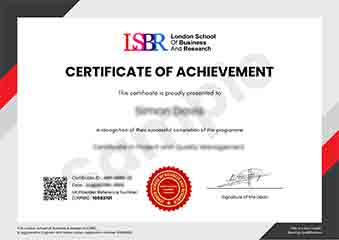
Sample Certificate
Preview the certificate you'll receive upon successful completion of this program.
Get Free Course Info
Receive detailed course information, curriculum breakdown, and career outcomes straight to your inbox.
Employer Sponsored?
Many employers cover professional development costs. Request a corporate invoice and we'll handle the rest. Bulk enrollment discounts available for teams of 3+.
How You Earn Your Certificate
Four simple steps to your professionally recognised qualification
Enroll & Get Instant Access
Complete your enrollment and access course materials immediately
Study at Your Own Pace
Work through the modules on your schedule, from anywhere in the world
Complete Assessments
Demonstrate your knowledge through practical, real-world assessments
Receive Your Certificate
Get your official LSBR UK certificate, recognised across 180+ countries
Real Results from Real Learners
Our graduates consistently report measurable career growth and professional advancement after completing their programmes.
Reviews from Our Learners
Hear from our students about their experience with the Executive Development Programme in Calculus for Computational Physics at LSBR UK - Executive Education.
Sophie Brown
United Kingdom"The course content was incredibly thorough, providing a solid foundation in advanced calculus that directly applies to computational physics problems. Gaining these practical skills has significantly enhanced my ability to model complex physical systems, which is invaluable for my career in research and development."
Ahmad Rahman
Malaysia"The Executive Development Programme in Calculus for Computational Physics has significantly enhanced my ability to apply complex mathematical models in real-world scenarios, making me a more valuable asset in my current role and opening up new career opportunities in advanced computational fields."
Jia Li Lim
Singapore"The course structure was meticulously organized, seamlessly integrating theoretical concepts with practical applications, which greatly enhanced my understanding and appreciation of calculus in computational physics. It provided a solid foundation, making the transition to real-world problem-solving much smoother and more intuitive."
Need more time to decide?
Join 23,000+ professionals who advanced their careers. Enroll today and start learning immediately.
Enroll NowSecure payment • Instant access • Certificate included