
Executive Development Programme in Flood Hazard Mapping with Remote Sensing
This programme equips executives with advanced skills in flood hazard mapping using remote sensing, enhancing decision-making and risk management.
Executive Development Programme in Flood Hazard Mapping with Remote Sensing
Programme Overview
The Executive Development Programme in Flood Hazard Mapping with Remote Sensing is designed for mid-to-senior level professionals in the fields of environmental management, urban planning, disaster risk reduction, and remote sensing technology. This program equips participants with advanced skills in utilizing remote sensing and geographic information systems (GIS) to analyze and predict flood risks, enabling them to make informed decisions that can mitigate environmental and economic impacts of flooding.
Participants will develop expertise in various aspects of flood hazard mapping, including data acquisition from satellite imagery, processing and analyzing remote sensing data, creating flood hazard models, and integrating these models with GIS for comprehensive risk assessment. They will also enhance their understanding of the underlying hydrological, meteorological, and geological principles that contribute to flood events. Practical workshops and case studies will ensure learners can apply their knowledge to real-world scenarios, improving their ability to manage flood risks effectively.
This program significantly impacts career trajectories by enhancing participants' proficiency in advanced remote sensing technologies and flood risk management strategies. Graduates will be well-prepared to lead projects in flood hazard assessment, contribute to policy and planning processes, and develop innovative solutions to reduce vulnerability to flood hazards. The program also fosters leadership and strategic thinking, crucial for navigating complex environmental challenges and driving positive change in their organizations and communities.
What You'll Learn
The Executive Development Programme in Flood Hazard Mapping with Remote Sensing is a transformative initiative designed for professionals seeking to enhance their expertise in geospatial technology and disaster management. This program equips participants with advanced skills in using remote sensing techniques to assess and mitigate flood risks. Key topics include satellite imagery interpretation, geographic information systems (GIS), hydrological modeling, and spatial analysis.
Graduates of this program will apply their knowledge in real-world scenarios, contributing to the development of more accurate flood hazard maps, which are crucial for emergency response planning and infrastructure design. They will be well-prepared to work in roles such as flood risk analysts, geographic information systems specialists, and environmental consultants.
The program’s comprehensive curriculum combines theoretical knowledge with hands-on experience through case studies and practical projects. It is ideal for environmental scientists, urban planners, and policymakers who wish to make a significant impact in reducing the vulnerability of communities to natural disasters. By the end of the program, participants will be equipped to lead initiatives that leverage remote sensing technology to protect lives and property in flood-prone areas.
Programme Highlights
Industry-Aligned Curriculum
Developed with industry leaders for job-ready skills
Globally Recognised Certificate
Recognised by employers across 180+ countries
Flexible Online Learning
Study at your own pace with lifetime access
Instant Access
Start learning immediately, no application process
Constantly Updated Content
Latest industry trends and best practices
Career Advancement
87% report measurable career progression within 6 months
Topics Covered
- Introduction to Flood Hazards: Provides an overview of flood types, impacts, and global trends.: Remote Sensing Fundamentals: Explains the basics of remote sensing technology and its applications in hazard assessment.
- GIS in Flood Mapping: Introduces Geographic Information Systems and their role in creating flood hazard maps.: Data Acquisition and Processing: Covers techniques for gathering and preprocessing remote sensing data.
- Advanced Remote Sensing Techniques: Discusses advanced methods such as SAR imaging and thermal sensing for flood mapping.: Case Studies and Best Practices: Analyzes real-world examples and shares best practices in flood hazard mapping.
What You Get When You Enroll
Key Facts
Audience: Mid-level to senior professionals in disaster management
Prerequisites: Basic understanding of remote sensing and GIS
Outcomes: Enhanced skills in flood hazard mapping, predictive analytics
Ready to Advance Your Career?
Join thousands of professionals who have transformed their careers with LSBR UK
Why This Course
Enhance Expertise: The Executive Development Programme in Flood Hazard Mapping with Remote Sensing equips professionals with advanced skills in using remote sensing technologies and Geographic Information Systems (GIS) for accurate flood hazard mapping. This specialization can significantly enhance career prospects in fields such as urban planning, environmental management, and disaster risk reduction.
Competitive Edge: With the increasing frequency and intensity of natural disasters, organizations are seeking professionals who can leverage remote sensing data to predict and mitigate flood risks. Graduates of this program can offer valuable insights and solutions, positioning themselves as industry leaders and differentiating themselves from peers.
Global Demand: The demand for professionals skilled in flood hazard mapping with remote sensing is growing globally. This program prepares participants to meet this demand by providing them with the knowledge and tools to analyze satellite imagery, interpret geospatial data, and develop predictive models. Such skills are crucial for addressing the challenges posed by climate change and urbanization.
Career Versatility: The program not only enhances technical skills but also develops critical thinking and problem-solving abilities. These competencies are transferable across various sectors, including government agencies, non-profits, and private companies involved in infrastructure development and environmental conservation. This versatility opens up multiple career paths and opportunities for growth.
3-4 Weeks
Study at your own pace
Course Brochure
Download our comprehensive course brochure with all details
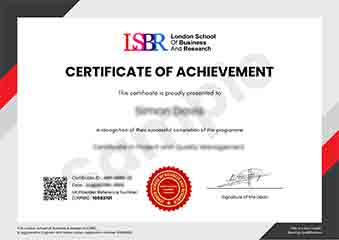
Sample Certificate
Preview the certificate you'll receive upon successful completion of this program.
Get Free Course Info
Receive detailed course information, curriculum breakdown, and career outcomes straight to your inbox.
Employer Sponsored?
Many employers cover professional development costs. Request a corporate invoice and we'll handle the rest. Bulk enrollment discounts available for teams of 3+.
Your Path to Certification
Four simple steps to your professionally recognised qualification
Enroll & Get Instant Access
Complete your enrollment and access course materials immediately
Study at Your Own Pace
Work through the modules on your schedule, from anywhere in the world
Complete Assessments
Demonstrate your knowledge through practical, real-world assessments
Receive Your Certificate
Get your official LSBR UK certificate, recognised across 180+ countries
Join Thousands Who Transformed Their Careers
Our graduates consistently report measurable career growth and professional advancement after completing their programmes.
What People Say About Us
Hear from our students about their experience with the Executive Development Programme in Flood Hazard Mapping with Remote Sensing at LSBR UK - Executive Education.
James Thompson
United Kingdom"The course content was incredibly detailed and well-structured, providing a solid foundation in flood hazard mapping techniques using remote sensing. Gaining hands-on experience with GIS software and real-world case studies significantly enhanced my analytical skills and prepared me for more advanced roles in environmental management."
Mei Ling Wong
Singapore"This course has significantly enhanced my ability to apply remote sensing techniques in flood hazard mapping, making my skills highly relevant in the job market. It has opened up new career opportunities and allowed me to contribute more effectively to disaster management initiatives."
Anna Schmidt
Germany"The course structure was meticulously organized, offering a seamless transition from theoretical concepts to practical applications in flood hazard mapping, which significantly enhanced my understanding and prepared me for real-world challenges."
Still deciding?
Join 23,000+ professionals who advanced their careers. Enroll today and start learning immediately.
Enroll NowSecure payment • Instant access • Certificate included