
Executive Development Programme in Handling Imbalanced Data in Classification Problems
Learn advanced techniques to effectively manage and classify imbalanced data, enhancing predictive model accuracy and business decision-making.
Executive Development Programme in Handling Imbalanced Data in Classification Problems
Programme Overview
This course is for data scientists, analysts, and engineers eager to tackle imbalanced data. You will learn to identify common issues and select the right techniques to handle them.
First, you will gain a solid understanding of imbalanced data, its impact, and the importance of addressing it. Next, you will dive into various techniques. For example, you will learn to resample data, tweak algorithms, and use specialized metrics. Furthermore, you will practice applying these techniques to real-world datasets that have imbalanced data. Thus, you will be well-equipped to handle these challenges in your projects.
What You'll Learn
Unlock the power of data with our Executive Development Programme in Handling Imbalanced Data in Classification Problems. First, dive into the fundamentals of imbalanced data. You will learn to identify and address this challenge head-on. Next, discover advanced techniques, tools, and methodologies vital for enhancing model performance. You will also gain hands-on experience with real-world datasets, ensuring you can apply what you learn immediately.
Moreover, this program offers unparalleled career opportunities. In today's data-driven world, understanding imbalanced data is crucial. Employers seek professionals equipped with these skills. Finally, stand out in the job market. Whether you aim to advance in your current role or pivot to a new career, this program propels you ahead. Enroll now and transform your data handling capabilities!
Programme Highlights
Industry-Aligned Curriculum
Developed with industry leaders to ensure practical, job-ready skills valued by employers worldwide.
Expert Faculty
Learn from experienced professionals with real-world expertise in your chosen field.
Flexible Learning
Study at your own pace, from anywhere in the world, with our flexible online platform.
Industry Focus
Practical, real-world knowledge designed to meet the demands of today's competitive job market.
Latest Curriculum
Stay ahead with constantly updated content reflecting the latest industry trends and best practices.
Career Advancement
Unlock new opportunities with a globally recognized qualification respected by employers.
Topics Covered
- Introduction to Imbalanced Data: Understand the definition and challenges of imbalanced data in classification problems.
- Data Preprocessing Techniques: Explore methods to clean, transform, and handle missing values in imbalanced datasets.
- Resampling Methods: Learn about oversampling and undersampling techniques to balance class distributions.
- Algorithmic Approaches to Imbalance: Study algorithms designed to handle imbalanced data, such as SMOTE and ensemble methods.
- Evaluation Metrics for Imbalanced Data: Understand appropriate metrics like precision, recall, F1-score, and ROC-AUC for evaluation.
- Case Studies and Practical Applications: Apply learned techniques to real-world datasets and analyze the results.
Key Facts
Audience:
Professionals managing or using data for classification tasks.
Data scientists and analysts seeking to enhance skills.
Decision-makers aiming to improve data-driven insights.
Prerequisites:
Basic understanding of data classification. Familiarity with Python or R.
Completion of introductory data science courses. Access to a computer with internet connection.
Outcomes:
Participants will learn to identify and mitigate imbalanced data issues. They will apply techniques. Such as SMOTE, undersampling, and oversampling.
Gain hands-on experience with real-world datasets. Develop models that handle imbalanced data effectively.
Enhance job prospects and career growth by adding valuable skills to resumes.
Why This Course
First, this program focuses on handling imbalanced data. Therefore, it equips learners to tackle real-world classification issues. Moreover, this program offers practical skills. After all, it emphasizes hands-on learning. Therefore, participants actively apply techniques. Finally, it builds a supportive community. Besides, networking opportunities allow learners to connect.
Programme Title
Executive Development Programme in Handling Imbalanced Data in Classification Problems
Course Brochure
Download our comprehensive course brochure with all details
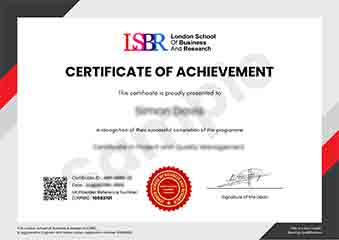
Sample Certificate
Preview the certificate you'll receive upon successful completion of this program.
Pay as an Employer
Request an invoice for your company to pay for this course. Perfect for corporate training and professional development.
What People Say About Us
Hear from our students about their experience with the Executive Development Programme in Handling Imbalanced Data in Classification Problems at LSBR UK - Executive Education.
Sophie Brown
United Kingdom"The course content was exceptionally comprehensive, covering a wide range of techniques for handling imbalanced data in classification problems. I particularly appreciated the practical exercises that allowed me to apply these techniques to real-world datasets, which has significantly enhanced my skills and confidence in tackling similar challenges in my career."
Rahul Singh
India"The Executive Development Programme in Handling Imbalanced Data in Classification Problems has been instrumental in equipping me with cutting-edge techniques that are directly applicable to real-world industry challenges. The course has significantly enhanced my ability to tackle complex data issues, leading to immediate improvements in my job performance and opening up new opportunities for career advancement."
Oliver Davies
United Kingdom"The course structure was exceptionally well-organized, with a clear progression from fundamental concepts to advanced techniques in handling imbalanced data. The comprehensive content not only deepened my understanding of classification problems but also provided practical insights into real-world applications, significantly enhancing my professional growth in data science."