
Executive Development Programme in Mathematical Climate Prediction Techniques
This programme equips executives with advanced mathematical climate prediction techniques, enhancing strategic decision-making and sustainability initiatives.
Executive Development Programme in Mathematical Climate Prediction Techniques
About This Course
The Executive Development Programme in Mathematical Climate Prediction Techniques is a comprehensive initiative designed for senior executives, researchers, and professionals in the environmental, technology, and policy sectors who aim to enhance their understanding and application of advanced mathematical models in climate prediction. The programme focuses on developing the ability to interpret, analyze, and utilize climate data effectively to inform strategic decisions and innovations. Participants will explore cutting-edge mathematical techniques, including statistical modeling, machine learning algorithms, and high-resolution simulations, which are essential for addressing complex environmental challenges.
Through this programme, learners will develop key skills such as data analysis, predictive modeling, and the ability to integrate mathematical insights into policy-making and business strategies. They will also gain proficiency in using specialized software and tools for climate data analysis and modeling. The curriculum is designed to foster critical thinking and innovation, enabling participants to contribute effectively to interdisciplinary projects and to lead initiatives that drive sustainable development.
The career impact of this programme is significant, as participants will be better equipped to navigate the complexities of climate-related issues, make data-driven decisions, and contribute to the development of innovative solutions. Graduates of this programme are expected to lead??????,????????????????????????,???????????????,???????????????????
What You Will Learn
The Executive Development Programme in Mathematical Climate Prediction Techniques is an intensive, five-month course designed for executives and professionals seeking to harness the power of advanced mathematical models in climate prediction. This program equips participants with the skills to interpret complex climate data, develop predictive models, and leverage these insights to inform strategic decision-making in various sectors. Key topics include statistical methods, machine learning algorithms, and computational models, all tailored to address the challenges of climate change.
Participants will learn to analyze large datasets, forecast climate trends, and assess the impacts of climate change on ecosystems, economies, and societies. Through hands-on projects, case studies, and expert-led sessions, graduates will gain practical experience in integrating mathematical climate predictions into business strategies. The program also emphasizes ethical considerations and the responsible use of predictive models.
Upon completion, graduates are prepared to lead climate-related initiatives, drive innovation in sustainable practices, and make informed decisions based on robust predictive models. Career opportunities include roles such as climate data analyst, sustainability consultant, and environmental policy advisor. This program serves as a transformative gateway for professionals aiming to contribute significantly to climate resilience and sustainable development.
Course Benefits
Industry-Aligned Curriculum
Developed with industry leaders for job-ready skills
Globally Recognised Certificate
Recognised by employers across 180+ countries
Flexible Online Learning
Study at your own pace with lifetime access
Instant Access
Start learning immediately, no application process
Constantly Updated Content
Latest industry trends and best practices
Career Advancement
87% report measurable career progression within 6 months
What This Course Covers
- Introduction to Climate Systems: Provides an overview of global climate systems and their components.: Mathematical Modeling Basics: Introduces fundamental mathematical models used in climate prediction.
- Statistical Methods in Climate Analysis: Covers statistical techniques for analyzing climate data.: Dynamical Systems in Climate Models: Discusses the use of dynamical systems theory in climate modeling.
- Numerical Methods for Climate Simulation: Explains numerical methods used in simulating climate processes.: Climate Prediction Case Studies: Analyzes real-world case studies of climate prediction techniques and their outcomes.
Everything You Get With This Course
Course Facts
Target professionals in climate science
No prior programming experience required
Enhance skills in climate modeling
Develop proficiency in data analysis tools
Apply mathematical techniques to climate prediction
Ready to Advance Your Career?
Join thousands of professionals who have transformed their careers with LSBR UK
Why This Course Is Right for You
Enhanced Career Opportunities: The 'Executive Development Programme in Mathematical Climate Prediction Techniques' equips professionals with advanced skills in data analysis and climate modeling. This knowledge is highly sought after in sectors like environmental consulting, renewable energy, and government agencies, expanding career horizons and increasing employability.
Innovative Problem-Solving Skills: The program focuses on developing skills in statistical models, machine learning, and computational techniques specific to climate prediction. These skills are crucial for addressing complex environmental challenges and can be applied to a wide range of industries, from meteorology to urban planning.
Leadership and Strategic Insights: The program goes beyond technical skills by incorporating leadership and strategic thinking. Participants learn to leverage data-driven insights for strategic decision-making, a key competency for executive roles. This blend of technical expertise and leadership skills prepares professionals to lead in roles that require both technical acumen and strategic foresight.
Networking Opportunities: Engaging with peers and industry experts in the program can lead to valuable professional connections. These networks can provide mentorship, collaboration opportunities, and access to cutting-edge research and industry trends, enhancing professional development and career advancement.
3-4 Weeks
Study at your own pace
Course Brochure
Download our comprehensive course brochure with all details
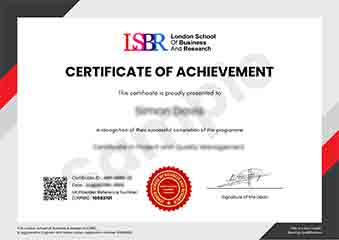
Sample Certificate
Preview the certificate you'll receive upon successful completion of this program.
Get Free Course Info
Receive detailed course information, curriculum breakdown, and career outcomes straight to your inbox.
Employer Sponsored?
Many employers cover professional development costs. Request a corporate invoice and we'll handle the rest. Bulk enrollment discounts available for teams of 3+.
How You Earn Your Certificate
Four simple steps to your professionally recognised qualification
Enroll & Get Instant Access
Complete your enrollment and access course materials immediately
Study at Your Own Pace
Work through the modules on your schedule, from anywhere in the world
Complete Assessments
Demonstrate your knowledge through practical, real-world assessments
Receive Your Certificate
Get your official LSBR UK certificate, recognised across 180+ countries
Real Results from Real Learners
Our graduates consistently report measurable career growth and professional advancement after completing their programmes.
Reviews from Our Learners
Hear from our students about their experience with the Executive Development Programme in Mathematical Climate Prediction Techniques at LSBR UK - Executive Education.
Oliver Davies
United Kingdom"The course content was incredibly rich and well-structured, providing a deep understanding of mathematical climate prediction techniques that are directly applicable to real-world problems. Gaining these skills has significantly enhanced my ability to analyze and predict climate patterns, opening up new career opportunities in environmental consulting."
Madison Davis
United States"The Executive Development Programme in Mathematical Climate Prediction Techniques has significantly enhanced my ability to apply complex models in real-world scenarios, making me a more valuable asset in my organization's climate risk management efforts. This program has not only deepened my technical skills but also opened up new career opportunities in the intersection of mathematics and environmental science."
Ryan MacLeod
Canada"The course structure was meticulously organized, providing a seamless progression from foundational concepts to advanced predictive models, which greatly enhanced my understanding of mathematical climate prediction techniques. The comprehensive content and real-world applications have significantly broadened my perspective on how these techniques can be applied in professional settings."
Need more time to decide?
Join 23,000+ professionals who advanced their careers. Enroll today and start learning immediately.
Enroll NowSecure payment • Instant access • Certificate included