
Executive Development Programme in Mathematical Modeling for Philosophers
This program equips philosophers with advanced mathematical modeling skills, enhancing analytical abilities and contributing to innovative philosophical research.
Executive Development Programme in Mathematical Modeling for Philosophers
Programme Overview
The Executive Development Programme in Mathematical Modeling for Philosophers is a comprehensive initiative designed for individuals with a philosophical background who seek to integrate advanced mathematical modeling techniques into their professional toolkit. This program is tailored for academicians, researchers, and professionals in philosophy, logic, and related fields who wish to enhance their analytical capabilities through a rigorous exploration of mathematical concepts and their applications.
Participants will develop a robust understanding of key mathematical modeling techniques, including probability theory, game theory, and decision theory, and learn how to apply these tools to philosophical problems. The curriculum includes hands-on workshops, case studies, and collaborative projects that facilitate the integration of mathematical models into philosophical inquiry. By the end of the program, learners will be proficient in using mathematical methods to analyze complex systems, construct logical arguments, and explore abstract concepts in a more structured and rigorous manner.
The program significantly impacts career trajectories by equipping participants with enhanced analytical and problem-solving skills. Graduates will be better positioned to contribute to interdisciplinary research, develop innovative solutions to philosophical questions, and lead in areas where mathematical and philosophical insights are essential. This dual expertise opens up new opportunities in academia, research institutions, tech companies, and consultancies, where the ability to bridge mathematical rigor with philosophical depth is highly valued.
What You'll Learn
The Executive Development Programme in Mathematical Modeling for Philosophers is a groundbreaking initiative designed to bridge the gap between abstract philosophical inquiry and practical problem-solving. This program equips participants with advanced mathematical modeling skills, enabling them to apply rigorous analytical methods to complex ethical, epistemological, and metaphysical challenges. Through a blend of theoretical study and hands-on training, participants learn to construct, analyze, and interpret mathematical models that can inform philosophical debates and enhance decision-making processes in various sectors.
Key topics include set theory, logical systems, probability theory, and game theory, all tailored to philosophical contexts. Graduates are prepared to apply these skills in diverse fields such as artificial intelligence ethics, policy-making, and corporate governance. They can develop algorithms to model ethical decision-making, assess the implications of new technologies, and contribute to the design of fair and inclusive systems.
This program opens doors to a variety of career opportunities, including roles in tech companies, think tanks, government agencies, and educational institutions. Graduates are well-suited to lead interdisciplinary projects, shape public policy, and advance the field of philosophy through innovative applications of mathematical reasoning. By integrating mathematical rigor with philosophical depth, this program prepares leaders who can navigate the complexities of the modern world with confidence and insight.
Programme Highlights
Industry-Aligned Curriculum
Developed with industry leaders for job-ready skills
Globally Recognised Certificate
Recognised by employers across 180+ countries
Flexible Online Learning
Study at your own pace with lifetime access
Instant Access
Start learning immediately, no application process
Constantly Updated Content
Latest industry trends and best practices
Career Advancement
87% report measurable career progression within 6 months
Topics Covered
- Introduction to Mathematical Modeling: Overview of the field and its relevance to philosophical inquiry.: Logical Foundations: Examination of logical structures and their applications in mathematical modeling.
- Set Theory and Logic: Study of sets and logical operations in the context of philosophical problems.: Probability Theory: Application of probability concepts to model uncertainty and decision-making.
- Game Theory: Exploration of strategic interactions and decision-making processes in complex systems.: Computational Methods: Introduction to computational tools and algorithms for solving mathematical models.
What You Get When You Enroll
Key Facts
Audience: Mid-career philosophers seeking advanced skills
Prerequisites: Basic understanding of logic and philosophy
Outcomes: Enhanced modeling skills, interdisciplinary knowledge, practical problem-solving
Ready to Advance Your Career?
Join thousands of professionals who have transformed their careers with LSBR UK
Why This Course
Enhance Decision-Making Skills: This program equips philosophers with advanced mathematical modeling techniques, enabling them to analyze complex ethical dilemmas and policy decisions more effectively. By integrating mathematical tools with philosophical thought, professionals can develop more robust arguments and predictions.
Expand Career Opportunities: Graduates of the program are well-prepared to pursue roles in academia, research institutions, and industries such as finance, technology, and healthcare. The interdisciplinary skill set allows for a broader range of job applications and higher chances of career advancement.
Improve Critical Analysis: Through hands-on training in mathematical modeling, philosophers can refine their ability to critically analyze data and theories. This skill is crucial in evaluating the validity of arguments and assumptions in ethical and philosophical debates.
Foster Interdisciplinary Collaboration: The program encourages collaboration between mathematicians and philosophers, leading to innovative solutions in areas like social ethics and public policy. This collaborative approach not only enhances professional networks but also drives more impactful research and applications.
3-4 Weeks
Study at your own pace
Course Brochure
Download our comprehensive course brochure with all details
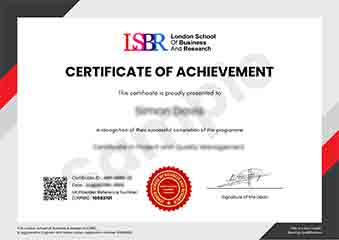
Sample Certificate
Preview the certificate you'll receive upon successful completion of this program.
Get Free Course Info
Receive detailed course information, curriculum breakdown, and career outcomes straight to your inbox.
Employer Sponsored?
Many employers cover professional development costs. Request a corporate invoice and we'll handle the rest. Bulk enrollment discounts available for teams of 3+.
Your Path to Certification
Four simple steps to your professionally recognised qualification
Enroll & Get Instant Access
Complete your enrollment and access course materials immediately
Study at Your Own Pace
Work through the modules on your schedule, from anywhere in the world
Complete Assessments
Demonstrate your knowledge through practical, real-world assessments
Receive Your Certificate
Get your official LSBR UK certificate, recognised across 180+ countries
Join Thousands Who Transformed Their Careers
Our graduates consistently report measurable career growth and professional advancement after completing their programmes.
What People Say About Us
Hear from our students about their experience with the Executive Development Programme in Mathematical Modeling for Philosophers at LSBR UK - Executive Education.
Charlotte Williams
United Kingdom"The course provided a robust foundation in mathematical modeling, which has significantly enhanced my ability to analyze complex philosophical problems quantitatively. Gaining these practical skills has opened up new avenues for research and application in my field."
Wei Ming Tan
Singapore"The Executive Development Programme in Mathematical Modeling for Philosophers has significantly enhanced my ability to apply abstract philosophical concepts to real-world problems, making my insights more relevant and impactful in the tech industry. This program has not only broadened my skill set but also opened up new career opportunities by bridging the gap between philosophy and data-driven decision-making."
Mei Ling Wong
Singapore"The course structure was meticulously organized, providing a clear path from foundational concepts to advanced applications in mathematical modeling, which significantly enhanced my understanding and practical skills. The comprehensive content and real-world examples were particularly beneficial, offering a clear vision of how these models can be applied in philosophical contexts to solve complex problems."
Still deciding?
Join 23,000+ professionals who advanced their careers. Enroll today and start learning immediately.
Enroll NowSecure payment • Instant access • Certificate included