
Executive Development Programme in Mathematical Modeling for System Verification
This program equips executives with mathematical modeling skills for effective system verification, enhancing strategic decision-making and operational efficiency.
Executive Development Programme in Mathematical Modeling for System Verification
Programme Overview
The Executive Development Programme in Mathematical Modeling for System Verification is designed for senior executives, engineers, and technical leaders in industries such as aerospace, automotive, and telecommunications seeking to enhance their understanding of mathematical modeling techniques and their application in system verification. This program equips participants with a comprehensive framework for leveraging mathematical models to ensure the reliability, efficiency, and safety of complex systems.
Participants will develop key skills in advanced mathematical modeling, including stochastic processes, differential equations, and optimization techniques, enabling them to create and validate models that predict system behavior under various conditions. They will also gain proficiency in using specialized tools and software for mathematical modeling and simulation, and learn best practices for integrating these models into the broader system verification lifecycle. Furthermore, the program emphasizes the importance of rigorous validation methods, risk assessment, and continuous improvement in model accuracy and relevance.
The impact on careers is significant, as participants will be better equipped to lead projects that require high levels of system reliability, manage interdisciplinary teams effectively, and drive innovation through the application of cutting-edge mathematical modeling techniques. This program not only enhances technical expertise but also fosters a deeper understanding of how to strategically utilize mathematical models to address complex challenges and achieve organizational goals.
What You'll Learn
The Executive Development Programme in Mathematical Modeling for System Verification is tailored to senior executives and professionals seeking to enhance their strategic capabilities in ensuring robust system reliability and security. This program equips participants with advanced mathematical modeling techniques, enabling them to predict and mitigate risks in complex systems, from cybersecurity to financial modeling. Key topics include stochastic processes, optimization algorithms, and risk assessment methodologies. Graduates apply these skills to develop comprehensive verification strategies, improve system resilience, and drive innovation in their organizations.
This program not only sharpens technical acumen but also fosters a deep understanding of how mathematical models can inform decision-making processes. Graduates emerge with the ability to lead interdisciplinary teams, integrate cutting-edge technologies, and ensure compliance with regulatory standards. The curriculum is designed to be practical, with case studies, real-world projects, and interactive workshops that simulate the challenges faced in the industry.
Career opportunities for program graduates are extensive, ranging from leadership roles in technology firms to senior positions in government agencies and research institutions. Graduates are well-positioned to spearhead initiatives that leverage mathematical modeling to achieve strategic objectives, drive technological advancements, and maintain competitive advantage in their sectors.
Programme Highlights
Industry-Aligned Curriculum
Developed with industry leaders for job-ready skills
Globally Recognised Certificate
Recognised by employers across 180+ countries
Flexible Online Learning
Study at your own pace with lifetime access
Instant Access
Start learning immediately, no application process
Constantly Updated Content
Latest industry trends and best practices
Career Advancement
87% report measurable career progression within 6 months
Topics Covered
- Introduction to Mathematical Modeling: Introduces the basics of mathematical modeling and its relevance to system verification.: System Modeling Techniques: Discusses various modeling techniques and their applications in system development.
- Verification and Validation Fundamentals: Explains the principles of verification and validation in the context of mathematical models.: Case Studies in System Verification: Analyzes real-world case studies to demonstrate the practical application of mathematical modeling in system verification.
- Advanced Modeling Tools and Software: Reviews advanced tools and software used in the creation and analysis of mathematical models.: Ethical Considerations in Mathematical Modeling: Examines ethical issues and considerations in the use of mathematical models for system verification.
What You Get When You Enroll
Key Facts
Audience: Mid-level to senior executives
Prerequisites: Basic understanding of math and systems
Outcomes: Enhanced ability in mathematical modeling
Outcomes: Improved skills in system verification
Outcomes: Better decision-making through data
Ready to Advance Your Career?
Join thousands of professionals who have transformed their careers with LSBR UK
Why This Course
Enhanced Problem-Solving Skills: Participating in an Executive Development Programme in Mathematical Modeling for System Verification equips professionals with advanced analytical tools and techniques. These skills are crucial for addressing complex, multifaceted challenges in various industries, such as engineering, finance, and healthcare, leading to more innovative and effective solutions.
Improved Decision-Making: The programme focuses on developing a deep understanding of mathematical models and their applications. This knowledge enables professionals to make informed, data-driven decisions, which can significantly enhance the efficiency and effectiveness of business operations and strategic planning.
Advanced Career Opportunities: By mastering mathematical modeling, professionals become more competitive in the job market. The ability to apply these skills can open doors to high-demand roles in research, development, and consulting. Companies often seek individuals who can leverage mathematical models to improve system verification and ensure product reliability, making this programme a valuable asset for career progression.
Interdisciplinary Collaboration: The programme fosters collaboration among professionals from diverse backgrounds, enhancing the ability to work in interdisciplinary teams. This skill is increasingly important as industries become more interconnected and require cross-functional expertise to solve emerging challenges.
3-4 Weeks
Study at your own pace
Course Brochure
Download our comprehensive course brochure with all details
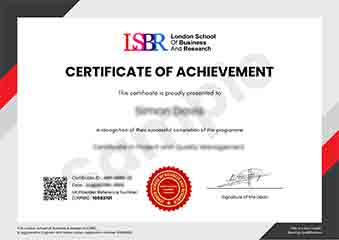
Sample Certificate
Preview the certificate you'll receive upon successful completion of this program.
Get Free Course Info
Receive detailed course information, curriculum breakdown, and career outcomes straight to your inbox.
Employer Sponsored?
Many employers cover professional development costs. Request a corporate invoice and we'll handle the rest. Bulk enrollment discounts available for teams of 3+.
Your Path to Certification
Four simple steps to your professionally recognised qualification
Enroll & Get Instant Access
Complete your enrollment and access course materials immediately
Study at Your Own Pace
Work through the modules on your schedule, from anywhere in the world
Complete Assessments
Demonstrate your knowledge through practical, real-world assessments
Receive Your Certificate
Get your official LSBR UK certificate, recognised across 180+ countries
Join Thousands Who Transformed Their Careers
Our graduates consistently report measurable career growth and professional advancement after completing their programmes.
What People Say About Us
Hear from our students about their experience with the Executive Development Programme in Mathematical Modeling for System Verification at LSBR UK - Executive Education.
Sophie Brown
United Kingdom"The course content was incredibly robust, providing deep insights into advanced mathematical modeling techniques that are essential for system verification. Gaining hands-on experience with these tools has significantly enhanced my ability to tackle complex real-world problems, which I believe will greatly benefit my career in systems engineering."
Muhammad Hassan
Malaysia"This course has significantly enhanced my ability to apply mathematical modeling in real-world systems, making my approach to system verification more robust and industry-aligned. It has opened up new opportunities in my career, particularly in roles that require advanced analytical skills and a deep understanding of system dynamics."
Fatimah Ibrahim
Malaysia"The course structure is well-organized, providing a comprehensive overview of mathematical modeling techniques that are directly applicable to system verification, enhancing my ability to tackle complex real-world problems effectively."
Still deciding?
Join 23,000+ professionals who advanced their careers. Enroll today and start learning immediately.
Enroll NowSecure payment • Instant access • Certificate included