
Executive Development Programme in Mathematical Simulation and Modeling Methods
Advance your career with certified mathematical simulation and modeling methods expertise. Open doors to new professional opportunities.
Executive Development Programme in Mathematical Simulation and Modeling Methods
About This Course
The Executive Development Programme in Mathematical Simulation and Modeling Methods is designed for senior executives and professionals aiming to enhance their strategic decision-making capabilities through advanced mathematical techniques. This program equips participants with the knowledge to apply sophisticated modeling methods to predict market trends, optimize operations, and innovate in their respective industries. Participants will engage with cutting-edge simulation tools and methodologies, including predictive analytics, optimization algorithms, and machine learning, which are essential for driving organizational success in today's data-driven environment.
Upon completion of the program, learners will develop key skills in formulating complex problems into mathematical models, interpreting simulation outputs, and leveraging data to inform business strategies. They will also gain proficiency in using software tools such as MATLAB, R, and Python for model development and analysis. Additionally, participants will learn to communicate technical insights effectively to non-technical stakeholders, ensuring that the benefits of mathematical modeling are fully realized within their organizations.
The program has a significant impact on career progression, as it enhances participants' ability to lead data-informed initiatives and innovate with complex systems. Graduates will be well-prepared to take on senior leadership roles that require a deep understanding of mathematical simulation and modeling, and they will be adept at guiding their teams towards more strategic and efficient business practices. This program not only sharpens technical skills but also develops critical thinking and problem-solving abilities, making participants invaluable assets in their organizations.
What You Will Learn
The Executive Development Programme in Mathematical Simulation and Modeling Methods is designed to equip leaders with advanced skills in leveraging mathematical models to solve complex business challenges. This program is ideal for executives seeking to enhance their strategic decision-making capabilities through the application of cutting-edge simulation techniques and modeling methodologies.
Key topics include systems dynamics, optimization techniques, statistical analysis, and predictive analytics. Participants will learn to develop and validate models that can simulate real-world scenarios, enabling them to forecast trends, optimize processes, and make data-driven decisions. The curriculum also focuses on the ethical implications of using mathematical models in business environments, ensuring a balanced approach to innovation and responsibility.
Graduates of this program will be well-equipped to lead cross-functional teams in implementing simulation-based solutions across industries, from manufacturing and healthcare to finance and technology. They can apply these skills to improve operational efficiency, innovate new products, and develop strategic plans that leverage quantitative insights for competitive advantage.
This program opens doors to a multitude of career opportunities, including roles as Chief Data Officers, Head of Operations Research, and Director of Analytics. Graduates will be prepared to drive organizational change through evidence-based decision-making and quantitative leadership, making a significant impact in their respective fields.
Course Benefits
Industry-Aligned Curriculum
Developed with industry leaders for job-ready skills
Globally Recognised Certificate
Recognised by employers across 180+ countries
Flexible Online Learning
Study at your own pace with lifetime access
Instant Access
Start learning immediately, no application process
Constantly Updated Content
Latest industry trends and best practices
Career Advancement
87% report measurable career progression within 6 months
What This Course Covers
- Introduction to Mathematical Simulation: Provides an overview of the field and its applications.: Probabilistic Modeling: Focuses on building models using probability theory.
- Optimization Techniques: Discusses various optimization methods and their implementation.: Data Analysis and Statistics: Covers statistical methods for data analysis.
- Computational Algorithms: Introduces key algorithms used in mathematical modeling.: Case Studies in Modeling: Analyzes real-world problems and solutions using simulation techniques.
Everything You Get With This Course
Course Facts
Audience: Mid-level to senior executives
Prerequisites: Basic understanding of mathematics
Outcomes: Enhanced decision-making, simulation skills, model validation
Ready to Advance Your Career?
Join thousands of professionals who have transformed their careers with LSBR UK
Why This Course Is Right for You
Enhance Decision-Making Skills: Executives enrolled in this program gain advanced proficiency in mathematical simulation and modeling. These skills enable them to make more informed, data-driven decisions, which can significantly impact strategic planning and resource allocation. For instance, they can use predictive models to forecast market trends, thereby optimizing product development and sales strategies.
Strengthen Problem-Solving Abilities: The program equips professionals with sophisticated analytical tools and techniques to tackle complex business challenges. Participants learn to develop and implement simulations that can model various scenarios, helping them to identify potential risks and opportunities. This capability is crucial for devising robust business strategies that can navigate through uncertain market conditions.
Foster Innovation and Competitive Advantage: By mastering mathematical simulation and modeling methods, executives can innovate more effectively. They can create new products, services, and business models that leverage advanced analytics. For example, companies using these methods to optimize supply chains can reduce costs and improve customer satisfaction, providing a competitive edge in the market.
Improve Collaboration Across Teams: The program often includes team projects that involve collaboration with colleagues from different departments. This interaction enhances cross-functional understanding and cooperation, which is essential for implementing complex simulations and models across the organization. Such collaboration can lead to more effective and efficient problem-solving, benefiting both the company and its customers.
3-4 Weeks
Study at your own pace
Course Brochure
Download our comprehensive course brochure with all details
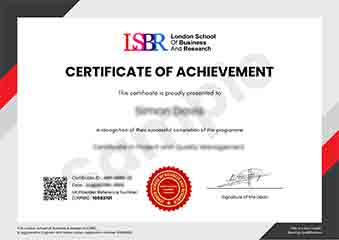
Sample Certificate
Preview the certificate you'll receive upon successful completion of this program.
Get Free Course Info
Receive detailed course information, curriculum breakdown, and career outcomes straight to your inbox.
Employer Sponsored?
Many employers cover professional development costs. Request a corporate invoice and we'll handle the rest. Bulk enrollment discounts available for teams of 3+.
How You Earn Your Certificate
Four simple steps to your professionally recognised qualification
Enroll & Get Instant Access
Complete your enrollment and access course materials immediately
Study at Your Own Pace
Work through the modules on your schedule, from anywhere in the world
Complete Assessments
Demonstrate your knowledge through practical, real-world assessments
Receive Your Certificate
Get your official LSBR UK certificate, recognised across 180+ countries
Real Results from Real Learners
Our graduates consistently report measurable career growth and professional advancement after completing their programmes.
Reviews from Our Learners
Hear from our students about their experience with the Executive Development Programme in Mathematical Simulation and Modeling Methods at LSBR UK - Executive Education.
Charlotte Williams
United Kingdom"The course provided a deep dive into advanced mathematical simulation techniques, which significantly enhanced my ability to model complex systems. Gaining hands-on experience with these methods has been incredibly valuable for my career, offering practical tools to solve real-world problems more effectively."
Wei Ming Tan
Singapore"This course has been instrumental in bridging the gap between theoretical mathematics and practical business applications, significantly enhancing my ability to model complex systems and make data-driven decisions, which has propelled my career forward in the tech industry."
Jia Li Lim
Singapore"The course structure is well-organized, providing a comprehensive overview of mathematical simulation and modeling methods that directly enhance my ability to apply these techniques in real-world scenarios, significantly boosting my professional growth."
Need more time to decide?
Join 23,000+ professionals who advanced their careers. Enroll today and start learning immediately.
Enroll NowSecure payment • Instant access • Certificate included