
Executive Development Programme in Phylogenetic Pattern Identification: Tools and Methods
This programme equips executives with advanced tools and methods for phylogenetic pattern identification, enhancing strategic decision-making in biological and ecological research.
Executive Development Programme in Phylogenetic Pattern Identification: Tools and Methods
Programme Overview
The Executive Development Programme in Phylogenetic Pattern Identification: Tools and Methods is designed for professionals in the life sciences, including biologists, researchers, and data scientists, particularly those working in genomics, ecology, and evolutionary biology. This program equips participants with a comprehensive understanding of advanced tools and methodologies for analyzing and interpreting phylogenetic patterns, crucial for advancing their research and contributing to cutting-edge scientific discoveries.
Throughout the program, learners will develop a deep understanding of phylogenetic tree construction, sequence alignment techniques, and the use of computational tools for phylogenetic inference. They will also learn how to apply statistical methods for evaluating evolutionary relationships, analyze genomic data, and interpret complex biological patterns. Additionally, the program emphasizes practical skills in using specialized software and programming languages such as Python and R, along with hands-on experience with large-scale genomic datasets.
This program significantly enhances career prospects by enabling participants to lead or contribute to interdisciplinary research projects, develop innovative analytical methods, and publish high-impact research papers. Graduates will be well-prepared to drive scientific advancements, innovate in biotech and pharmaceutical industries, and address critical challenges in biodiversity and conservation.
What You'll Learn
The Executive Development Programme in Phylogenetic Pattern Identification: Tools and Methods is a comprehensive, eight-month executive education programme designed for professionals seeking to enhance their skills in identifying and analyzing phylogenetic patterns. This programme equips participants with advanced knowledge in state-of-the-art tools and methods used in molecular biology, bioinformatics, and evolutionary analysis. Participants will delve into topics such as sequence alignment, phylogenetic tree construction, and the application of machine learning techniques in evolutionary studies.
Participants will gain hands-on experience through practical workshops and projects, allowing them to develop and refine their ability to interpret complex biological data. They will learn to apply these skills in real-world scenarios, supporting research, pharmaceutical development, and conservation efforts. The programme’s curriculum is curated by leading experts in the field, ensuring that participants are at the forefront of current research and technological advancements.
Graduates of this programme are well-prepared for a diverse range of career opportunities, including roles as data analysts, bioinformaticians, and research scientists in academia, pharmaceutical companies, and environmental organizations. They will also be equipped to lead projects, develop innovative solutions, and contribute to the advancement of evolutionary biology and bioinformatics. By the end of the programme, participants will not only have a deeper understanding of phylogenetic pattern identification but also the practical skills to implement these knowledge in their professional endeavors.
Programme Highlights
Industry-Aligned Curriculum
Developed with industry leaders for job-ready skills
Globally Recognised Certificate
Recognised by employers across 180+ countries
Flexible Online Learning
Study at your own pace with lifetime access
Instant Access
Start learning immediately, no application process
Constantly Updated Content
Latest industry trends and best practices
Career Advancement
87% report measurable career progression within 6 months
Topics Covered
- Phylogenetics Fundamentals: Covers core principles and key terminology.: Molecular Data Analysis: Explores techniques for analyzing DNA and protein sequences.
- Tree Construction Methods: Discusses algorithms and software for building phylogenetic trees.: Comparative Genomics: Analyzes evolutionary relationships using genomic data.
- Phylogenetic Pattern Recognition: Identifies and interprets patterns in phylogenetic data.: Case Studies in Phylogenetics: Applies learned methods to real-world biological problems.
What You Get When You Enroll
Key Facts
Audience: Research scientists, bioinformaticians
Prerequisites: Basic understanding of genetics, programming experience
Outcomes: Proficient in phylogenetic tools, capable of pattern analysis
Ready to Advance Your Career?
Join thousands of professionals who have transformed their careers with LSBR UK
Why This Course
Enhance Expertise: The Executive Development Programme in Phylogenetic Pattern Identification equips professionals with advanced knowledge in the latest tools and methods for analyzing evolutionary relationships among different species. This expertise is crucial for roles in bioinformatics, molecular biology, and environmental science, where understanding genetic relationships can drive innovation and discovery.
Career Advancement: Mastery of these skills can significantly enhance career prospects. Employers in biotech, pharmaceuticals, and research often seek candidates with a deep understanding of phylogenetic analysis. Graduates from this program are well-positioned for leadership roles in research and development, project management, and strategic planning.
Interdisciplinary Collaboration: The programme fosters an interdisciplinary approach, integrating knowledge from biology, computer science, and statistics. This broad skill set enables professionals to collaborate effectively across departments and industries, contributing to interdisciplinary projects that address complex biological questions.
Competitive Advantage: With the increasing demand for sophisticated data analysis in the life sciences, professionals with specialized skills in phylogenetic pattern identification gain a competitive edge in the job market. The programme prepares participants to tackle real-world challenges, making them valuable assets to their organizations and positioning them for career growth in a rapidly evolving technological landscape.
3-4 Weeks
Study at your own pace
Course Brochure
Download our comprehensive course brochure with all details
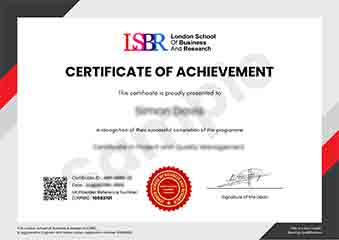
Sample Certificate
Preview the certificate you'll receive upon successful completion of this program.
Get Free Course Info
Receive detailed course information, curriculum breakdown, and career outcomes straight to your inbox.
Employer Sponsored?
Many employers cover professional development costs. Request a corporate invoice and we'll handle the rest. Bulk enrollment discounts available for teams of 3+.
Your Path to Certification
Four simple steps to your professionally recognised qualification
Enroll & Get Instant Access
Complete your enrollment and access course materials immediately
Study at Your Own Pace
Work through the modules on your schedule, from anywhere in the world
Complete Assessments
Demonstrate your knowledge through practical, real-world assessments
Receive Your Certificate
Get your official LSBR UK certificate, recognised across 180+ countries
Join Thousands Who Transformed Their Careers
Our graduates consistently report measurable career growth and professional advancement after completing their programmes.
What People Say About Us
Hear from our students about their experience with the Executive Development Programme in Phylogenetic Pattern Identification: Tools and Methods at LSBR UK - Executive Education.
James Thompson
United Kingdom"The course content was exceptionally comprehensive, providing a deep dive into the latest tools and methods in phylogenetic pattern identification. Gaining hands-on experience with these techniques significantly enhanced my analytical skills and has already proven invaluable in my current role."
Kai Wen Ng
Singapore"This course has significantly enhanced my ability to analyze complex phylogenetic data, making me more competitive in the job market. The practical tools and methods taught have directly translated into more effective solutions for real-world biological research challenges."
Oliver Davies
United Kingdom"The course structure was meticulously organized, making complex concepts in phylogenetic pattern identification accessible and easy to follow. It provided a wealth of knowledge that has significantly enhanced my ability to analyze and interpret biological data, offering valuable insights for my professional growth in the field."
Still deciding?
Join 23,000+ professionals who advanced their careers. Enroll today and start learning immediately.
Enroll NowSecure payment • Instant access • Certificate included