
Global Certificate in Boundary Layer Transition Modeling
Enhance aerodynamics expertise with certified boundary layer transition modeling skills and knowledge for improved design outcomes.
Global Certificate in Boundary Layer Transition Modeling
Programme Overview
The Global Certificate in Boundary Layer Transition Modeling is a comprehensive programme designed for engineers, researchers, and scientists working in the fields of aerospace, mechanical, and chemical engineering. This programme covers the fundamental principles of boundary layer transition, including laminar-turbulent transition, transition modeling, and simulation techniques. Participants will delve into the complexities of boundary layer dynamics, exploring the underlying physics and numerical methods used to predict transition.
Through a combination of lectures, case studies, and hands-on simulations, learners will develop practical skills in modeling and simulating boundary layer transition using cutting-edge software and tools. They will gain a deep understanding of transition mechanisms, including the effects of surface roughness, freestream turbulence, and pressure gradients. Participants will also learn to analyze and interpret simulation results, validating their models against experimental data and applying their knowledge to real-world engineering problems.
Upon completing the programme, learners will be equipped to tackle complex engineering challenges in fields such as aircraft design, turbine engineering, and pipeline flow. They will possess the expertise to develop and apply advanced transition models, enhancing their career prospects and contributing to innovative solutions in their respective industries.
What You'll Learn
The Global Certificate in Boundary Layer Transition Modeling is a cutting-edge programme designed to equip professionals with expertise in predicting and analyzing the complex physics of boundary layer transition. This programme is valuable and relevant in today's professional landscape as it addresses the critical need for accurate modeling and simulation in various industries, including aerospace, energy, and automotive.
Key topics covered include turbulent flow modeling, Reynolds-averaged Navier-Stokes (RANS), large eddy simulation (LES), and direct numerical simulation (DNS). Students develop competencies in using computational fluid dynamics (CFD) tools, such as OpenFOAM and ANSYS Fluent, to simulate and analyze boundary layer transition. They also learn to apply theoretical frameworks, including the e^N method and the correlation-based transition model, to real-world problems.
Graduates of this programme apply their skills in real-world settings, such as optimizing aircraft and wind turbine designs, predicting heat transfer in electronic devices, and simulating fluid flow in pipelines. They work with industry-leading companies, research institutions, and government agencies, contributing to the development of innovative technologies and solutions.
Upon completion of the programme, graduates can pursue career advancement opportunities in research and development, engineering design, and technical consulting. They can work as CFD engineers, aerodynamics specialists, or research scientists, applying their expertise to drive innovation and improve performance in their respective fields. The programme's strong industry connections and emphasis on practical application ensure that graduates are well-prepared to tackle complex challenges and succeed in their
Programme Highlights
Industry-Aligned Curriculum
Developed with industry leaders for job-ready skills
Globally Recognised Certificate
Recognised by employers across 180+ countries
Flexible Online Learning
Study at your own pace with lifetime access
Instant Access
Start learning immediately, no application process
Constantly Updated Content
Latest industry trends and best practices
Career Advancement
87% report measurable career progression within 6 months
Topics Covered
- Introduction to BLT: Basics of boundary layer transition.
- Transition Modeling: Modeling methods and techniques.
- Laminar-Turbulent Transition: Transition from laminar to turbulent.
- Turbulence Modeling: Turbulence modeling and simulation.
- Boundary Layer Physics: Physics of boundary layer flow.
- Application and Validation: Practical applications and validation.
What You Get When You Enroll
Key Facts
Target Audience: Engineers, researchers, and professionals working in aerospace, automotive, and energy industries.
Prerequisites: No formal prerequisites required, but basic understanding of fluid dynamics and mathematics is beneficial.
Learning Outcomes:
Apply boundary layer transition models to real-world problems.
Analyze and interpret results from transition modeling simulations.
Develop skills in selecting appropriate transition models for different applications.
Evaluate the accuracy and limitations of various transition modeling techniques.
Implement boundary layer transition modeling in engineering design and optimization.
Assessment Method: Quiz-based assessment to evaluate understanding of key concepts and application of skills.
Certification: Industry-recognised digital certificate awarded upon successful completion of the course, verifying expertise in boundary layer transition modeling.
Ready to Advance Your Career?
Join thousands of professionals who have transformed their careers with LSBR UK
Why This Course
The 'Global Certificate in Boundary Layer Transition Modeling' programme offers a unique opportunity for professionals to enhance their skills in a highly specialized field, providing a competitive edge in the industry. By gaining expertise in boundary layer transition modeling, professionals can significantly impact the design and development of various engineering systems, including aircraft, turbines, and pipelines.
Career Advancement: The programme enables professionals to develop advanced skills in computational fluid dynamics, numerical methods, and data analysis, making them highly sought after by top employers in the aerospace, energy, and automotive industries. This expertise can lead to career advancement opportunities, such as senior research positions or leadership roles in engineering teams. With the certificate, professionals can demonstrate their commitment to staying up-to-date with the latest advancements in the field.
Improved Design Capabilities: The programme focuses on the practical application of boundary layer transition modeling to real-world problems, allowing professionals to improve the design and performance of engineering systems. By mastering the techniques and tools taught in the programme, professionals can optimize system design, reduce drag, and increase efficiency, leading to significant cost savings and improved product performance.
Industry Relevance: The certificate programme is designed in collaboration with industry partners, ensuring that the curriculum is relevant to current industry needs and challenges. Professionals who complete the programme will be equipped with the knowledge and skills required to tackle complex problems in boundary layer transition modeling, making them valuable assets to their organizations and enabling them to drive innovation and growth in their respective fields.
3-4 Weeks
Study at your own pace
Course Brochure
Download our comprehensive course brochure with all details
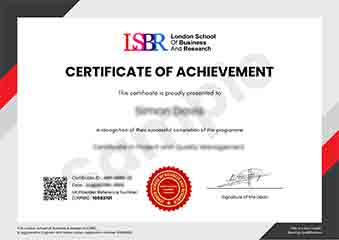
Sample Certificate
Preview the certificate you'll receive upon successful completion of this program.
Get Free Course Info
Receive detailed course information, curriculum breakdown, and career outcomes straight to your inbox.
Employer Sponsored?
Many employers cover professional development costs. Request a corporate invoice and we'll handle the rest. Bulk enrollment discounts available for teams of 3+.
Your Path to Certification
Four simple steps to your professionally recognised qualification
Enroll & Get Instant Access
Complete your enrollment and access course materials immediately
Study at Your Own Pace
Work through the modules on your schedule, from anywhere in the world
Complete Assessments
Demonstrate your knowledge through practical, real-world assessments
Receive Your Certificate
Get your official LSBR UK certificate, recognised across 180+ countries
Join Thousands Who Transformed Their Careers
Our graduates consistently report measurable career growth and professional advancement after completing their programmes.
What People Say About Us
Hear from our students about their experience with the Global Certificate in Boundary Layer Transition Modeling at LSBR UK - Executive Education.
Sophie Brown
United Kingdom"The course material was incredibly comprehensive and well-structured, providing me with a deep understanding of boundary layer transition modeling and its applications in various fields. Through this course, I gained hands-on experience with modeling and simulation tools, which has significantly enhanced my practical skills and ability to tackle complex problems in my career. The knowledge and skills I acquired have been highly valuable, allowing me to make more accurate predictions and informed decisions in my professional work."
Muhammad Hassan
Malaysia"The Global Certificate in Boundary Layer Transition Modeling has been a game-changer for my career, equipping me with the specialized skills to tackle complex fluid dynamics problems and drive innovation in my field. I've seen a significant boost in my ability to analyze and predict transition phenomena, which has not only enhanced my credibility as an engineer but also opened up new opportunities for career advancement in the aerospace industry. By mastering the concepts and tools taught in this course, I'm now better positioned to contribute to high-impact projects and collaborate with cross-functional teams to develop more efficient and reliable systems."
James Thompson
United Kingdom"The course structure was well-organized, allowing me to seamlessly transition between topics and gain a deeper understanding of boundary layer transition modeling, which has significantly enhanced my knowledge in this area. I appreciated the comprehensive content, which not only covered theoretical foundations but also provided insights into real-world applications, making the subject more relatable and interesting. Through this course, I have acquired a solid foundation in transition modeling, which I believe will greatly contribute to my professional growth in the field of aerodynamics and fluid dynamics."
Still deciding?
Join 23,000+ professionals who advanced their careers. Enroll today and start learning immediately.
Enroll NowSecure payment • Instant access • Certificate included