
Global Certificate in Experimental Design in Social Sciences
This global certificate equips social scientists with advanced experimental design skills, enhancing research validity and impact.
Global Certificate in Experimental Design in Social Sciences
Programme Overview
The Global Certificate in Experimental Design in Social Sciences is a comprehensive programme tailored for social science researchers, educators, and professionals aiming to enhance their understanding and application of experimental design methodologies. This programme covers a wide range of topics, including the principles of experimental design, ethical considerations, statistical analysis techniques, and the integration of qualitative and quantitative research methods. It is designed for those who wish to improve their research methodologies, particularly in social sciences, by learning how to design, implement, and analyze experiments effectively.
Participants in this programme will develop a robust set of skills and knowledge, including the ability to formulate research questions, design experiments to address these questions, and analyze data using appropriate statistical methods. They will also learn about the ethical dilemmas that arise in experimental research and how to navigate them. Additionally, learners will gain proficiency in using software tools for data analysis and will understand how to interpret and communicate the results of their experiments to both academic and non-academic audiences.
The impact of this programme on learners' careers is significant. Graduates will be better equipped to conduct high-quality research, publish their findings, and contribute to their field. This certificate can enhance their credibility as researchers and professionals, leading to opportunities for career advancement in academia, research institutions, and the private sector. It also prepares them for leadership roles where the ability to design and implement rigorous research is crucial.
What You'll Learn
The Global Certificate in Experimental Design in Social Sciences is a comprehensive, online program designed for professionals and students seeking to master the critical skills of experimental design and analysis in the social sciences. This program equips participants with a robust understanding of statistical methods, research methodologies, and data analysis techniques essential for conducting rigorous social science research.
Key topics include experimental design principles, statistical analysis, qualitative and quantitative research methods, and ethical considerations in social science research. Participants engage in hands-on projects and real-world case studies, allowing them to apply experimental design techniques to diverse social science contexts. The program emphasizes the importance of reproducibility and transparency in research, preparing students to contribute effectively to the scientific community.
Upon completion, graduates are well-prepared to design and implement experiments, analyze complex data sets, and communicate findings clearly. They can apply these skills in academic research, market research, public policy analysis, and social impact assessment. Career opportunities abound in academia, research institutions, government agencies, non-profit organizations, and technology firms. The program also enhances career prospects for those in market research, data science, and public health sectors, where experimental design skills are highly valued.
Programme Highlights
Industry-Aligned Curriculum
Developed with industry leaders for job-ready skills
Globally Recognised Certificate
Recognised by employers across 180+ countries
Flexible Online Learning
Study at your own pace with lifetime access
Instant Access
Start learning immediately, no application process
Constantly Updated Content
Latest industry trends and best practices
Career Advancement
87% report measurable career progression within 6 months
Topics Covered
- Introduction to Experimental Design: Introduces the basic concepts and importance of experimental design in social sciences.: Hypothesis Testing and Statistical Inference: Discusses the process of formulating hypotheses and using statistical methods to test them.
- Experimental Design Strategies: Explores various designs including between-subjects, within-subjects, and mixed designs.: Data Collection Methods: Covers qualitative and quantitative data collection techniques specific to social science research.
- Analyzing Experimental Data: Teaches statistical analysis techniques for experimental data, including ANOVA and regression analysis.: Reporting and Publishing Experimental Findings: Guides students on how to effectively report and publish their experimental research.
What You Get When You Enroll
Key Facts
Audience: Researchers, social scientists, data analysts
Prerequisites: Basic statistics knowledge, foundational research skills
Outcomes: Proficient in experimental design, capable of data analysis
Ready to Advance Your Career?
Join thousands of professionals who have transformed their careers with LSBR UK
Why This Course
Enhance Methodological Proficiency: The Global Certificate in Experimental Design in Social Sciences equips professionals with a robust understanding of experimental design principles. This knowledge is crucial for conducting rigorous research, which can significantly impact career advancement in academia and policy analysis roles. For instance, researchers in public health can design more effective intervention studies, leading to better health outcomes and improved policies.
Boost Research Competence: By mastering experimental design, professionals can improve the quality and reliability of their research. This skill is particularly valuable in fields like sociology, psychology, and political science, where robust methodologies are essential. For example, a social scientist can design experiments to test the effectiveness of community-based interventions, enhancing their research's credibility and influence.
Attract Valuable Networking Opportunities: Upon completing the certificate, professionals gain access to a global network of experts and practitioners. This network can provide mentorship, collaboration opportunities, and career advancement pathways. For instance, a participant might collaborate with leading researchers on a project, leading to co-authorship of research papers or invitations to key conferences.
Elevate Career Value: Demonstrating expertise in experimental design can make professionals more attractive to employers and funding bodies. This certification can lead to higher positions, larger research grants, and increased job security. For example, a seasoned researcher might secure a lead role in a large-scale study, leveraging their advanced knowledge of experimental design to guide the project's success.
3-4 Weeks
Study at your own pace
Course Brochure
Download our comprehensive course brochure with all details
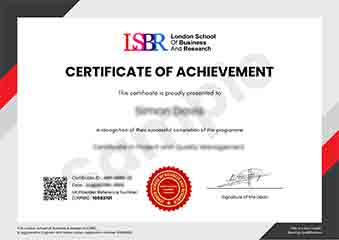
Sample Certificate
Preview the certificate you'll receive upon successful completion of this program.
Get Free Course Info
Receive detailed course information, curriculum breakdown, and career outcomes straight to your inbox.
Employer Sponsored?
Many employers cover professional development costs. Request a corporate invoice and we'll handle the rest. Bulk enrollment discounts available for teams of 3+.
Your Path to Certification
Four simple steps to your professionally recognised qualification
Enroll & Get Instant Access
Complete your enrollment and access course materials immediately
Study at Your Own Pace
Work through the modules on your schedule, from anywhere in the world
Complete Assessments
Demonstrate your knowledge through practical, real-world assessments
Receive Your Certificate
Get your official LSBR UK certificate, recognised across 180+ countries
Join Thousands Who Transformed Their Careers
Our graduates consistently report measurable career growth and professional advancement after completing their programmes.
What People Say About Us
Hear from our students about their experience with the Global Certificate in Experimental Design in Social Sciences at LSBR UK - Executive Education.
Charlotte Williams
United Kingdom"The course content is incredibly thorough and well-researched, providing a solid foundation in experimental design that has greatly enhanced my ability to conduct social science studies effectively. Gaining hands-on experience in designing experiments and analyzing data has been invaluable for my career in research."
Ryan MacLeod
Canada"This course has been instrumental in bridging the gap between theoretical knowledge and practical application in experimental design. It has significantly enhanced my ability to design and conduct robust social science research, making me more competitive in the job market and opening up new opportunities in my field."
Madison Davis
United States"The course's well-organized structure and comprehensive content provided a solid foundation for understanding experimental design, which has greatly enhanced my ability to apply these principles in real-world social science research settings, fostering my professional growth significantly."
Still deciding?
Join 23,000+ professionals who advanced their careers. Enroll today and start learning immediately.
Enroll NowSecure payment • Instant access • Certificate included