
Global Certificate in Statistical Tolerance Analysis Techniques
Elevate your skills in statistical tolerance analysis with a global certification, enhancing product design and manufacturing precision.
Global Certificate in Statistical Tolerance Analysis Techniques
Programme Overview
The Global Certificate in Statistical Tolerance Analysis Techniques is an advanced programme designed for engineers, quality assurance professionals, and data analysts seeking to enhance their ability to manage and optimize product designs and manufacturing processes. This course provides comprehensive training in statistical methods and techniques specifically tailored to tolerance analysis, enabling participants to understand and predict variations in component and system performance.
Participants will develop a deep understanding of statistical principles, including probability distributions, regression analysis, and reliability models. They will learn how to apply these principles to conduct tolerance analysis, assess risk, and optimize design for manufacturability. Key skills include using statistical software for data analysis, interpreting tolerance stack-ups, and implementing Six Sigma and lean manufacturing practices to improve process capability.
The programme significantly impacts careers by equipping professionals with the ability to reduce variability in products, minimize waste, and enhance customer satisfaction. Graduates can lead projects that improve product performance, reduce development time, and achieve higher quality standards. This certificate is particularly valuable for individuals in industries such as automotive, aerospace, and electronics, where precision and reliability are paramount.
What You'll Learn
The Global Certificate in Statistical Tolerance Analysis Techniques is a comprehensive and practical program designed for engineers, designers, and quality professionals who seek to enhance their expertise in precision manufacturing and product development. This program equips participants with the skills necessary to analyze and optimize the variability in component and system performance, ensuring that products meet or exceed quality standards.
Key topics include statistical methods for tolerance analysis, design of experiments, and the application of tolerance stacks and tree methods. Participants learn to use advanced software tools for tolerance analysis, enabling them to predict and control manufacturing tolerances effectively. The curriculum also covers real-world case studies, allowing learners to apply theoretical knowledge to solve practical problems.
Graduates of this program can immediately apply their skills in various industries, including automotive, aerospace, electronics, and medical devices. They gain the ability to reduce production costs, improve product reliability, and enhance customer satisfaction. Career opportunities include roles as tolerance analysts, quality engineers, and project managers, as well as advanced positions such as product development managers and manufacturing engineers.
By mastering statistical tolerance analysis techniques, participants are better positioned to contribute to innovation and efficiency in their respective fields, leading to more robust and reliable products and processes.
Programme Highlights
Industry-Aligned Curriculum
Developed with industry leaders for job-ready skills
Globally Recognised Certificate
Recognised by employers across 180+ countries
Flexible Online Learning
Study at your own pace with lifetime access
Instant Access
Start learning immediately, no application process
Constantly Updated Content
Latest industry trends and best practices
Career Advancement
87% report measurable career progression within 6 months
Topics Covered
- Foundational Concepts: Covers the core principles and key terminology.: Statistical Fundamentals: Provides a thorough understanding of statistical methods and their application.
- Tolerance Design: Explains the design process and strategies for creating tolerances.: Measurement Systems Analysis: Focuses on evaluating and improving measurement systems.
- ANOVA and DOE: Introduces Analysis of Variance and Design of Experiments techniques.: Case Studies: Applies learned techniques to real-world scenarios through detailed analysis.
What You Get When You Enroll
Key Facts
Audience: Engineers, statisticians, quality assurance professionals
Prerequisites: Basic statistics knowledge, calculus
Outcomes: Proficient in tolerance analysis, capable of designing robust systems
Ready to Advance Your Career?
Join thousands of professionals who have transformed their careers with LSBR UK
Why This Course
Enhanced Analytical Capabilities: Professionals who earn the Global Certificate in Statistical Tolerance Analysis Techniques gain a deep understanding of statistical methods and their application in engineering and manufacturing. This knowledge allows them to accurately predict system behavior and reliability, leading to more robust design solutions.
Competitive Edge in the Job Market: With the increasing demand for data-driven decision-making in industries such as automotive, aerospace, and electronics, having a certificate in statistical tolerance analysis makes professionals more attractive to employers. This certification demonstrates a commitment to continuous learning and expertise in a crucial area of quality and reliability engineering.
Improved Cost Efficiency and Reducing Waste: By applying statistical tools in tolerance analysis, professionals can optimize product design and manufacturing processes, leading to reduced material waste and lower production costs. This skill set is particularly valuable in industries where cost and efficiency are critical concerns.
Better Compliance with Industry Standards: The certificate equips professionals with the knowledge to adhere to industry standards such as ASME Y14.and ISO , which require the use of statistical methods in manufacturing processes. This ensures that their work meets industry best practices, enhancing their ability to work in diverse, globally recognized standards-based environments.
3-4 Weeks
Study at your own pace
Course Brochure
Download our comprehensive course brochure with all details
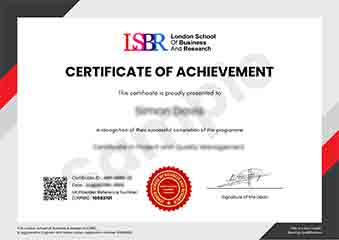
Sample Certificate
Preview the certificate you'll receive upon successful completion of this program.
Get Free Course Info
Receive detailed course information, curriculum breakdown, and career outcomes straight to your inbox.
Employer Sponsored?
Many employers cover professional development costs. Request a corporate invoice and we'll handle the rest. Bulk enrollment discounts available for teams of 3+.
Your Path to Certification
Four simple steps to your professionally recognised qualification
Enroll & Get Instant Access
Complete your enrollment and access course materials immediately
Study at Your Own Pace
Work through the modules on your schedule, from anywhere in the world
Complete Assessments
Demonstrate your knowledge through practical, real-world assessments
Receive Your Certificate
Get your official LSBR UK certificate, recognised across 180+ countries
Join Thousands Who Transformed Their Careers
Our graduates consistently report measurable career growth and professional advancement after completing their programmes.
What People Say About Us
Hear from our students about their experience with the Global Certificate in Statistical Tolerance Analysis Techniques at LSBR UK - Executive Education.
Charlotte Williams
United Kingdom"The course content is comprehensive and well-structured, providing a solid foundation in statistical tolerance analysis techniques that are directly applicable in real-world engineering problems. Gaining these skills has significantly enhanced my ability to solve complex design challenges and has opened up new career opportunities in product development."
Greta Fischer
Germany"The Global Certificate in Statistical Tolerance Analysis Techniques has significantly enhanced my ability to address variability in product design, making me more competitive in the job market. This course has provided me with practical tools that I can directly apply to improve product quality and reduce costs in my current role."
Isabella Dubois
Canada"The course structure is well-organized, providing a clear path from foundational concepts to advanced techniques in statistical tolerance analysis, which greatly enhances my understanding and application of these methods in real-world engineering problems. It has significantly contributed to my professional growth by equipping me with the tools necessary to improve product design and manufacturing processes."
Still deciding?
Join 23,000+ professionals who advanced their careers. Enroll today and start learning immediately.
Enroll NowSecure payment • Instant access • Certificate included