
Postgraduate Certificate in Atmospheric Circulation Modeling
Master advanced atmospheric modeling techniques to drive impactful climate research and secure high-demanding careers in meteorology and environmental science.
Postgraduate Certificate in Atmospheric Circulation Modeling
About This Course
The Postgraduate Certificate in Atmospheric Circulation Modeling equips meteorologists, climate scientists, and environmental data analysts with advanced computational techniques for simulating global weather systems. This intensive programme targets professionals seeking to deepen their expertise in numerical weather prediction and long-term climate projection. You will engage directly with state-of-the-art General Circulation Models (GCMs) and Regional Climate Models (RCMs) to analyze complex atmospheric dynamics. The curriculum bridges theoretical fluid dynamics with practical high-performance computing applications, ensuring you can tackle real-world meteorological challenges. Participants gain immediate access to industry-standard software platforms and exclusive datasets from leading meteorological agencies.
You will master the configuration and execution of complex simulation codes while interpreting vast outputs with precision. The course emphasizes rigorous validation methods to ensure model accuracy against observed historical climate data. Learners develop proficiency in Python and Fortran for customizing model parameters and automating data processing workflows. You will also explore critical topics such as parameterization of sub-grid scale processes and cloud microphysics interactions. These technical competencies allow you to diagnose model biases and implement effective correction strategies for improved predictive reliability.
Graduates emerge as highly sought-after specialists capable of driving innovation in weather forecasting and climate risk assessment sectors. Employers value your ability to translate complex simulation results into actionable insights for agricultural planning and disaster management strategies. This qualification positions you for senior roles in national meteorological services, renewable energy firms, and international research institutions. You will lead projects that require sophisticated understanding of atmospheric variability and its
What You Will Learn
Unlock the secrets of our planet’s dynamic weather systems with the Postgraduate Certificate in Atmospheric Circulation Modeling. This intensive programme is designed for ambitious professionals ready to bridge the gap between theoretical meteorology and practical computational science. You will gain a competitive edge by mastering the complex algorithms that drive modern climate predictions and severe weather forecasting.
The curriculum dives deep into numerical weather prediction, fluid dynamics, and thermodynamics. You will learn to construct, validate, and refine high-resolution atmospheric models using industry-standard software like WRF and CESM. Hands-on labs guide you through data assimilation techniques, ensuring you can effectively integrate satellite observations with model outputs. We emphasize critical thinking by challenging you to diagnose model biases and improve simulation accuracy for diverse climatic zones.
Graduates emerge with the technical prowess to tackle real-world environmental challenges. You will apply these skills to predict extreme weather events, assess climate change impacts on agriculture, or optimize renewable energy resources like wind and solar power. Employers value your ability to translate complex data into actionable insights for policy makers and industry leaders.
Career opportunities span a wide array of sectors. You might join national meteorological services to enhance public safety warnings, work with environmental consultancies to conduct impact assessments, or contribute to research institutions focusing on global climate resilience. The private sector also seeks your expertise in aviation, insurance risk modeling, and urban planning. This certificate is more than a qualification; it is a launchpad for a meaningful career dedicated to understanding and protecting our atmosphere. Join
Course Benefits
Industry-Aligned Curriculum
Developed with industry leaders for job-ready skills
Globally Recognised Certificate
Recognised by employers across 180+ countries
Flexible Online Learning
Study at your own pace with lifetime access
Instant Access
Start learning immediately, no application process
Constantly Updated Content
Latest industry trends and best practices
Career Advancement
87% report measurable career progression within 6 months
What This Course Covers
- Numerical Methods for Fluid Dynamics: Introduces discretization techniques and stability analysis for solving atmospheric equations.: Dynamics of the Global Circulation: Examines the physical mechanisms driving large-scale wind patterns and planetary waves.
- Data Assimilation Techniques: Covers methods for integrating observational data into numerical models to improve initial conditions.: Cloud Microphysics and Parameterization: Explores sub-grid scale processes and their representation in general circulation models.
- Climate Variability and Change: Analyzes long-term trends, feedback loops, and forcing mechanisms in atmospheric systems.: High-Performance Computing for Modeling: Focuses on parallel computing strategies and optimization for running complex atmospheric simulations.
Everything You Get With This Course
Course Facts
Audience: Ambitious professionals seeking advanced climate modeling skills.
Prerequisites: Bachelor’s degree in physics, meteorology, or related field.
Outcomes: Master atmospheric dynamics and secure global research roles.
This certificate empowers you to drive meaningful climate solutions. You gain practical expertise in circulation patterns, positioning yourself for impactful careers in environmental science. We support your journey toward becoming a leading expert in atmospheric research.
Ready to Advance Your Career?
Join thousands of professionals who have transformed their careers with LSBR UK
Why This Course Is Right for You
You stand at a pivotal moment in your career, ready to deepen your expertise in climate science impact. The Postgraduate Certificate in Atmospheric Circulation Modeling offers a precise, high-value pathway to achieve this.
You gain mastery of cutting-edge numerical models like WRF and CESM. This technical proficiency allows you to simulate complex weather patterns with unprecedented accuracy. Employers in meteorology and environmental consulting desperately seek candidates who can translate raw data into actionable insights. Your ability to run these simulations directly enhances your employability and sets you apart from peers with only theoretical knowledge.
You develop robust computational skills in Python and Fortran for data processing. These tools are essential for handling massive atmospheric datasets efficiently. By mastering these programming languages, you become indispensable to research teams and government agencies. Your capacity to automate data workflows significantly reduces project timelines, making you a highly valued asset in fast-paced research environments.
You strengthen your analytical reasoning through rigorous case studies. You will tackle real-world problems such as predicting extreme weather events or assessing climate change impacts. This hands-on experience builds confidence in your decision-making abilities. You learn to communicate complex scientific findings to non-expert stakeholders, a critical skill for leadership roles in policy advisory or private sector consulting.
You join a global network of climate professionals. This community provides mentorship opportunities and collaborative research prospects. Connecting with experts expands your professional horizons and opens doors to international projects. Your career trajectory accelerates as you leverage these relationships for
3-4 Weeks
Study at your own pace
Course Brochure
Download our comprehensive course brochure with all details
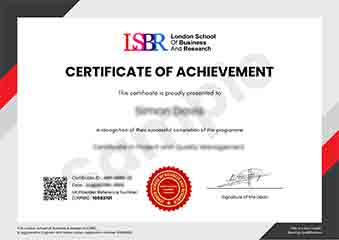
Sample Certificate
Preview the certificate you'll receive upon successful completion of this program.
Get Free Course Info
Receive detailed course information, curriculum breakdown, and career outcomes straight to your inbox.
Employer Sponsored?
Many employers cover professional development costs. Request a corporate invoice and we'll handle the rest. Bulk enrollment discounts available for teams of 3+.
How You Earn Your Certificate
Four simple steps to your professionally recognised qualification
Enroll & Get Instant Access
Complete your enrollment and access course materials immediately
Study at Your Own Pace
Work through the modules on your schedule, from anywhere in the world
Complete Assessments
Demonstrate your knowledge through practical, real-world assessments
Receive Your Certificate
Get your official LSBR UK certificate, recognised across 180+ countries
Real Results from Real Learners
Our graduates consistently report measurable career growth and professional advancement after completing their programmes.
Reviews from Our Learners
Hear from our students about their experience with the Postgraduate Certificate in Atmospheric Circulation Modeling at LSBR UK - Executive Education.
Oliver Davies
United Kingdom"The rigorous focus on numerical methods and fluid dynamics provided a robust theoretical foundation that immediately translated into hands-on proficiency with advanced simulation software. Mastering these complex modeling techniques has significantly enhanced my ability to analyze large-scale weather patterns, making me a much stronger candidate for specialized roles in meteorological research."
Oliver Davies
United Kingdom"Mastering the numerical methods for simulating large-scale atmospheric dynamics gave me the technical confidence to transition from general meteorology to specialized climate modeling roles. The rigorous focus on interpreting complex circulation patterns directly enhanced my ability to contribute to high-impact research projects in renewable energy site assessment."
Zoe Williams
Australia"The logical progression from fundamental fluid dynamics to complex numerical schemes provided a robust framework for understanding atmospheric systems. This structured approach significantly enhanced my ability to interpret large-scale circulation patterns and apply these models to real-world climate scenarios."
Need more time to decide?
Join 23,000+ professionals who advanced their careers. Enroll today and start learning immediately.
Enroll NowSecure payment • Instant access • Certificate included