
Postgraduate Certificate in Atmospheric Pollutant Source Identification
This program equips students with advanced skills in identifying and analyzing atmospheric pollutant sources for environmental protection and policy-making.
Postgraduate Certificate in Atmospheric Pollutant Source Identification
About This Course
The Postgraduate Certificate in Atmospheric Pollutant Source Identification is a specialized programme designed for environmental scientists, engineers, and policymakers who seek to enhance their expertise in the detection and analysis of atmospheric pollutants. This programme delves into the methodologies and technologies employed to identify and quantify sources of air pollution, including industrial emissions, vehicular exhaust, and natural sources. It also covers the impact of these pollutants on air quality and public health, providing a comprehensive understanding of the environmental challenges facing modern urban and industrial landscapes.
Learners will develop a robust set of skills in data analysis, environmental monitoring, and the use of advanced scientific instruments for pollutant detection. The programme emphasizes the application of Geographic Information Systems (GIS) and statistical tools to analyze pollution data, as well as the interpretation of satellite imagery for atmospheric monitoring. Students will also gain proficiency in regulatory frameworks and policy development related to air quality management, enabling them to contribute effectively to environmental governance.
The programme has a significant impact on learners' career trajectories by equipping them with the knowledge and skills necessary for roles in environmental consulting, government agencies, and research institutions. Graduates are well-prepared to lead initiatives in air quality management, conduct independent research, and develop effective strategies for reducing atmospheric pollution. The programme's focus on practical applications and real-world problem-solving ensures that learners are highly sought after in the environmental sector, contributing to sustainable development and public health improvements.
What You Will Learn
Embark on a transformative journey with our 'Postgraduate Certificate in Atmospheric Pollutant Source Identification.' This program equips you with the cutting-edge skills needed to address one of the most pressing environmental challenges of our time. Through a rigorous curriculum, you will delve into the complexities of air quality analysis, emission source characterization, and environmental monitoring techniques. Utilizing state-of-the-art technologies and methodologies, you will learn to identify and quantify sources of atmospheric pollutants with precision, ensuring that your work contributes to more effective policy-making and environmental protection.
Upon completion, you will be adept at applying your knowledge in a variety of sectors. Whether you aim to work with government agencies, research institutions, or private companies, your skills will be highly valued. You can contribute to the development of air quality management plans, assist in the implementation of pollution control measures, or engage in academic and industrial research. Graduates often find positions as environmental consultants, air quality engineers, or research scientists, with opportunities to make a significant impact on global environmental health. This program not only enhances your technical expertise but also fosters a deeper understanding of the environmental and societal implications of air pollution, preparing you to lead in this critical field.
Course Benefits
Industry-Aligned Curriculum
Developed with industry leaders for job-ready skills
Globally Recognised Certificate
Recognised by employers across 180+ countries
Flexible Online Learning
Study at your own pace with lifetime access
Instant Access
Start learning immediately, no application process
Constantly Updated Content
Latest industry trends and best practices
Career Advancement
87% report measurable career progression within 6 months
What This Course Covers
- Foundational Concepts: Covers the core principles and key terminology.: Atmospheric Chemistry: Examines the chemical processes affecting pollutants.
- Emission Inventories: Teaches how to develop and use emission data.: Monitoring Techniques: Discusses various methods for pollutant measurement.
- Data Analysis: Focuses on statistical methods for pollutant source identification.: Case Studies: Analyzes real-world examples of source identification.
Everything You Get With This Course
Course Facts
Audience: Environmental scientists, engineers
Prerequisites: Bachelor’s degree in environmental science
Outcomes: Identifies atmospheric pollutants, applies monitoring techniques, develops mitigation strategies
Ready to Advance Your Career?
Join thousands of professionals who have transformed their careers with LSBR UK
Why This Course Is Right for You
Enhanced Expertise: A Postgraduate Certificate in Atmospheric Pollutant Source Identification provides professionals with a deep understanding of the sources and effects of atmospheric pollutants. This knowledge is crucial for developing effective strategies to mitigate environmental pollution and improve public health. For instance, graduates can better assess the impact of industrial emissions on air quality.
Advanced Analytical Skills: The program equips professionals with advanced analytical tools and techniques for identifying sources of atmospheric pollutants. These skills are invaluable in environmental monitoring and compliance, allowing professionals to accurately measure pollutant levels and determine sources. This capability can significantly enhance the effectiveness of environmental regulatory efforts.
Career Advancement: Gaining such specialized knowledge can lead to career progression in various sectors, including environmental consulting, government agencies, and research institutions. For example, professionals who specialize in atmospheric pollutant identification can transition into roles such as environmental impact assessors or air quality managers, where their expertise is highly valued.
3-4 Weeks
Study at your own pace
Course Brochure
Download our comprehensive course brochure with all details
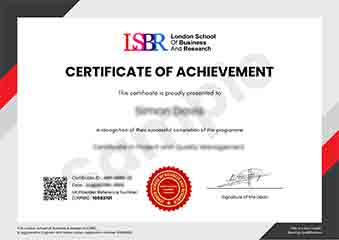
Sample Certificate
Preview the certificate you'll receive upon successful completion of this program.
Get Free Course Info
Receive detailed course information, curriculum breakdown, and career outcomes straight to your inbox.
Employer Sponsored?
Many employers cover professional development costs. Request a corporate invoice and we'll handle the rest. Bulk enrollment discounts available for teams of 3+.
How You Earn Your Certificate
Four simple steps to your professionally recognised qualification
Enroll & Get Instant Access
Complete your enrollment and access course materials immediately
Study at Your Own Pace
Work through the modules on your schedule, from anywhere in the world
Complete Assessments
Demonstrate your knowledge through practical, real-world assessments
Receive Your Certificate
Get your official LSBR UK certificate, recognised across 180+ countries
Real Results from Real Learners
Our graduates consistently report measurable career growth and professional advancement after completing their programmes.
Reviews from Our Learners
Hear from our students about their experience with the Postgraduate Certificate in Atmospheric Pollutant Source Identification at LSBR UK - Executive Education.
Charlotte Williams
United Kingdom"The course content is comprehensive and well-researched, providing a solid foundation in atmospheric pollutant source identification. Gaining hands-on experience through practical exercises has significantly enhanced my ability to analyze and mitigate air pollution issues, which is incredibly beneficial for my career in environmental science."
Klaus Mueller
Germany"This postgraduate certificate has significantly enhanced my ability to identify and analyze atmospheric pollutants, making my skills highly relevant in the environmental consultancy sector. It has opened up new career opportunities and allowed me to contribute more effectively to projects aimed at improving air quality."
Rahul Singh
India"The course structure is meticulously organized, providing a clear pathway to understanding complex atmospheric pollutant sources, which has significantly enhanced my ability to analyze real-world environmental issues. The comprehensive content not only deepens my theoretical knowledge but also equips me with practical tools for professional growth in environmental science."
Need more time to decide?
Join 23,000+ professionals who advanced their careers. Enroll today and start learning immediately.
Enroll NowSecure payment • Instant access • Certificate included