
Postgraduate Certificate in Category Theory for Data Science Applications
Gain advanced skills in category theory and its applications in data science, earning a Postgraduate Certificate with enhanced analytical and problem-solving capabilities.
Postgraduate Certificate in Category Theory for Data Science Applications
About This Course
The Postgraduate Certificate in Category Theory for Data Science Applications is designed for graduates and professionals with a background in mathematics, computer science, or data science who wish to deepen their understanding of advanced mathematical concepts and apply them to real-world data science problems. This program is ideal for those interested in leveraging the structural and categorical approaches to enhance their data analysis, machine learning, and algorithmic design capabilities.
Learners will develop a robust understanding of category theory, including categories, functors, natural transformations, and universal properties, along with their applications in data science. They will learn how to model data using category-theoretic frameworks, analyze data structures, and design algorithms that are both mathematically rigorous and practically applicable. Key skills include the ability to apply categorical thinking to data science, implement categorical models for data analysis, and interpret categorical results in the context of machine learning and data visualization.
This program significantly impacts career trajectories in data science, research, and academia. Graduates will be well-equipped to tackle complex data problems using advanced mathematical tools, enhancing their ability to innovate in areas such as machine learning, data mining, and algorithmic design. The program also prepares students for roles that require a deep understanding of both mathematical theory and its application in data science, making them highly sought after in industries ranging from tech and finance to healthcare and cybersecurity.
What You Will Learn
The Postgraduate Certificate in Category Theory for Data Science Applications is designed to equip students with advanced mathematical tools and a deep understanding of category theory, a branch of mathematics that offers a unifying framework for data science. This program bridges the gap between abstract mathematical concepts and practical data science applications, making it invaluable for professionals seeking to enhance their analytical capabilities and innovation in the field.
Key topics include categorical foundations, functors, natural transformations, and adjunctions, all of which are explored through their applications in data science. Students will learn to apply these theories to model complex data relationships, optimize algorithms, and develop new methodologies for data analysis. The curriculum emphasizes hands-on learning, with projects that involve real-world data sets, enabling students to apply their knowledge to solve challenging problems in machine learning, data visualization, and more.
Graduates of this program are well-prepared to tackle a wide range of roles in academia, industry, and research. They can leverage their expertise in category theory to innovate in data science, contributing to advancements in artificial intelligence, machine learning, and big data analytics. Potential career paths include data scientist, research analyst, machine learning engineer, and data science consultant, where they can apply their unique skill set to drive impactful solutions in various sectors such as finance, healthcare, technology, and beyond.
Course Benefits
Industry-Aligned Curriculum
Developed with industry leaders for job-ready skills
Globally Recognised Certificate
Recognised by employers across 180+ countries
Flexible Online Learning
Study at your own pace with lifetime access
Instant Access
Start learning immediately, no application process
Constantly Updated Content
Latest industry trends and best practices
Career Advancement
87% report measurable career progression within 6 months
What This Course Covers
- Category Theory Fundamentals: Covers the core principles and key terminology.: Functorial Thinking: Explores the use of functors in data transformations.
- Natural Transformations and Their Applications: Discusses natural transformations and their practical implications.: Universal Properties and Data Structures: Analyzes how universal properties can be applied to data structures.
- Adjunctions and Their Role in Data Science: Investigates adjunctions and their significance in data science.: Limits and Colimits in Data Analysis: Examines the role of limits and colimits in analyzing complex data sets.
Everything You Get With This Course
Course Facts
For data scientists, researchers
Basic knowledge in mathematics
Understand category theory fundamentals
Apply category theory to data science
Enhance problem-solving skills
Develop advanced data modeling techniques
Ready to Advance Your Career?
Join thousands of professionals who have transformed their careers with LSBR UK
Why This Course Is Right for You
Enhance Problem-Solving Skills: Category theory offers a unique framework for understanding data relationships and transformations, which can significantly enhance a data scientist's ability to solve complex problems. By learning to think in terms of objects and morphisms, professionals can develop more robust and scalable data models.
Improve Model Interpretability: Understanding category theory can lead to the creation of more interpretable models. This is because category theory emphasizes composability and structure, which can help in breaking down complex systems into simpler, more understandable components.
Expand Capabilities in Advanced Analytics: Category theory provides a foundation for understanding advanced concepts in machine learning and data science, such as monads and functors. These concepts can be applied to develop sophisticated algorithms, enabling data scientists to tackle cutting-edge problems and stay ahead in the rapidly evolving field.
Foster Interdisciplinary Collaboration: Knowledge of category theory can bridge the gap between data science and other disciplines, such as computer science, mathematics, and artificial intelligence. This interdisciplinary perspective can facilitate more effective collaboration and innovation, leading to breakthroughs in data-driven solutions.
3-4 Weeks
Study at your own pace
Course Brochure
Download our comprehensive course brochure with all details
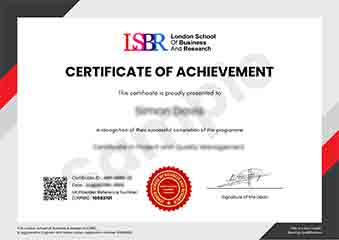
Sample Certificate
Preview the certificate you'll receive upon successful completion of this program.
Get Free Course Info
Receive detailed course information, curriculum breakdown, and career outcomes straight to your inbox.
Employer Sponsored?
Many employers cover professional development costs. Request a corporate invoice and we'll handle the rest. Bulk enrollment discounts available for teams of 3+.
How You Earn Your Certificate
Four simple steps to your professionally recognised qualification
Enroll & Get Instant Access
Complete your enrollment and access course materials immediately
Study at Your Own Pace
Work through the modules on your schedule, from anywhere in the world
Complete Assessments
Demonstrate your knowledge through practical, real-world assessments
Receive Your Certificate
Get your official LSBR UK certificate, recognised across 180+ countries
Real Results from Real Learners
Our graduates consistently report measurable career growth and professional advancement after completing their programmes.
Reviews from Our Learners
Hear from our students about their experience with the Postgraduate Certificate in Category Theory for Data Science Applications at LSBR UK - Executive Education.
Sophie Brown
United Kingdom"The course provided a deep dive into the practical applications of category theory in data science, equipping me with powerful tools to analyze and model complex systems more effectively. I now have a solid foundation that I believe will significantly enhance my career in data science."
Priya Sharma
India"This postgraduate certificate has been incredibly valuable, equipping me with advanced category theory skills that are directly applicable to data science problems. It has opened up new career opportunities in areas that require a deep understanding of abstract mathematical structures."
Kai Wen Ng
Singapore"The course structure is well-organized, providing a clear path from foundational concepts to advanced applications in data science, which has significantly enhanced my understanding and practical skills in using category theory."
Need more time to decide?
Join 23,000+ professionals who advanced their careers. Enroll today and start learning immediately.
Enroll NowSecure payment • Instant access • Certificate included