
Postgraduate Certificate in Machine Learning in Molecular Sciences
Master machine learning for molecular sciences, gaining advanced skills to accelerate drug discovery and enhance research outcomes.
Postgraduate Certificate in Machine Learning in Molecular Sciences
About This Course
The Postgraduate Certificate in Machine Learning in Molecular Sciences equips bioinformaticians, chemists, and data scientists with advanced computational techniques to accelerate drug discovery and materials research. This intensive programme targets professionals seeking to bridge the gap between traditional molecular biology and modern artificial intelligence applications. You will explore deep learning architectures tailored for protein structure prediction, molecular docking simulations, and high-throughput screening analysis. The curriculum integrates rigorous statistical modeling with practical Python programming exercises designed for complex biological datasets. Participants engage with real-world case studies from leading pharmaceutical companies and academic research institutes. This focused training ensures you gain immediate, applicable expertise in interpreting large-scale omics data through neural networks.
Learners master the implementation of graph neural networks for molecular representation and reinforcement learning for de novo molecule design. You will develop proficiency in handling sparse, noisy biological data while ensuring model interpretability and regulatory compliance. The course emphasizes ethical AI practices and reproducibility standards essential for scientific validation. Students build robust pipelines for automated feature extraction and predictive modeling of chemical properties. You will also learn to optimize computational resources for high-performance computing environments common in industrial R&D labs. These technical competencies enable precise manipulation of molecular dynamics simulations and quantum mechanical calculations. Graduates emerge with a specialized toolkit that transforms raw experimental data into actionable scientific insights.
This certification significantly enhances your employability in the rapidly expanding fields of computational chemistry and precision medicine. Employers value candidates who can independently deploy machine learning models to reduce trial-and-error phases in experimental workflows. You
What You Will Learn
Imagine unlocking the hidden patterns within complex molecular structures to accelerate drug discovery and material science. The Postgraduate Certificate in Machine Learning in Molecular Sciences is designed for ambitious professionals ready to bridge the gap between computational power and biological insight. This programme offers a transformative opportunity to master the algorithms driving the next generation of scientific breakthroughs, positioning you at the forefront of a rapidly evolving field.
You will dive deep into essential topics such as deep learning for protein structure prediction, graph neural networks for molecular representation, and generative models for de novo drug design. Our curriculum emphasizes practical application, ensuring you gain hands-on experience with industry-standard tools and datasets. You will learn to interpret large-scale omics data, optimize chemical synthesis pathways, and predict molecular properties with unprecedented accuracy. These skills are not just theoretical; they are the keys to solving real-world challenges in healthcare, agriculture, and sustainable energy.
Graduates emerge equipped to tackle complex problems in research laboratories, pharmaceutical companies, and biotech startups. You will be prepared to lead projects that reduce development timelines and costs, making your expertise highly sought after. Career paths include roles as a Bioinformatics Scientist, Computational Chemist, or Data Analyst in life sciences. Whether you aim to innovate in academia or drive product development in industry, this certificate provides the technical foundation and strategic vision you need.
We invite you to join a community of innovators dedicated to shaping the future of science. By combining rigorous machine learning training with domain-specific knowledge in molecular sciences, you will
Course Benefits
Industry-Aligned Curriculum
Developed with industry leaders for job-ready skills
Globally Recognised Certificate
Recognised by employers across 180+ countries
Flexible Online Learning
Study at your own pace with lifetime access
Instant Access
Start learning immediately, no application process
Constantly Updated Content
Latest industry trends and best practices
Career Advancement
87% report measurable career progression within 6 months
What This Course Covers
- Molecular Data Representation: Explores graph-based and sequence-based methods for encoding chemical structures and biological molecules.: Statistical Learning for Bioinformatics: Covers regression, classification, and clustering algorithms applied to genomic and proteomic datasets.
- Deep Learning in Structural Biology: Examines neural network architectures for predicting protein folding, binding affinities, and molecular dynamics.: Generative Models for Drug Discovery: Introduces variational autoencoders and generative adversarial networks for de novo molecular design and optimization.
- Natural Language Processing for Scientific Text: Applies transformer models and embedding techniques to mine knowledge from biomedical literature and patents.: Ethical AI and Reproducibility in Science: Discusses bias mitigation, interpretability, and best practices for transparent and reproducible machine learning workflows.
Everything You Get With This Course
Course Facts
Audience: Professionals seeking to apply machine learning in molecular research and drug discovery.
Prerequisites: Bachelor’s degree in science, engineering, or related quantitative field with programming skills.
Outcomes: Master predictive modeling techniques to accelerate molecular innovations and boost your career trajectory.
This program empowers you to bridge data science and chemistry, opening doors to impactful roles in biotech and pharmaceutical industries.
Ready to Advance Your Career?
Join thousands of professionals who have transformed their careers with LSBR UK
Why This Course Is Right for You
Embarking on a Postgraduate Certificate in Machine Learning in Molecular Sciences opens exciting doors for your professional journey. This specialized program bridges the gap between data science and life sciences, equipping you with cutting-edge tools to solve complex biological challenges. You will gain a competitive edge in a rapidly evolving job market by mastering techniques that drive innovation in pharmaceuticals, biotechnology, and healthcare.
You will acquire advanced technical skills in applying deep learning algorithms to predict molecular properties and drug interactions. This hands-on experience allows you to accelerate drug discovery processes, making you an invaluable asset to research and development teams seeking to reduce time-to-market for new therapies.
The curriculum emphasizes practical application, enabling you to interpret large-scale genomic and proteomic datasets with precision. By learning to extract meaningful insights from noisy biological data, you position yourself as a critical decision-maker who can translate complex information into actionable strategies for clinical trials and personalized medicine initiatives.
You will build a robust professional network through collaborative projects with industry experts and academic leaders. These connections often lead to mentorship opportunities and direct pathways to roles in computational biology or bioinformatics, where demand for interdisciplinary talent continues to surge.
Completing this certificate demonstrates your commitment to lifelong learning and adaptability. Employers value professionals who can seamlessly integrate emerging technologies into traditional scientific workflows, ensuring your career remains resilient and forward-looking in the age of AI-driven science.
3-4 Weeks
Study at your own pace
Course Brochure
Download our comprehensive course brochure with all details
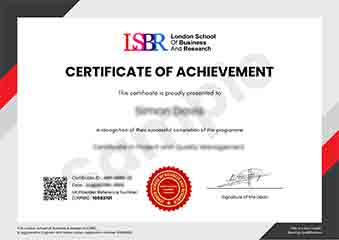
Sample Certificate
Preview the certificate you'll receive upon successful completion of this program.
Get Free Course Info
Receive detailed course information, curriculum breakdown, and career outcomes straight to your inbox.
Employer Sponsored?
Many employers cover professional development costs. Request a corporate invoice and we'll handle the rest. Bulk enrollment discounts available for teams of 3+.
How You Earn Your Certificate
Four simple steps to your professionally recognised qualification
Enroll & Get Instant Access
Complete your enrollment and access course materials immediately
Study at Your Own Pace
Work through the modules on your schedule, from anywhere in the world
Complete Assessments
Demonstrate your knowledge through practical, real-world assessments
Receive Your Certificate
Get your official LSBR UK certificate, recognised across 180+ countries
Real Results from Real Learners
Our graduates consistently report measurable career growth and professional advancement after completing their programmes.
Reviews from Our Learners
Hear from our students about their experience with the Postgraduate Certificate in Machine Learning in Molecular Sciences at LSBR UK - Executive Education.
James Thompson
United Kingdom"The curriculum brilliantly bridges the gap between complex molecular biology and advanced machine learning, providing a robust theoretical foundation that feels immediately applicable. I gained hands-on experience with real-world datasets, which significantly boosted my confidence in developing predictive models for drug discovery and personalized medicine."
Wei Ming Tan
Singapore"The rigorous focus on applying machine learning algorithms to complex molecular datasets bridged the gap between theoretical knowledge and real-world pharmaceutical challenges. This specialized training directly accelerated my transition into a senior data science role, where I now lead predictive modeling initiatives for drug discovery."
Muhammad Hassan
Malaysia"The logical progression of modules seamlessly bridges theoretical machine learning concepts with complex molecular data, creating a highly coherent learning experience. This structured approach has significantly expanded my technical toolkit, enabling me to apply advanced algorithms directly to real-world drug discovery challenges."
Need more time to decide?
Join 23,000+ professionals who advanced their careers. Enroll today and start learning immediately.
Enroll NowSecure payment • Instant access • Certificate included