
Postgraduate Certificate in Wave-Current Interaction Analysis Methods
Master advanced wave-current interaction techniques to enhance coastal engineering solutions and drive impactful, data-driven environmental research outcomes.
Postgraduate Certificate in Wave-Current Interaction Analysis Methods
About This Course
This rigorous postgraduate certificate equips coastal engineers and oceanographers with advanced methodologies to model complex wave-current interactions in dynamic marine environments. Designed for professionals seeking to deepen their technical expertise, the curriculum integrates theoretical fluid dynamics with practical computational fluid dynamics applications. You will engage with industry-standard software tools to simulate real-world scenarios, ensuring your analytical capabilities align with current engineering demands.
Learners will master the numerical techniques required to resolve nonlinear coupling between surface waves and underlying currents in shallow and deep water regimes. The programme emphasizes the development of robust simulation models that accurately predict sediment transport patterns and structural loading on offshore infrastructure. You will gain proficiency in interpreting high-resolution hydrodynamic data and validating model outputs against field measurements to ensure scientific accuracy. This hands-on approach ensures you can troubleshoot complex hydraulic problems with confidence and precision.
Graduates emerge as highly competitive candidates for roles in coastal protection, offshore renewable energy, and maritime logistics sectors. Employers value your ability to mitigate risks associated with extreme weather events through precise interaction analysis. This qualification directly enhances your capacity to design resilient infrastructure that withstands severe hydrodynamic forces. You will position yourself as a subject matter expert capable of leading critical projects that safeguard communities and optimize marine resource utilization.
What You Will Learn
Bridge the gap between theoretical fluid dynamics and real-world coastal engineering with our Postgraduate Certificate in Wave-Current Interaction Analysis Methods. This intensive programme equips you with the advanced computational tools and physical insights necessary to tackle the complex challenges of modern marine environments. You will move beyond basic hydrodynamics to master the intricate behaviors where waves and currents converge, a critical factor in designing resilient offshore structures and sustainable coastal defenses.
Your curriculum dives deep into numerical modeling techniques, including the application of Computational Fluid Dynamics (CFD) and spectral wave models. You will explore topics such as wave-current coupling mechanisms, sediment transport under combined flow conditions, and the impact of climate change on extreme hydrodynamic events. Through hands-on projects using industry-standard software, you will learn to simulate realistic scenarios, validate model outputs against field data, and interpret results with precision. These practical exercises ensure you graduate with confidence in handling large-scale datasets and complex simulation environments.
Professionals who complete this certificate find themselves highly sought after by engineering firms, government agencies, and research institutions. You will apply your skills to design safer offshore wind farms, optimize port infrastructure, and mitigate coastal erosion risks. Graduates often step into roles as Coastal Engineers, Hydrodynamic Modelers, or Environmental Consultants. Whether you aim to lead projects in renewable energy development or advise on climate adaptation strategies, this programme provides the technical depth and analytical rigor required to excel. Join a community of innovators dedicated to protecting our coastlines while harnessing the power of the
Course Benefits
Industry-Aligned Curriculum
Developed with industry leaders for job-ready skills
Globally Recognised Certificate
Recognised by employers across 180+ countries
Flexible Online Learning
Study at your own pace with lifetime access
Instant Access
Start learning immediately, no application process
Constantly Updated Content
Latest industry trends and best practices
Career Advancement
87% report measurable career progression within 6 months
What This Course Covers
- Linear Wave Theory and Current Dynamics: Introduces fundamental equations governing wave propagation and steady current interactions.: Wave-Current Refraction and Shallow Water Effects: Examines how currents alter wave direction and energy distribution in coastal zones.
- Numerical Modeling Techniques for Coupled Systems: Covers computational methods and software tools for simulating complex wave-current scenarios.: Spectral Analysis and Energy Transfer Mechanisms: Analyzes frequency-domain approaches to understanding energy exchange between waves and currents.
- Laboratory and Field Measurement Methodologies: Details experimental setups and sensor technologies for capturing real-world interaction data.: Coastal Engineering Applications and Case Studies: Applies analytical methods to practical problems such as harbor design and sediment transport.
Everything You Get With This Course
Course Facts
Audience: Ambitious engineers ready to master complex ocean dynamics.
Prerequisites: Solid foundation in fluid mechanics and calculus.
Outcomes: Gain expertise in advanced wave-current modeling techniques.
You will develop the practical skills needed to tackle real-world coastal challenges. This certificate empowers you to lead innovative projects with confidence. Take the next step in your career today.
Ready to Advance Your Career?
Join thousands of professionals who have transformed their careers with LSBR UK
Why This Course Is Right for You
You stand at a pivotal moment in your career where specialized knowledge can truly set you apart. The Postgraduate Certificate in Wave-Current Interaction Analysis Methods offers exactly the edge you need to thrive in today’s competitive marine and coastal engineering sectors.
You will master advanced computational fluid dynamics techniques that are rarely taught in standard undergraduate programs. This hands-on experience allows you to model complex coastal phenomena with precision, making you an invaluable asset for firms designing offshore wind farms or coastal defense structures.
Your ability to predict sediment transport and structural loads will improve dramatically. Employers value professionals who can minimize project risks and costs through accurate forecasting. This skill directly translates into higher-level project management roles and significant salary advancements within the industry.
You gain access to a robust network of industry leaders and researchers. The program connects you with mentors who actively shape policy and design standards. These relationships often lead to exclusive job opportunities and collaborative research projects that accelerate your professional trajectory.
The curriculum emphasizes practical application over pure theory. You will work on real-world case studies that mirror current industry challenges. This approach ensures you can hit the ground running on day one, solving immediate problems for your clients or organization with confidence and expertise.
Investing in this certificate is investing in your future. You are not just learning concepts; you are building a toolkit for lasting success. Embrace this opportunity to transform your potential into tangible, high-impact career growth.
3-4 Weeks
Study at your own pace
Course Brochure
Download our comprehensive course brochure with all details
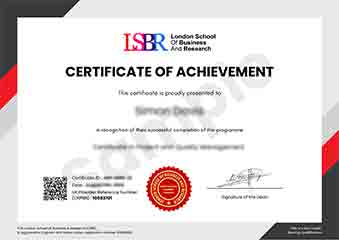
Sample Certificate
Preview the certificate you'll receive upon successful completion of this program.
Get Free Course Info
Receive detailed course information, curriculum breakdown, and career outcomes straight to your inbox.
Employer Sponsored?
Many employers cover professional development costs. Request a corporate invoice and we'll handle the rest. Bulk enrollment discounts available for teams of 3+.
How You Earn Your Certificate
Four simple steps to your professionally recognised qualification
Enroll & Get Instant Access
Complete your enrollment and access course materials immediately
Study at Your Own Pace
Work through the modules on your schedule, from anywhere in the world
Complete Assessments
Demonstrate your knowledge through practical, real-world assessments
Receive Your Certificate
Get your official LSBR UK certificate, recognised across 180+ countries
Real Results from Real Learners
Our graduates consistently report measurable career growth and professional advancement after completing their programmes.
Reviews from Our Learners
Hear from our students about their experience with the Postgraduate Certificate in Wave-Current Interaction Analysis Methods at LSBR UK - Executive Education.
James Thompson
United Kingdom"The rigorous focus on numerical modeling techniques provided a deep understanding of complex hydrodynamic processes that I couldn't find in standard textbooks. Mastering these advanced simulation tools has significantly boosted my confidence in tackling real-world coastal engineering challenges."
Emma Tremblay
Canada"Mastering the numerical modeling techniques in this program gave me the confidence to lead complex coastal engineering projects from day one. The direct application of wave-current interaction analysis has significantly accelerated my transition into a senior specialist role within the offshore energy sector."
Greta Fischer
Germany"The logical progression from theoretical foundations to advanced modeling techniques made complex wave-current dynamics surprisingly accessible. This structured approach has significantly enhanced my ability to apply these analytical methods to real-world coastal engineering challenges."
Need more time to decide?
Join 23,000+ professionals who advanced their careers. Enroll today and start learning immediately.
Enroll NowSecure payment • Instant access • Certificate included