
Professional Certificate in Mathematical Techniques in Geomechanics for Stability
This professional certificate equips engineers with advanced mathematical techniques for analyzing and ensuring geomechanical stability.
Professional Certificate in Mathematical Techniques in Geomechanics for Stability
Programme Overview
The Professional Certificate in Mathematical Techniques in Geomechanics for Stability is designed for engineers, geologists, and researchers who seek to enhance their analytical skills in the assessment of geomechanical stability. This program delves into advanced mathematical methodologies, specifically tailored to address complex geomechanical challenges. Learners will explore topics such as rock mechanics, soil mechanics, finite element analysis, and probabilistic modeling, equipping them with the necessary skills to predict and mitigate stability issues in various engineering projects.
Key skills and knowledge developed through this program include proficiency in applying mathematical techniques to solve geomechanical problems, understanding of advanced numerical methods, and the ability to interpret and analyze geomechanical data. Participants will also gain expertise in software tools commonly used in the field, such as FLAC (Fast Lagrangian Analysis of Continua) and PLAXIS, which are essential for modern geomechanical analysis.
The career impact of this program is significant, as graduates will be well-prepared to tackle stability challenges in mining, civil engineering, construction, and environmental projects. They will be capable of conducting detailed stability assessments, designing safer and more sustainable infrastructure, and contributing to the development of innovative solutions in geomechanical engineering. This certificate can serve as a valuable credential, enhancing professional profiles and opening up opportunities for advanced roles in geomechanics and related fields.
What You'll Learn
The Professional Certificate in Mathematical Techniques in Geomechanics for Stability is designed for engineers, geologists, and researchers seeking to enhance their skills in analyzing and addressing challenges in geomechanical stability. This comprehensive program equips learners with advanced mathematical tools and methodologies essential for predicting and mitigating risks in geological environments. Key topics include soil mechanics, rock mechanics, stress analysis, and numerical modeling, utilizing software such as FLAC and PLAXIS.
Graduates of this program will be adept at applying these skills in diverse fields, from civil engineering projects that require slope stability assessments to mining operations that necessitate thorough rock mass characterization. The curriculum is grounded in real-world applications, ensuring that participants can immediately apply their knowledge to improve project outcomes and ensure safety.
Upon completion, participants will be well-prepared for roles as geotechnical engineers, geomechanical analysts, and project managers in mining, construction, and environmental consulting. The program also opens pathways to advanced studies and research, positioning graduates at the forefront of innovation in geomechanics. With a strong foundation in mathematical techniques and practical experience, graduates are uniquely qualified to contribute to the design and execution of stable, sustainable, and safe geological projects.
Programme Highlights
Industry-Aligned Curriculum
Developed with industry leaders for job-ready skills
Globally Recognised Certificate
Recognised by employers across 180+ countries
Flexible Online Learning
Study at your own pace with lifetime access
Instant Access
Start learning immediately, no application process
Constantly Updated Content
Latest industry trends and best practices
Career Advancement
87% report measurable career progression within 6 months
Topics Covered
- Fundamentals of Geomechanics: Covers basic principles of soil mechanics and rock mechanics.: Stress and Strain Analysis: Explores the principles of stress and strain in geomechanical systems.
- Numerical Modeling Techniques: Introduces finite element methods and their application in geomechanics.: Stability Analysis: Focuses on methods for assessing the stability of slopes and foundations.
- Soil-Structure Interaction: Examines the interaction between soil and structures.: Case Studies: Applies learned techniques to real-world geomechanical problems.
What You Get When You Enroll
Key Facts
For engineering and geoscience professionals
Basic knowledge of geomechanics and mathematics
Understand advanced geomechanical principles
Apply mathematical techniques for stability analysis
Enhance decision-making in geotechnical projects
Ready to Advance Your Career?
Join thousands of professionals who have transformed their careers with LSBR UK
Why This Course
Enhances Expertise: Obtaining a Professional Certificate in Mathematical Techniques in Geomechanics for Stability significantly boosts one's expertise in applying advanced mathematical models and techniques to assess and improve the stability of geological structures. This knowledge is crucial for professionals in mining, construction, and civil engineering, where ensuring the safety and integrity of infrastructure is paramount.
Career Advancement: The certificate provides a competitive edge, opening doors to advanced positions and higher-level roles. Organizations often seek candidates with specialized skills in geomechanics for stability, making this certification a valuable asset. Professionals with this certification can lead projects, manage risk, and contribute to innovative solutions in geotechnical engineering.
Practical Application: The program focuses on real-world applications, equipping professionals with the skills to solve complex geomechanical problems encountered in various industries. By mastering these techniques, individuals can enhance project outcomes, reduce costs, and ensure compliance with industry standards and regulations. This practical approach is particularly beneficial for those working on large-scale projects or those involved in research and development.
3-4 Weeks
Study at your own pace
Course Brochure
Download our comprehensive course brochure with all details
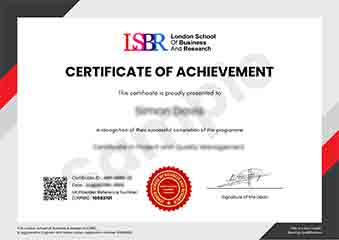
Sample Certificate
Preview the certificate you'll receive upon successful completion of this program.
Get Free Course Info
Receive detailed course information, curriculum breakdown, and career outcomes straight to your inbox.
Employer Sponsored?
Many employers cover professional development costs. Request a corporate invoice and we'll handle the rest. Bulk enrollment discounts available for teams of 3+.
Your Path to Certification
Four simple steps to your professionally recognised qualification
Enroll & Get Instant Access
Complete your enrollment and access course materials immediately
Study at Your Own Pace
Work through the modules on your schedule, from anywhere in the world
Complete Assessments
Demonstrate your knowledge through practical, real-world assessments
Receive Your Certificate
Get your official LSBR UK certificate, recognised across 180+ countries
Join Thousands Who Transformed Their Careers
Our graduates consistently report measurable career growth and professional advancement after completing their programmes.
What People Say About Us
Hear from our students about their experience with the Professional Certificate in Mathematical Techniques in Geomechanics for Stability at LSBR UK - Executive Education.
Oliver Davies
United Kingdom"The course content is incredibly thorough, covering advanced mathematical techniques that are directly applicable to real-world geomechanical challenges. Gaining proficiency in these methods has significantly enhanced my ability to analyze and solve stability issues in construction projects."
Siti Abdullah
Malaysia"This course has been instrumental in bridging the gap between theoretical knowledge and practical applications in geomechanics, significantly enhancing my ability to assess and improve the stability of structures in the field. It has not only deepened my technical skills but also opened up new career opportunities in specialized roles that demand a strong grasp of mathematical techniques in geomechanics."
James Thompson
United Kingdom"The course structure is well-organized, providing a comprehensive overview of mathematical techniques essential for understanding geomechanical stability, which has significantly enhanced my ability to apply these concepts in real-world scenarios."
Still deciding?
Join 23,000+ professionals who advanced their careers. Enroll today and start learning immediately.
Enroll NowSecure payment • Instant access • Certificate included