
Professional Certificate in Mathematical Tools for Architectural Innovation
Gain advanced skills in mathematical tools for architectural innovation, enhancing design efficiency and creativity.
Professional Certificate in Mathematical Tools for Architectural Innovation
Programme Overview
The Professional Certificate in Mathematical Tools for Architectural Innovation is a comprehensive educational programme designed for architects, engineers, and designers seeking to integrate advanced mathematical techniques into their work. This program equips professionals with the skills to leverage mathematical models and computational tools to drive innovation in architectural design and construction. It covers a wide range of topics, including geometric transformations, optimization techniques, and computational geometry, as well as software proficiency in MATLAB, Grasshopper, and other specialized tools. Participants will delve into the application of mathematical principles to complex architectural problems, from form-finding to sustainable design practices, thereby enhancing their ability to innovate in a rapidly evolving industry.
Learners will develop key skills in mathematical modeling, computational design, and data analysis, enabling them to tackle intricate spatial and structural challenges. They will gain expertise in using mathematical tools to optimize building performance, reduce material waste, and enhance energy efficiency. Additionally, the programme fosters a deep understanding of how to integrate these mathematical approaches with traditional architectural design processes, creating a seamless workflow that leverages the power of digital technology.
The career impact of this programme is significant, as graduates will be well-prepared to lead innovative projects that push the boundaries of architectural design. They will be able to introduce cutting-edge solutions to clients, contributing to the advancement of sustainable and high-performance architectural practices. The program’s focus on practical applications and real-world problem-solving ensures that participants are ready to implement their knowledge in professional settings, positioning them as leaders in the field of architectural innovation
What You'll Learn
The Professional Certificate in Mathematical Tools for Architectural Innovation is a cutting-edge program designed to equip architects and design professionals with advanced mathematical skills essential for innovation in the field. This program leverages the latest mathematical tools and software to solve complex architectural problems, enhancing creativity and sustainability in design.
Key topics include advanced geometry, optimization algorithms, computational design, and sustainability metrics. Students learn to apply mathematical principles to simulate and analyze structures, optimize building performance, and integrate renewable energy systems. Through hands-on projects and real-world case studies, participants gain practical skills in using software like Grasshopper, Dynamo, and Rhino for parametric design.
Graduates of this program are well-prepared to lead innovative projects that push the boundaries of architectural design. They can collaborate with multidisciplinary teams, develop sustainable solutions, and integrate cutting-edge technologies into their designs. This program opens doors to careers in architectural firms, research institutions, and consulting firms, as well as opportunities for independent practice focused on innovative design and sustainability.
Programme Highlights
Industry-Aligned Curriculum
Developed with industry leaders for job-ready skills
Globally Recognised Certificate
Recognised by employers across 180+ countries
Flexible Online Learning
Study at your own pace with lifetime access
Instant Access
Start learning immediately, no application process
Constantly Updated Content
Latest industry trends and best practices
Career Advancement
87% report measurable career progression within 6 months
Topics Covered
- Linear Algebra Fundamentals: Introduces vectors, matrices, and transformations essential for spatial analysis.: Calculus for Design: Explores derivatives and integrals to optimize architectural forms and structures.
- Probability and Statistics: Teaches how to analyze and predict building performance data.: Computational Geometry: Focuses on algorithms for creating and manipulating geometric models.
- Machine Learning Basics: Covers key machine learning techniques for predictive modeling in architecture.: Visualization Techniques: Develops skills in using software for 3D modeling and rendering.
What You Get When You Enroll
Key Facts
Audience: Architects, engineers, design students
Prerequisites: Basic math and design software skills
Outcomes: Proficient in advanced mathematical tools, innovative design techniques
Ready to Advance Your Career?
Join thousands of professionals who have transformed their careers with LSBR UK
Why This Course
Enhance Expertise in Architectural Design: The Professional Certificate in Mathematical Tools for Architectural Innovation equips professionals with advanced mathematical tools such as parametric design software. This not only improves their ability to model complex structures but also enables them to explore innovative designs that might be too challenging to conceptualize without these tools. For instance, professionals can use these tools to create designs that optimize structural efficiency and sustainability.
Boost Career Opportunities: Acquiring this certificate opens doors to specialized roles within architectural firms, particularly in innovation and design. It positions professionals as leaders in sustainable and innovative design practices, which are increasingly valued in the industry. Companies are likely to seek individuals with this skill set to drive innovation and maintain a competitive edge.
Strengthen Project Feasibility and Viability: Understanding the mathematical principles underlying architectural design helps in assessing project feasibility and cost-effectiveness. For example, professionals can use these skills to predict material usage, calculate structural stability, and estimate project costs with greater accuracy. This enhances the overall project management capabilities, leading to more successful project completions.
Foster Collaboration and Innovation: The certificate encourages a multidisciplinary approach by integrating mathematical tools with architectural design. This fosters a collaborative environment among designers, engineers, and other stakeholders. By leveraging mathematical tools, teams can develop more efficient and innovative solutions, pushing the boundaries of what is possible in architectural design.
3-4 Weeks
Study at your own pace
Course Brochure
Download our comprehensive course brochure with all details
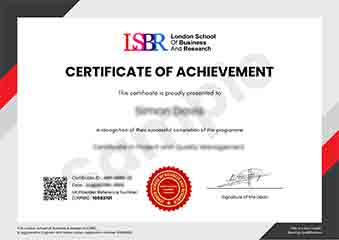
Sample Certificate
Preview the certificate you'll receive upon successful completion of this program.
Get Free Course Info
Receive detailed course information, curriculum breakdown, and career outcomes straight to your inbox.
Employer Sponsored?
Many employers cover professional development costs. Request a corporate invoice and we'll handle the rest. Bulk enrollment discounts available for teams of 3+.
Your Path to Certification
Four simple steps to your professionally recognised qualification
Enroll & Get Instant Access
Complete your enrollment and access course materials immediately
Study at Your Own Pace
Work through the modules on your schedule, from anywhere in the world
Complete Assessments
Demonstrate your knowledge through practical, real-world assessments
Receive Your Certificate
Get your official LSBR UK certificate, recognised across 180+ countries
Join Thousands Who Transformed Their Careers
Our graduates consistently report measurable career growth and professional advancement after completing their programmes.
What People Say About Us
Hear from our students about their experience with the Professional Certificate in Mathematical Tools for Architectural Innovation at LSBR UK - Executive Education.
Charlotte Williams
United Kingdom"The course content is incredibly thorough and well-structured, providing a solid foundation in mathematical tools that are directly applicable to architectural innovation. Gaining proficiency in these tools has significantly enhanced my ability to approach complex design challenges with a more analytical and innovative mindset."
Fatimah Ibrahim
Malaysia"This course has been instrumental in bridging the gap between theoretical mathematics and practical architectural design, equipping me with advanced tools to innovate in my field. It has not only enhanced my technical skills but also opened up new career opportunities in cutting-edge architectural projects."
Arjun Patel
India"The course structure is well-organized, providing a seamless transition from theoretical concepts to practical applications, which has significantly enhanced my understanding and ability to innovate in architectural design."
Still deciding?
Join 23,000+ professionals who advanced their careers. Enroll today and start learning immediately.
Enroll NowSecure payment • Instant access • Certificate included