
Professional Certificate in Non-Parametric Methods for Survival Data
Elevate skills in analyzing survival data without parametric assumptions; earn a professional certificate in non-parametric methods.
Professional Certificate in Non-Parametric Methods for Survival Data
About This Course
The Professional Certificate in Non-Parametric Methods for Survival Data is designed for professionals in healthcare, biostatistics, epidemiology, and related fields who need advanced analytical skills to handle complex survival data. This program focuses on non-parametric techniques essential for analyzing time-to-event data without making stringent distributional assumptions. Learners will gain in-depth knowledge of Kaplan-Meier estimators, Cox proportional hazards models, and other non-parametric methods, including their applications and limitations in real-world scenarios.
Throughout the program, participants will develop a robust set of skills in applying non-parametric methods to survival data, interpreting survival functions, and conducting hypothesis testing. They will also learn to use statistical software such as R or SAS for data analysis, enhancing their ability to manage and analyze large datasets effectively. Practical skills in evaluating the appropriateness of non-parametric methods in various contexts and understanding the underlying theory will be emphasized to ensure a comprehensive understanding.
The certificate will significantly impact participants' careers by equipping them with advanced analytical tools to conduct sophisticated research, contribute to evidence-based decision-making in clinical and public health settings, and advance their expertise in time-to-event analyses. This program is particularly valuable for researchers, data analysts, and healthcare professionals aiming to enhance their analytical capabilities in survival analysis, leading to more accurate and reliable insights in their work.
What You Will Learn
The Professional Certificate in Non-Parametric Methods for Survival Data is designed to equip professionals with advanced statistical techniques essential for analyzing survival data, a critical tool in fields such as medicine, engineering, and social sciences. This program delves into specialized non-parametric methods, which do not assume a specific distribution of data, offering robust solutions for complex data analysis.
Key topics include Kaplan-Meier estimators, Cox proportional hazards models, and log-rank tests, providing a comprehensive understanding of survival analysis. Participants will learn how to handle censored data, a common feature in survival studies, and apply non-parametric methods to estimate survival functions and conduct hypothesis testing.
Upon completion, graduates will be proficient in using statistical software like R or Python for data analysis. They will be able to interpret results accurately, communicate findings effectively to stakeholders, and make evidence-based decisions. These skills are highly valuable in roles such as biostatisticians, data analysts, and clinical researchers.
Career opportunities span across various sectors, including pharmaceuticals, healthcare, manufacturing, and research institutions. Graduates can pursue specialized positions or enhance their career prospects in roles requiring advanced statistical skills for survival data analysis. This program not only offers a solid foundation in non-parametric methods but also equips learners with the practical skills needed to excel in their professional endeavors.
Course Benefits
Industry-Aligned Curriculum
Developed with industry leaders for job-ready skills
Globally Recognised Certificate
Recognised by employers across 180+ countries
Flexible Online Learning
Study at your own pace with lifetime access
Instant Access
Start learning immediately, no application process
Constantly Updated Content
Latest industry trends and best practices
Career Advancement
87% report measurable career progression within 6 months
What This Course Covers
- Introduction to Survival Analysis: Introduces basic concepts and terminology in survival analysis.: Kaplan-Meier Estimator: Discusses the construction and interpretation of Kaplan-Meier survival curves.
- Log-Rank Test: Examines the use of the log-rank test for comparing survival distributions.: Cox Proportional Hazards Model: Covers the formulation and application of Cox models in survival analysis.
- Non-Proportional Hazards Models: Explores models that address violations of the proportional hazards assumption.: Advanced Topics in Survival Analysis: Delves into specialized methods and case studies in survival data analysis.
Everything You Get With This Course
Course Facts
Audience: Data analysts, biostatisticians, researchers
Prerequisites: Basic statistics, survival analysis concepts
Outcomes: Proficient in non-parametric survival techniques
Ready to Advance Your Career?
Join thousands of professionals who have transformed their careers with LSBR UK
Why This Course Is Right for You
Enhance Analytical Skills: Obtaining a Professional Certificate in Non-Parametric Methods for Survival Data significantly improves one's ability to analyze complex data sets, particularly those involving time-to-event outcomes. This skill is crucial in fields such as biostatistics, epidemiology, and clinical research, where understanding patient survival rates and other time-dependent variables is essential.
Career Advancement: Professionals with this certification are well-equipped to handle advanced statistical tasks and can contribute more effectively to research projects and clinical trials. This expertise is in high demand, leading to opportunities for career advancement in academia, pharmaceutical companies, and healthcare organizations.
Competitive Edge: In a crowded job market, having a professional certificate stands out. It demonstrates a commitment to continuous learning and expertise in specialized statistical techniques. Employers value candidates who can apply non-parametric methods to real-world problems, making certified professionals more attractive to potential employers.
Improved Decision Making: By mastering non-parametric methods, professionals can make more informed decisions based on robust statistical analyses. This capability is particularly valuable in healthcare settings, where accurate survival data can influence treatment protocols, patient care, and public health policy.
3-4 Weeks
Study at your own pace
Course Brochure
Download our comprehensive course brochure with all details
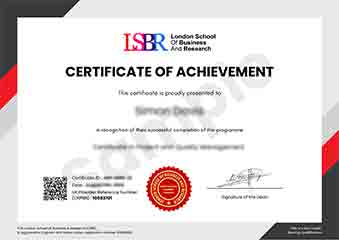
Sample Certificate
Preview the certificate you'll receive upon successful completion of this program.
Get Free Course Info
Receive detailed course information, curriculum breakdown, and career outcomes straight to your inbox.
Employer Sponsored?
Many employers cover professional development costs. Request a corporate invoice and we'll handle the rest. Bulk enrollment discounts available for teams of 3+.
How You Earn Your Certificate
Four simple steps to your professionally recognised qualification
Enroll & Get Instant Access
Complete your enrollment and access course materials immediately
Study at Your Own Pace
Work through the modules on your schedule, from anywhere in the world
Complete Assessments
Demonstrate your knowledge through practical, real-world assessments
Receive Your Certificate
Get your official LSBR UK certificate, recognised across 180+ countries
Real Results from Real Learners
Our graduates consistently report measurable career growth and professional advancement after completing their programmes.
Reviews from Our Learners
Hear from our students about their experience with the Professional Certificate in Non-Parametric Methods for Survival Data at LSBR UK - Executive Education.
James Thompson
United Kingdom"The course provided a robust foundation in non-parametric methods for analyzing survival data, equipping me with practical skills to tackle real-world challenges in healthcare and biostatistics. Gaining proficiency in these techniques has significantly enhanced my analytical capabilities and opened up new career opportunities in data-driven research."
Emma Tremblay
Canada"This course has been incredibly valuable, equipping me with the skills to analyze survival data effectively, which is directly applicable in my field of biostatistics. It has opened up new opportunities for me to contribute more meaningfully to research projects, enhancing my career prospects significantly."
Klaus Mueller
Germany"The course structure was well-organized, providing a clear path from basic concepts to advanced techniques in non-parametric methods for survival data, which greatly enhanced my understanding and practical skills in analyzing real-world data sets."
Need more time to decide?
Join 23,000+ professionals who advanced their careers. Enroll today and start learning immediately.
Enroll NowSecure payment • Instant access • Certificate included