
Professional Certificate in Numerical Methods for Turbulent Flow
Elevate skills in numerical methods for turbulent flow, gaining expertise in advanced modeling techniques and simulation for professional applications.
Professional Certificate in Numerical Methods for Turbulent Flow
About This Course
The Professional Certificate in Numerical Methods for Turbulent Flow is a comprehensive programme designed for professionals in engineering, physics, and related fields who seek to enhance their expertise in computational fluid dynamics (CFD). This program focuses on advanced numerical techniques and their application to the simulation of turbulent flows, including theoretical foundations, practical computational methods, and real-world problem-solving. Participants will gain in-depth knowledge of turbulence models, numerical algorithms, and high-performance computing, enabling them to effectively model and analyze complex fluid dynamics scenarios.
Key skills and knowledge developed through this programme include proficiency in turbulence modeling techniques, such as large eddy simulation (LES) and Reynolds-averaged Navier-Stokes (RANS) methods; understanding of numerical stability, accuracy, and convergence; and hands-on experience with state-of-the-art CFD software and high-performance computing environments. Learners will also develop the ability to critically evaluate computational results, interpret data, and apply advanced numerical methods to solve industry-specific challenges.
The career impact of this programme is significant, as it equips professionals with the skills necessary to advance in roles requiring expertise in computational fluid dynamics, such as aerospace engineering, automotive design, environmental fluid mechanics, and industrial process optimization. Graduates will be better positioned to lead projects involving complex flow simulations, contribute to research and development in fluid dynamics, and enhance their problem-solving capabilities in their respective fields.
What You Will Learn
Explore the intricate world of fluid dynamics with the Professional Certificate in Numerical Methods for Turbulent Flow. This program equips you with advanced skills in computational fluid dynamics (CFD), focusing on the numerical solutions to the Navier-Stokes equations and other turbulence models. You will delve into essential topics such as turbulence modeling, discretization techniques, and solver strategies, enhancing your ability to predict and analyze turbulent flows accurately.
This certificate is invaluable for professionals in aerospace, automotive, and environmental engineering, as well as for researchers and engineers aiming to optimize designs and improve performance. By the end of the program, you will be proficient in using advanced CFD software and possess the knowledge to develop custom turbulence models tailored to specific applications. Graduates can apply these skills to reduce drag, enhance efficiency, and ensure safety in various engineering projects.
Career opportunities are vast, including roles in CFD analysis, computational engineering, and research and development. You will be well-prepared to work in industries ranging from automotive and aerospace to power generation and environmental management, where the ability to model and understand turbulent flows is crucial. The program also provides a solid foundation for further academic pursuits or professional certifications in the field of computational fluid dynamics.
Course Benefits
Industry-Aligned Curriculum
Developed with industry leaders for job-ready skills
Globally Recognised Certificate
Recognised by employers across 180+ countries
Flexible Online Learning
Study at your own pace with lifetime access
Instant Access
Start learning immediately, no application process
Constantly Updated Content
Latest industry trends and best practices
Career Advancement
87% report measurable career progression within 6 months
What This Course Covers
- Introduction to Turbulent Flow: Introduces the concept of turbulence, its importance in fluid dynamics, and the characteristics of turbulent flows.: Governing Equations: Discusses the Navier-Stokes equations and their relevance to turbulent flow, along with simplifications and assumptions.
- Turbulence Models: Explores various turbulence modeling techniques including Reynolds-Averaged Navier-Stokes (RANS) and Large Eddy Simulation (LES).: Numerical Discretization: Covers finite difference, finite volume, and finite element methods for solving partial differential equations.
- Computational Grids: Focuses on grid generation, types of grids, and their impact on numerical accuracy and efficiency.: Validation and Verification: Teaches techniques for validating numerical models against experimental data and verifying numerical methods for accuracy.
Everything You Get With This Course
Course Facts
For engineers and researchers
Basic knowledge of numerical methods
Proficient in turbulence modeling techniques
Capable of using CFD software
Understands numerical simulation processes
Can analyze complex flow scenarios
Ready to Advance Your Career?
Join thousands of professionals who have transformed their careers with LSBR UK
Why This Course Is Right for You
Enhance Expertise in Fluid Dynamics: The Professional Certificate in Numerical Methods for Turbulent Flow equips professionals with advanced knowledge in computational fluid dynamics (CFD), particularly focusing on turbulent flow. This is crucial for solving complex engineering problems in aerospace, automotive, and environmental sectors, where precise simulations can lead to significant improvements in product design and efficiency.
Leverage Advanced Numerical Techniques: The certificate provides in-depth training on state-of-the-art numerical methods, such as finite volume and finite element techniques, used in CFD. These skills enable professionals to handle large-scale simulations more effectively, leading to better predictive models and reduced physical prototyping costs.
Bridge Theory and Practice: By combining theoretical knowledge with practical application, the certificate helps bridge the gap between academic theory and industrial practice. This dual approach ensures that professionals can apply numerical methods to real-world problems, enhancing their problem-solving capabilities and decision-making in their respective fields.
3-4 Weeks
Study at your own pace
Course Brochure
Download our comprehensive course brochure with all details
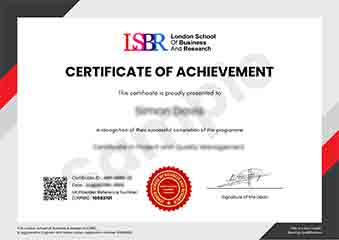
Sample Certificate
Preview the certificate you'll receive upon successful completion of this program.
Get Free Course Info
Receive detailed course information, curriculum breakdown, and career outcomes straight to your inbox.
Employer Sponsored?
Many employers cover professional development costs. Request a corporate invoice and we'll handle the rest. Bulk enrollment discounts available for teams of 3+.
How You Earn Your Certificate
Four simple steps to your professionally recognised qualification
Enroll & Get Instant Access
Complete your enrollment and access course materials immediately
Study at Your Own Pace
Work through the modules on your schedule, from anywhere in the world
Complete Assessments
Demonstrate your knowledge through practical, real-world assessments
Receive Your Certificate
Get your official LSBR UK certificate, recognised across 180+ countries
Real Results from Real Learners
Our graduates consistently report measurable career growth and professional advancement after completing their programmes.
Reviews from Our Learners
Hear from our students about their experience with the Professional Certificate in Numerical Methods for Turbulent Flow at LSBR UK - Executive Education.
Oliver Davies
United Kingdom"The course provided an excellent foundation in numerical methods for turbulent flow, equipping me with practical skills that are directly applicable in my field. Gaining this knowledge has significantly enhanced my ability to model complex fluid dynamics problems, opening up new career opportunities in research and industry."
Ruby McKenzie
Australia"This course has been incredibly valuable, equipping me with advanced numerical methods that are directly applicable in my field. It has not only enhanced my technical skills but also opened up new opportunities for career advancement in turbulent flow analysis."
Ruby McKenzie
Australia"The course structure is well-organized, providing a comprehensive overview of numerical methods for turbulent flow that seamlessly bridges theoretical concepts with practical applications, significantly enhancing my understanding and professional growth in fluid dynamics."
Need more time to decide?
Join 23,000+ professionals who advanced their careers. Enroll today and start learning immediately.
Enroll NowSecure payment • Instant access • Certificate included