
Professional Certificate in Pollutant Transport Modeling in Aquatic Systems
Earn a Professional Certificate in modeling pollutant transport in aquatic systems, enhancing predictive capabilities and environmental management skills.
Professional Certificate in Pollutant Transport Modeling in Aquatic Systems
Programme Overview
The Professional Certificate in Pollutant Transport Modeling in Aquatic Systems is designed for environmental scientists, engineers, and researchers who seek to enhance their expertise in understanding and predicting the movement of pollutants within aquatic environments. This program equips participants with the advanced knowledge and practical skills necessary to model and analyze the complex interactions between pollutants and aquatic ecosystems, including surface waters, groundwater, and estuaries.
Participants will develop a comprehensive understanding of the fundamental principles underlying pollutant transport, including advection, diffusion, and chemical reactions. They will learn to apply state-of-the-art modeling techniques and software, such as Delft3D, MIKE , and SimaPro, to simulate pollutant transport scenarios accurately. Key skills include interpreting environmental data, selecting appropriate models, and validating model outputs against field data.
This program significantly impacts career trajectories by providing professionals with the skills to contribute to environmental management and policy, support pollution mitigation strategies, and conduct research in aquatic pollution control. Graduates are well-prepared to work in academic institutions, government agencies, consulting firms, and non-profit organizations focused on environmental conservation and sustainability.
What You'll Learn
The Professional Certificate in Pollutant Transport Modeling in Aquatic Systems is designed for professionals seeking to enhance their expertise in modeling and predicting pollutant transport within aquatic environments. This comprehensive program equips participants with advanced skills in mathematical modeling, environmental chemistry, and hydrodynamics, utilizing state-of-the-art software and analytical tools.
Key topics include the principles of water quality modeling, the dynamics of pollutant transport, and the integration of environmental data for accurate predictions. Students will learn to model various pollutants, from nutrients and pathogens to heavy metals, understanding their behavior in different aquatic systems. The curriculum also covers the latest techniques in data assimilation and uncertainty quantification, ensuring that models are robust and reliable.
Graduates of this program are well-prepared to tackle real-world challenges in water resource management, environmental policy, and pollution control. They can apply their skills in regulatory agencies, environmental consulting firms, academic institutions, and non-profit organizations, contributing to sustainable water management and environmental protection.
Career opportunities abound for program alumni, including roles such as environmental modeler, water quality analyst, and environmental scientist. The program’s emphasis on practical applications and hands-on training ensures that graduates are not only knowledgeable but also capable of driving meaningful change in their respective fields.
Programme Highlights
Industry-Aligned Curriculum
Developed with industry leaders for job-ready skills
Globally Recognised Certificate
Recognised by employers across 180+ countries
Flexible Online Learning
Study at your own pace with lifetime access
Instant Access
Start learning immediately, no application process
Constantly Updated Content
Latest industry trends and best practices
Career Advancement
87% report measurable career progression within 6 months
Topics Covered
- Foundational Concepts: Covers the core principles and key terminology.: Hydrodynamics Basics: Introduces the fundamentals of water flow and currents.
- Water Quality Parameters: Discusses essential pollutants and their measurement.: Modeling Software Tools: Reviews popular software used for pollutant transport.
- Case Studies: Analyzes real-world scenarios and modeling applications.: Future Trends: Explores emerging technologies and methodologies in the field.
What You Get When You Enroll
Key Facts
For environmental scientists, engineers, and researchers
No prior modeling experience required
Understands pollutant behavior in water
Develops predictive models for pollution
Analyzes real-world pollution scenarios
Applies technical software for modeling
Prepares reports for policy makers
Ready to Advance Your Career?
Join thousands of professionals who have transformed their careers with LSBR UK
Why This Course
For professionals aiming to enhance their expertise in environmental science and engineering, obtaining a Professional Certificate in Pollutant Transport Modeling in Aquatic Systems offers a specialized focus. This certification equips individuals with the ability to model the movement and fate of pollutants in water bodies, a critical skill for addressing water quality issues. For instance, it enables professionals to predict the dispersion of contaminants from industrial discharges or agricultural runoff, facilitating better management and mitigation strategies.
The certificate also significantly boosts career opportunities by aligning with growing industry demands. As environmental regulations become more stringent, professionals skilled in pollutant transport modeling are in high demand. This certification can lead to roles such as environmental consultant, water quality analyst, or regulatory compliance officer, where the ability to model pollutant behavior is crucial.
Skill development is another compelling reason for professionals to pursue this certificate. It provides a comprehensive understanding of various modeling techniques and software tools, such as IDWAT, CMAQ, and SWAT. These tools are essential for conducting detailed analyses and making informed decisions. For example, professionals can use these models to simulate the effects of different treatment technologies on pollutant levels in surface water, thereby contributing to more effective environmental policies and practices.
3-4 Weeks
Study at your own pace
Course Brochure
Download our comprehensive course brochure with all details
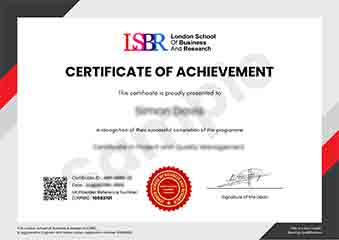
Sample Certificate
Preview the certificate you'll receive upon successful completion of this program.
Get Free Course Info
Receive detailed course information, curriculum breakdown, and career outcomes straight to your inbox.
Employer Sponsored?
Many employers cover professional development costs. Request a corporate invoice and we'll handle the rest. Bulk enrollment discounts available for teams of 3+.
Your Path to Certification
Four simple steps to your professionally recognised qualification
Enroll & Get Instant Access
Complete your enrollment and access course materials immediately
Study at Your Own Pace
Work through the modules on your schedule, from anywhere in the world
Complete Assessments
Demonstrate your knowledge through practical, real-world assessments
Receive Your Certificate
Get your official LSBR UK certificate, recognised across 180+ countries
Join Thousands Who Transformed Their Careers
Our graduates consistently report measurable career growth and professional advancement after completing their programmes.
What People Say About Us
Hear from our students about their experience with the Professional Certificate in Pollutant Transport Modeling in Aquatic Systems at LSBR UK - Executive Education.
Oliver Davies
United Kingdom"The course content is comprehensive and well-structured, providing a solid foundation in pollutant transport modeling in aquatic systems. I gained valuable practical skills that will be directly applicable to my work, enhancing my ability to model and predict environmental impacts effectively."
Fatimah Ibrahim
Malaysia"This course has been incredibly valuable, equipping me with advanced modeling techniques that are directly applicable in my work. It has not only enhanced my ability to predict pollutant transport in aquatic systems but also opened up new career opportunities in environmental consultancy."
Greta Fischer
Germany"The course structure was meticulously organized, providing a seamless progression from basic principles to advanced modeling techniques, which greatly enhanced my understanding of pollutant transport in aquatic systems. The comprehensive content and real-world applications have significantly broadened my knowledge base and prepared me for professional challenges in environmental management."
Still deciding?
Join 23,000+ professionals who advanced their careers. Enroll today and start learning immediately.
Enroll NowSecure payment • Instant access • Certificate included