
Professional Certificate in Spatial Analysis for Historians
Enhance historical research skills with a Professional Certificate in Spatial Analysis, offering advanced GIS techniques and historical data interpretation.
Professional Certificate in Spatial Analysis for Historians
Programme Overview
The Professional Certificate in Spatial Analysis for Historians is designed for historians, archivists, and researchers interested in integrating geographic information systems (GIS) and spatial analysis techniques into their work. This program equips participants with the skills to analyze, interpret, and visualize historical data in a spatial context, enhancing their ability to explore and understand historical events, trends, and patterns across time and space. The curriculum covers a range of topics, including spatial data management, geocoding, map creation, and the use of spatial analytics to uncover historical narratives that are often hidden or overlooked in traditional textual analysis.
Participants will develop a comprehensive set of skills in spatial analysis, including the ability to manage and analyze large datasets, create accurate and informative maps, and interpret spatial data to derive meaningful insights. They will learn to use advanced GIS software and tools, such as ArcGIS and QGIS, to conduct spatial queries, perform overlay analysis, and conduct spatial statistics. By the end of the program, learners will be proficient in using spatial methods to enhance their research, making their work more compelling and accessible to a broader audience.
The certificate program will significantly impact learners' careers by providing them with a competitive edge in the job market, particularly in roles that require an understanding of spatial data and its application in historical research. Graduates will be well-prepared to apply spatial analysis techniques in academic publications, digital humanities projects, and consultancy. The skills acquired will also be valuable in urban planning, heritage conservation, and policy-making contexts
What You'll Learn
Embark on a transformative journey with the Professional Certificate in Spatial Analysis for Historians, designed to equip you with advanced skills in analyzing and interpreting historical data through a spatial lens. This program, a collaborative effort between historians and data scientists, offers a unique blend of theoretical knowledge and practical tools that are essential for uncovering new insights into historical events and contexts.
Key topics include geographic information systems (GIS), spatial data visualization, and the integration of historical data with contemporary analytical techniques. Through hands-on projects, you will learn to map historical events, analyze migration patterns, and examine urban development over time, enhancing your ability to present historical narratives in a compelling and data-driven manner.
Graduates of this program are well-prepared to advance their careers in academia, non-profit organizations, government agencies, and private sector firms that require specialized historical analysis. Potential roles include historical data analysts, digital humanities researchers, and urban planners. By leveraging spatial analysis skills, you can contribute to projects that range from historical preservation to policy-making, making your expertise invaluable in a rapidly evolving digital landscape.
Join this pioneering program and unlock the full potential of spatial analysis in your historical research, contributing to a deeper understanding of the past and its enduring impacts on our world today.
Programme Highlights
Industry-Aligned Curriculum
Developed with industry leaders for job-ready skills
Globally Recognised Certificate
Recognised by employers across 180+ countries
Flexible Online Learning
Study at your own pace with lifetime access
Instant Access
Start learning immediately, no application process
Constantly Updated Content
Latest industry trends and best practices
Career Advancement
87% report measurable career progression within 6 months
Topics Covered
- Foundational Concepts: Covers the core principles and key terminology.: Historical GIS Fundamentals: Introduces the use of Geographic Information Systems in historical research.
- Spatial Data Collection: Techniques for gathering and managing spatial data.: Spatial Analysis Techniques: Advanced methods for analyzing historical spatial data.
- Case Studies in Spatial Analysis: Examines real-world applications of spatial analysis in historical contexts.: Spatial Visualization and Mapping: Skills for creating effective visual representations of historical data.
What You Get When You Enroll
Key Facts
Audience: Historians, data analysts, archaeologists
Prerequisites: Basic computer skills, introductory statistics knowledge
Outcomes: Master spatial data analysis, GIS proficiency, historical site mapping
Ready to Advance Your Career?
Join thousands of professionals who have transformed their careers with LSBR UK
Why This Course
Enhanced Analytical Skills: The Professional Certificate in Spatial Analysis for Historians equips professionals with advanced analytical tools and techniques, such as Geographic Information Systems (GIS). This enables them to effectively map and analyze historical data, enhancing their ability to interpret and present historical narratives spatially.
Career Versatility: By acquiring spatial analysis skills, historians can expand their career opportunities. These skills are valuable in various sectors, including academia, government, cultural heritage management, and urban planning. For instance, professionals can utilize GIS to analyze historical migration patterns, contributing to urban development projects or public policy.
Improved Research Capabilities: The certificate program provides hands-on training with software and methodologies that are crucial for contemporary historical research. Historians will learn to integrate spatial data with historical documents and artifacts, leading to more comprehensive and nuanced research. This approach can uncover new insights and relationships that might not be apparent through traditional methods alone.
Stronger Communicative Skills: Spatial analysis requires the ability to visualize and communicate complex data effectively. Through this program, professionals will develop strong visual communication skills, enabling them to create compelling maps and presentations. This capability is essential for engaging a wide audience, whether in academic settings or public exhibitions, making historical information more accessible and impactful.
3-4 Weeks
Study at your own pace
Course Brochure
Download our comprehensive course brochure with all details
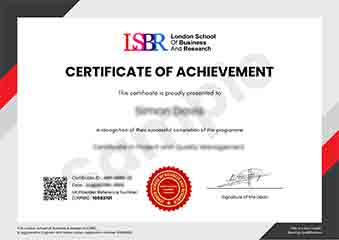
Sample Certificate
Preview the certificate you'll receive upon successful completion of this program.
Get Free Course Info
Receive detailed course information, curriculum breakdown, and career outcomes straight to your inbox.
Employer Sponsored?
Many employers cover professional development costs. Request a corporate invoice and we'll handle the rest. Bulk enrollment discounts available for teams of 3+.
Your Path to Certification
Four simple steps to your professionally recognised qualification
Enroll & Get Instant Access
Complete your enrollment and access course materials immediately
Study at Your Own Pace
Work through the modules on your schedule, from anywhere in the world
Complete Assessments
Demonstrate your knowledge through practical, real-world assessments
Receive Your Certificate
Get your official LSBR UK certificate, recognised across 180+ countries
Join Thousands Who Transformed Their Careers
Our graduates consistently report measurable career growth and professional advancement after completing their programmes.
What People Say About Us
Hear from our students about their experience with the Professional Certificate in Spatial Analysis for Historians at LSBR UK - Executive Education.
Charlotte Williams
United Kingdom"This course provided an excellent foundation in spatial analysis techniques that are directly applicable to historical research, enhancing my ability to visualize and interpret historical data in new ways. Gaining these skills has significantly improved my analytical toolkit and opened up new avenues for exploring historical patterns and trends."
Anna Schmidt
Germany"This course has been instrumental in bridging the gap between historical research and modern spatial analysis techniques, equipping me with the tools to analyze and interpret historical data in a more nuanced and comprehensive way. It has significantly enhanced my career prospects by providing me with industry-relevant skills that are in high demand in both academic and professional settings."
Zoe Williams
Australia"The course structure is meticulously organized, providing a seamless transition from theoretical concepts to practical applications, which significantly enhances my understanding and appreciation of spatial analysis in historical contexts. The comprehensive content not only deepens my knowledge but also equips me with valuable skills for analyzing historical data in a spatially informed manner, opening up new avenues for research."
Still deciding?
Join 23,000+ professionals who advanced their careers. Enroll today and start learning immediately.
Enroll NowSecure payment • Instant access • Certificate included