
Professional Certificate in Spatial Modeling for Environmental Impact
Develop spatial modeling skills to predict and mitigate environmental impacts effectively.
Professional Certificate in Spatial Modeling for Environmental Impact
Programme Overview
The Professional Certificate in Spatial Modeling for Environmental Impact is a comprehensive programme that covers the principles and applications of spatial modeling in environmental impact assessment. Designed for professionals and graduates in environmental science, geography, and related fields, this programme equips learners with the skills and knowledge to analyze and predict the environmental effects of development projects and policies.
Through a combination of theoretical foundations and practical exercises, learners develop expertise in spatial data analysis, geographic information systems (GIS), and environmental modeling. They learn to apply spatial modeling techniques to real-world problems, such as climate change, land use planning, and natural resource management. The programme focuses on the development of practical skills in data visualization, spatial analysis, and model interpretation, enabling learners to communicate complex environmental issues effectively to stakeholders.
By completing this programme, learners enhance their career prospects in environmental consulting, government agencies, and research institutions, where they can apply their skills to inform policy decisions and contribute to sustainable development. The programme's emphasis on spatial modeling and environmental impact assessment prepares learners for roles such as environmental impact assessors, sustainability consultants, and spatial analysts.
What You'll Learn
The Professional Certificate in Spatial Modeling for Environmental Impact equips professionals with cutting-edge skills to analyze and mitigate the environmental footprint of human activities. In today's data-driven landscape, spatial modeling has become a crucial tool for informed decision-making, making this programme highly valuable and relevant. Key topics covered include Geographic Information Systems (GIS), remote sensing, spatial analysis, and environmental modeling, as well as competency in programming languages such as Python and R.
Students learn to apply these skills to real-world scenarios, such as assessing the impact of urbanization on biodiversity, modeling climate change effects on water resources, and evaluating the environmental sustainability of infrastructure projects. Graduates can apply their skills in various industries, including environmental consulting, urban planning, and natural resource management, working with organizations such as the Environmental Protection Agency, the World Wildlife Fund, or private sector companies like Esri and Autodesk.
Upon completion of the programme, graduates can pursue career advancement opportunities as spatial analysts, environmental modelers, or sustainability consultants, leveraging their expertise to drive evidence-based decision-making and promote environmentally responsible practices. The programme's emphasis on industry-relevant tools and frameworks, such as the Spatial Analysis and Modeling (SAM) framework and the Environmental Systems Research Institute (Esri) ArcGIS platform, ensures that graduates are well-prepared to tackle complex environmental challenges and advance in their careers.
Programme Highlights
Industry-Aligned Curriculum
Developed with industry leaders for job-ready skills
Globally Recognised Certificate
Recognised by employers across 180+ countries
Flexible Online Learning
Study at your own pace with lifetime access
Instant Access
Start learning immediately, no application process
Constantly Updated Content
Latest industry trends and best practices
Career Advancement
87% report measurable career progression within 6 months
Topics Covered
- Introduction to Spatial Modeling: Environmental impact assessment basics.
- Geographic Information Systems: GIS fundamentals and applications.
- Remote Sensing Techniques: Data collection and analysis methods.
- Spatial Analysis and Statistics: Data analysis for environmental insights.
- Environmental Impact Assessment: Assessing human impact on environments.
- Advanced Spatial Modeling: Complex modeling techniques and tools.
What You Get When You Enroll
Key Facts
Target Audience: Environmental professionals, researchers, and students seeking a career in spatial modeling and environmental impact assessment.
Prerequisites: No formal prerequisites required, but basic knowledge of geographic information systems (GIS) and environmental concepts is beneficial.
Learning Outcomes:
Apply spatial modeling techniques to analyze environmental data and predict potential impacts.
Develop and implement spatial models using industry-standard software and tools.
Interpret and communicate spatial modeling results to inform environmental decision-making.
Design and execute spatial modeling projects to address real-world environmental challenges.
Evaluate and validate spatial models to ensure accuracy and reliability.
Assessment Method: Quiz-based assessment to evaluate understanding of spatial modeling concepts and techniques.
Certification: Industry-recognised digital certificate awarded upon successful completion of the program, verifying expertise in spatial modeling for environmental impact assessment.
Ready to Advance Your Career?
Join thousands of professionals who have transformed their careers with LSBR UK
Why This Course
The 'Professional Certificate in Spatial Modeling for Environmental Impact' programme offers a unique opportunity for professionals to enhance their skills in geospatial analysis and environmental modeling, allowing them to make a meaningful impact in their field. By gaining expertise in spatial modeling, professionals can drive informed decision-making and contribute to sustainable development, making this programme an attractive choice for those seeking to advance their careers.
The programme enables professionals to develop advanced skills in spatial analysis and modeling, using industry-standard software such as ArcGIS and Python, which are highly valued in the job market. This expertise can be applied to a wide range of fields, including environmental consulting, urban planning, and conservation biology. By mastering these skills, professionals can increase their career prospects and stay competitive in a rapidly evolving job market.
The programme focuses on the application of spatial modeling to real-world environmental problems, such as climate change, deforestation, and water pollution, providing professionals with a deep understanding of the complex relationships between human activities and the environment. This knowledge can be used to develop effective strategies for mitigating environmental impacts and promoting sustainable development. Professionals can apply this knowledge to drive positive change in their organizations and communities.
The programme is designed to meet the needs of professionals working in a variety of industries, including government, non-profit, and private sectors, providing a comprehensive understanding of the role of spatial modeling in environmental impact assessment and management. This broad relevance makes the programme an excellent choice for professionals seeking to transition to new roles or advance
3-4 Weeks
Study at your own pace
Course Brochure
Download our comprehensive course brochure with all details
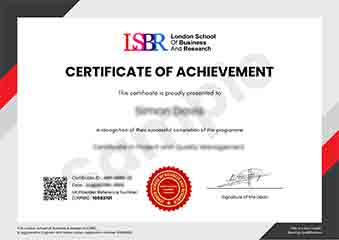
Sample Certificate
Preview the certificate you'll receive upon successful completion of this program.
Get Free Course Info
Receive detailed course information, curriculum breakdown, and career outcomes straight to your inbox.
Employer Sponsored?
Many employers cover professional development costs. Request a corporate invoice and we'll handle the rest. Bulk enrollment discounts available for teams of 3+.
Your Path to Certification
Four simple steps to your professionally recognised qualification
Enroll & Get Instant Access
Complete your enrollment and access course materials immediately
Study at Your Own Pace
Work through the modules on your schedule, from anywhere in the world
Complete Assessments
Demonstrate your knowledge through practical, real-world assessments
Receive Your Certificate
Get your official LSBR UK certificate, recognised across 180+ countries
Join Thousands Who Transformed Their Careers
Our graduates consistently report measurable career growth and professional advancement after completing their programmes.
What People Say About Us
Hear from our students about their experience with the Professional Certificate in Spatial Modeling for Environmental Impact at LSBR UK - Executive Education.
Oliver Davies
United Kingdom"The course material was incredibly comprehensive and well-structured, providing me with a deep understanding of spatial modeling techniques and their applications in environmental impact assessment. Through this course, I gained hands-on experience with industry-standard tools and developed practical skills in data analysis, mapping, and modeling, which I can confidently apply to real-world problems. The knowledge and skills I acquired have significantly enhanced my career prospects in environmental consulting and research."
Wei Ming Tan
Singapore"The Professional Certificate in Spatial Modeling for Environmental Impact has been a game-changer for my career, equipping me with the cutting-edge skills and knowledge to analyze and mitigate the environmental effects of large-scale projects, and I've already seen a significant boost in my job prospects. The course has given me a unique edge in the industry, allowing me to approach complex environmental challenges with a high degree of spatial awareness and technical expertise. As a result, I've been able to take on more senior roles and contribute meaningfully to high-impact projects that align with my passion for sustainable development."
Arjun Patel
India"The course structure was well-organized, allowing me to seamlessly transition between modules and gain a comprehensive understanding of spatial modeling concepts and their applications in environmental impact assessment. I appreciated how the course content was carefully curated to balance theoretical foundations with real-world examples, enabling me to develop practical skills that I can apply in my professional pursuits. Through this course, I have significantly enhanced my knowledge of spatial modeling and its role in informing environmental decision-making, which has been a valuable addition to my professional toolkit."
Still deciding?
Join 23,000+ professionals who advanced their careers. Enroll today and start learning immediately.
Enroll NowSecure payment • Instant access • Certificate included