
Undergraduate Certificate in Cellular Automata for Complexity
Earn an Undergraduate Certificate in Cellular Automata for Complexity to gain skills in modeling complex systems and predictive analytics.
Undergraduate Certificate in Cellular Automata for Complexity
About This Course
The Undergraduate Certificate in Cellular Automata for Complexity is designed for students and professionals interested in exploring the mathematical models that describe complex systems across various disciplines, including computer science, physics, biology, and social sciences. This program delves into the principles and applications of cellular automata, offering a comprehensive understanding of how simple rules can generate complex behaviors and patterns. Through this program, learners will analyze and model systems ranging from artificial life to urban development, with a focus on computational and algorithmic techniques.
Key skills and knowledge developed in this program include proficiency in software tools for simulating cellular automata, understanding of the mathematical foundations of complex systems, and the ability to apply cellular automata theory to real-world problems. Learners will gain hands-on experience in developing and analyzing models, enhancing their capability to predict and understand complex behaviors in diverse contexts. This foundational knowledge equips graduates with the skills necessary to contribute to fields such as computational biology, urban planning, data science, and artificial intelligence, where the ability to model and predict complex systems is crucial.
This program significantly impacts careers by preparing graduates to work in roles that require an understanding of complex systems and the ability to model and analyze data-driven phenomena. Graduates can pursue careers in research and development, data analysis, software engineering, or academic positions, contributing to advancements in technology, healthcare, environmental science, and more.
What You Will Learn
Explore the intricate patterns and emergent behaviors of complex systems with the Undergraduate Certificate in Cellular Automata for Complexity. This program equips students with the tools to analyze and model complex systems through the lens of cellular automata, a foundational concept in the study of complexity science. Key topics include the fundamentals of cellular automata, their applications in various fields such as biology, physics, and social sciences, and advanced computational techniques for simulation and analysis.
Graduates of this program are well-prepared to apply their skills in diverse sectors. They can model and predict behavior in biological systems, enhance urban planning through simulations of traffic flow and urban growth, and contribute to the development of artificial intelligence systems that mimic complex behaviors. The program also prepares students for further studies in complex systems, computer science, and related fields, or for careers in research, data analysis, and technology consulting.
This certificate stands out by integrating theoretical knowledge with practical applications, ensuring that students not only understand the underlying principles but also can apply them to solve real-world problems. Whether aspiring to become a complexity scientist, a data analyst, or a researcher, this program provides a robust foundation in cellular automata that is highly valued in today's data-driven world.
Course Benefits
Industry-Aligned Curriculum
Developed with industry leaders for job-ready skills
Globally Recognised Certificate
Recognised by employers across 180+ countries
Flexible Online Learning
Study at your own pace with lifetime access
Instant Access
Start learning immediately, no application process
Constantly Updated Content
Latest industry trends and best practices
Career Advancement
87% report measurable career progression within 6 months
What This Course Covers
- Foundational Concepts: Covers the core principles and key terminology.: Cellular Automata History: Traces the development and evolution of cellular automata theory.
- Mathematical Foundations: Introduces the necessary mathematical concepts and tools.: Rule Sets and Configurations: Explains how to define and apply rule sets.
- Simulation Techniques: Teaches methods for simulating cellular automata.: Applications in Complexity: Demonstrates how cellular automata are used to model complex systems.
Everything You Get With This Course
Course Facts
Audience: Computer science, math, and data science students
Prerequisites: Basic programming knowledge, calculus, linear algebra
Outcomes: Understand cellular automata fundamentals, model complex systems
Ready to Advance Your Career?
Join thousands of professionals who have transformed their careers with LSBR UK
Why This Course Is Right for You
Enhance Problem-Solving Skills: The Undergraduate Certificate in Cellular Automata for Complexity equips professionals with advanced analytical tools to model complex systems and predict behaviors. This is particularly beneficial in fields like computer science, data science, and systems engineering, where complex systems are prevalent.
Career Advancement: Specializing in cellular automata can make professionals stand out in their careers. This knowledge is increasingly valuable in sectors such as artificial intelligence, where understanding complex interactions is crucial. For instance, professionals can apply these techniques to improve machine learning models, enhancing their competitiveness in the job market.
Interdisciplinary Applications: The course bridges mathematics, computer science, and systems theory, offering a unique skill set that can be applied across disciplines. This interdisciplinary approach can be particularly advantageous in emerging fields like bioinformatics, where cellular automata can model biological systems, or in urban planning, where complex social and environmental interactions need to be analyzed.
Innovation and Research: With the increasing complexity of global challenges, there is a growing need for innovative approaches to problem-solving. Professionals with expertise in cellular automata can contribute to cutting-edge research and development, driving innovation in areas such as computational biology, robotics, and network science.
3-4 Weeks
Study at your own pace
Course Brochure
Download our comprehensive course brochure with all details
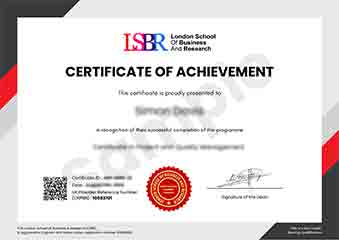
Sample Certificate
Preview the certificate you'll receive upon successful completion of this program.
Get Free Course Info
Receive detailed course information, curriculum breakdown, and career outcomes straight to your inbox.
Employer Sponsored?
Many employers cover professional development costs. Request a corporate invoice and we'll handle the rest. Bulk enrollment discounts available for teams of 3+.
How You Earn Your Certificate
Four simple steps to your professionally recognised qualification
Enroll & Get Instant Access
Complete your enrollment and access course materials immediately
Study at Your Own Pace
Work through the modules on your schedule, from anywhere in the world
Complete Assessments
Demonstrate your knowledge through practical, real-world assessments
Receive Your Certificate
Get your official LSBR UK certificate, recognised across 180+ countries
Real Results from Real Learners
Our graduates consistently report measurable career growth and professional advancement after completing their programmes.
Reviews from Our Learners
Hear from our students about their experience with the Undergraduate Certificate in Cellular Automata for Complexity at LSBR UK - Executive Education.
James Thompson
United Kingdom"The course content is deeply enriching, offering a comprehensive understanding of cellular automata and their applications in modeling complex systems. Gaining insights into how to apply these models in real-world scenarios has significantly enhanced my analytical and problem-solving skills, making me more competitive in the field of computational science."
Ashley Rodriguez
United States"This course has been incredibly valuable, equipping me with a robust understanding of cellular automata that I'm directly applying in my work at a tech firm. It's not just theoretical; the practical applications have opened up new avenues for problem-solving in complex systems."
Ruby McKenzie
Australia"The course structure is well-organized, providing a clear path from basic concepts to advanced applications of cellular automata, which greatly enhances understanding and practical skills in modeling complex systems. The comprehensive content not only deepens my knowledge but also opens up new avenues for exploring real-world problems in various fields."
Need more time to decide?
Join 23,000+ professionals who advanced their careers. Enroll today and start learning immediately.
Enroll NowSecure payment • Instant access • Certificate included