
Undergraduate Certificate in Mastering Optical Simulation for Product Design
Master optical simulation to optimize product designs, ensuring superior performance, reduced prototyping costs, and accelerated time-to-market.
Undergraduate Certificate in Mastering Optical Simulation for Product Design
About This Course
This Undergraduate Certificate targets engineering students and early-career designers seeking to integrate advanced optical physics into tangible product development. The curriculum delivers a rigorous foundation in ray tracing, wave optics, and electromagnetic theory, ensuring you understand the fundamental laws governing light interaction. You will master industry-standard software platforms like Zemax OpticStudio and Ansys Speos, allowing you to model complex optical systems with precision. The programme addresses the critical gap between theoretical physics and practical industrial application, making it ideal for those aiming to specialize in consumer electronics, automotive lighting, or medical imaging devices.
Learners will acquire the ability to simulate light propagation through various materials, enabling accurate prediction of glare, reflection, and transmission effects. You will develop proficiency in optimizing lens arrays and freeform surfaces to meet strict aesthetic and functional requirements while minimizing manufacturing costs. The course emphasizes iterative design processes, teaching you to rapidly prototype virtual optical solutions before committing to expensive physical molds. You will also learn to interpret simulation data effectively, translating complex graphical outputs into actionable engineering insights that drive decision-making.
Completing this certificate significantly enhances your employability in high-tech sectors where optical performance dictates product success. Employers value candidates who can reduce development cycles by identifying design flaws early through virtual testing rather than costly physical iterations. You will position yourself for roles such as Optical Design Engineer, Simulation Specialist, or Product Development Manager within leading technology firms. This qualification demonstrates your commitment to technical excellence and provides the specialized expertise required to innovate in competitive markets focused on visual
What You Will Learn
Transform your product designs with precision by mastering the art of optical simulation. This Undergraduate Certificate equips you with the technical expertise to model, analyze, and optimize light behavior before physical prototyping begins. In an industry where aesthetics and functionality intersect, understanding how light interacts with materials is no longer optional; it is essential. You will gain a competitive edge by learning to predict performance outcomes digitally, saving time and resources while elevating design quality.
The curriculum dives deep into practical applications, covering ray tracing, wave optics, and electromagnetic field analysis. You will explore critical topics such as lens design, illumination engineering, and display technology optimization. Through hands-on projects using industry-standard software, you will simulate complex scenarios ranging from smartphone camera modules to automotive headlight systems. These exercises bridge the gap between theoretical physics and real-world engineering challenges, ensuring you leave the programme ready to solve tangible problems.
Graduates apply these skills across diverse sectors, including consumer electronics, automotive lighting, medical devices, and augmented reality. You will be prepared to collaborate with cross-functional teams, translating optical requirements into viable design solutions. Whether you are refining the clarity of a VR headset or enhancing the efficiency of LED streetlights, your ability to simulate optical performance will drive innovation.
Career opportunities abound for those who hold this certificate. You can pursue roles as an Optical Design Engineer, Simulation Specialist, or Product Development Analyst. Many alumni find positions in leading tech firms and automotive manufacturers, where their ability to validate designs virtually reduces development cycles
Course Benefits
Industry-Aligned Curriculum
Developed with industry leaders for job-ready skills
Globally Recognised Certificate
Recognised by employers across 180+ countries
Flexible Online Learning
Study at your own pace with lifetime access
Instant Access
Start learning immediately, no application process
Constantly Updated Content
Latest industry trends and best practices
Career Advancement
87% report measurable career progression within 6 months
What This Course Covers
- Introduction to Optical Physics: Establishes the fundamental laws of light behavior and propagation relevant to product design.: Ray Tracing Fundamentals: Teaches the geometric optics principles and algorithms used for basic light path simulation.
- Wave Optics and Diffraction: Covers advanced electromagnetic theory for modeling interference and diffraction effects in micro-optics.: Software Tool Proficiency: Provides hands-on training with industry-standard simulation platforms like Zemax or Code V.
- Material Properties and Dispersion: Explores how different optical materials affect light transmission, reflection, and chromatic aberration.: Validation and Tolerance Analysis: Focuses on comparing simulation results with physical prototypes and accounting for manufacturing variances.
Everything You Get With This Course
Course Facts
Audience: Aspiring product designers and engineers seeking optical expertise.
Prerequisites: Basic physics knowledge and familiarity with D modeling tools.
Outcomes: Master simulation techniques to optimize real-world product designs effectively.
Ready to Advance Your Career?
Join thousands of professionals who have transformed their careers with LSBR UK
Why This Course Is Right for You
You are likely seeking to elevate your engineering or design capabilities, and this certificate offers a precise pathway to do just that. Optical simulation is no longer a niche skill; it is a critical component of modern product development across industries like consumer electronics, automotive, and healthcare. By enrolling in the Undergraduate Certificate in Mastering Optical Simulation for Product Design, you position yourself at the forefront of this technological shift.
You will gain proficiency in industry-standard software tools, allowing you to model light behavior accurately before physical prototyping. This technical mastery reduces costly trial-and-error phases, making you an invaluable asset to any R&D team focused on efficiency and budget management.
The curriculum emphasizes practical application, ensuring you can translate complex optical theories into tangible design improvements. You will learn to optimize lens systems, displays, and sensors, directly enhancing the visual performance and user experience of the products you help create.
This credential signals to employers that you possess specialized, high-demand expertise. As companies increasingly rely on digital twins and virtual testing, professionals who can bridge the gap between optical physics and product design stand out in competitive job markets.
You will join a community of like-minded innovators, fostering networking opportunities that can lead to collaborative projects and career advancements. Embrace this chance to refine your skill set and drive meaningful impact in your field. Your future in optical design starts with this decisive step toward professional excellence.
3-4 Weeks
Study at your own pace
Course Brochure
Download our comprehensive course brochure with all details
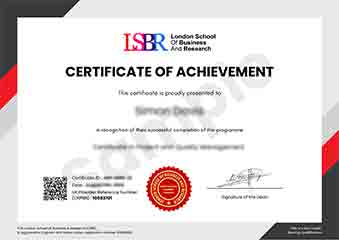
Sample Certificate
Preview the certificate you'll receive upon successful completion of this program.
Get Free Course Info
Receive detailed course information, curriculum breakdown, and career outcomes straight to your inbox.
Employer Sponsored?
Many employers cover professional development costs. Request a corporate invoice and we'll handle the rest. Bulk enrollment discounts available for teams of 3+.
How You Earn Your Certificate
Four simple steps to your professionally recognised qualification
Enroll & Get Instant Access
Complete your enrollment and access course materials immediately
Study at Your Own Pace
Work through the modules on your schedule, from anywhere in the world
Complete Assessments
Demonstrate your knowledge through practical, real-world assessments
Receive Your Certificate
Get your official LSBR UK certificate, recognised across 180+ countries
Real Results from Real Learners
Our graduates consistently report measurable career growth and professional advancement after completing their programmes.
Reviews from Our Learners
Hear from our students about their experience with the Undergraduate Certificate in Mastering Optical Simulation for Product Design at LSBR UK - Executive Education.
Charlotte Williams
United Kingdom"The course material provided a deep, intuitive understanding of light propagation that immediately translated into better product designs. I gained practical proficiency in simulating complex optical systems, which has significantly boosted my confidence in presenting technically sound solutions to clients."
Sophie Brown
United Kingdom"This certificate transformed my ability to simulate optical performance before physical prototyping has drastically reduced my iteration cycles and made me indispensable to my product development team. I now confidently lead complex lighting design projects, leveraging these advanced simulation skills to deliver precise, market-ready solutions faster than ever before."
Oliver Davies
United Kingdom"The logical progression of modules made complex optical concepts accessible, allowing me to build a robust foundation in simulation techniques. This structured approach directly enhanced my ability to apply these tools to real-world product design challenges, significantly boosting my professional confidence."
Need more time to decide?
Join 23,000+ professionals who advanced their careers. Enroll today and start learning immediately.
Enroll NowSecure payment • Instant access • Certificate included