
Undergraduate Certificate in Mathematical Simulation and Modelling Techniques
This certificate equips students with advanced skills in mathematical simulation and modelling techniques, enhancing analytical and problem-solving abilities for real-world applications.
Undergraduate Certificate in Mathematical Simulation and Modelling Techniques
Programme Overview
The Undergraduate Certificate in Mathematical Simulation and Modelling Techniques is designed for students with a foundational interest in mathematics and its applications in solving complex real-world problems. This programme equips learners with a robust understanding of mathematical principles and techniques, including differential equations, numerical methods, and statistical analysis. It emphasizes the use of advanced software tools and programming for mathematical simulation, enabling students to develop effective models for various scientific and engineering disciplines. The curriculum is structured to cater to students with diverse academic backgrounds, including those from mathematics, physics, engineering, and computer science, aiming to provide them with a comprehensive skill set in mathematical simulation and modelling.
Students will develop a wide range of key skills, including proficiency in programming languages such as Python and MATLAB, the ability to design and implement mathematical models, and expertise in data analysis and interpretation. Additionally, learners will gain experience in using simulation software, enhancing their problem-solving abilities and analytical skills. These skills are crucial for addressing challenges in industries such as finance, engineering, healthcare, and environmental science.
Upon completion of the programme, graduates will be well-prepared for careers in industries that require advanced mathematical and computational skills. Potential career paths include roles such as data analyst, mathematical modeler, software developer, and research assistant. The programme’s focus on practical application and interdisciplinary learning ensures that graduates are equipped to contribute effectively to a variety of sectors, driving innovation and problem-solving through mathematical simulation and modelling techniques.
What You'll Learn
Embark on a journey to master the art of mathematical simulation and modelling with our Undergraduate Certificate program. Designed for students eager to explore the intersection of mathematics, computing, and real-world problem-solving, this program equips you with the skills to analyze complex systems and predict outcomes in various fields. Key topics include differential equations, numerical methods, optimization techniques, and data analysis, providing a robust foundation in mathematical and computational tools.
Through hands-on projects and case studies, you'll learn to apply these skills in sectors such as finance, engineering, and environmental science. For instance, you might model financial markets to forecast trends, optimize supply chain logistics, or simulate environmental impacts of climate change. This program not only enhances your analytical and problem-solving abilities but also prepares you for a wide array of career paths.
Graduates are well-equipped to pursue roles in data science, operations research, software development, and research, among others. Our alumni have secured positions at leading companies such as Google, Amazon, and consulting firms like McKinsey & Company. Whether you aim to innovate in technology, contribute to scientific research, or drive strategic decisions in industry, this program provides the tools and knowledge to excel. Join us and unlock the power of mathematical simulation and modelling in shaping the future.
Programme Highlights
Industry-Aligned Curriculum
Developed with industry leaders for job-ready skills
Globally Recognised Certificate
Recognised by employers across 180+ countries
Flexible Online Learning
Study at your own pace with lifetime access
Instant Access
Start learning immediately, no application process
Constantly Updated Content
Latest industry trends and best practices
Career Advancement
87% report measurable career progression within 6 months
Topics Covered
- Foundational Concepts: Covers the core principles and key terminology.: Numerical Methods: Introduces algorithms and techniques for solving mathematical problems.
- Differential Equations: Focuses on ordinary and partial differential equations and their applications.: Optimization Techniques: Explores methods for finding the best solution among many alternatives.
- Data Analysis: Teaches statistical methods and data handling for model validation.: Computational Tools: Provides hands-on experience with software and programming for simulations.
What You Get When You Enroll
Key Facts
For working professionals, recent graduates
No specific prerequisites required
Develops skills in mathematical modeling
Enhances proficiency in simulation techniques
Increases ability to solve complex problems
Suitable for various industries
Ready to Advance Your Career?
Join thousands of professionals who have transformed their careers with LSBR UK
Why This Course
Enhanced Career Opportunities: Pursuing an Undergraduate Certificate in Mathematical Simulation and Modelling Techniques equips professionals with valuable skills that are highly sought after in various industries, including finance, engineering, and technology. This qualification can open doors to roles such as data analyst, simulation engineer, or quantitative analyst, providing a competitive edge in the job market.
Strong Foundation in Mathematical Tools: The certificate program focuses on developing a robust understanding of mathematical models and simulation techniques, which are crucial for solving complex problems. Proficiency in tools like MATLAB, Python, and R enhances problem-solving skills and prepares individuals for roles that require advanced analytical capabilities.
Practical Application of Knowledge: The program emphasizes practical application, allowing students to work on real-world projects. This hands-on experience is invaluable as it bridges the gap between theoretical knowledge and practical implementation, making graduates more adept at applying mathematical models to solve practical issues in their respective fields.
Versatility and Flexibility: With the increasing demand for interdisciplinary skills, this certificate offers a versatile educational path. It can complement existing degrees and enhance employability across sectors. For instance, a business professional with this certificate can apply mathematical models to improve business strategies or enhance marketing analytics.
3-4 Weeks
Study at your own pace
Course Brochure
Download our comprehensive course brochure with all details
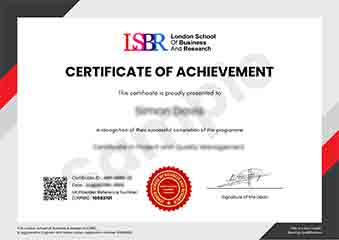
Sample Certificate
Preview the certificate you'll receive upon successful completion of this program.
Get Free Course Info
Receive detailed course information, curriculum breakdown, and career outcomes straight to your inbox.
Employer Sponsored?
Many employers cover professional development costs. Request a corporate invoice and we'll handle the rest. Bulk enrollment discounts available for teams of 3+.
Your Path to Certification
Four simple steps to your professionally recognised qualification
Enroll & Get Instant Access
Complete your enrollment and access course materials immediately
Study at Your Own Pace
Work through the modules on your schedule, from anywhere in the world
Complete Assessments
Demonstrate your knowledge through practical, real-world assessments
Receive Your Certificate
Get your official LSBR UK certificate, recognised across 180+ countries
Join Thousands Who Transformed Their Careers
Our graduates consistently report measurable career growth and professional advancement after completing their programmes.
What People Say About Us
Hear from our students about their experience with the Undergraduate Certificate in Mathematical Simulation and Modelling Techniques at LSBR UK - Executive Education.
Sophie Brown
United Kingdom"The course provided a robust foundation in mathematical simulation techniques, equipping me with practical skills that have been invaluable in real-world problem-solving scenarios. I gained a deep understanding of how to apply these techniques to model complex systems, which has significantly enhanced my career prospects in the field of data analysis."
Isabella Dubois
Canada"This course has been instrumental in bridging the gap between theoretical mathematics and practical applications, equipping me with advanced simulation and modelling techniques that are highly sought after in the industry. It has significantly enhanced my problem-solving skills and opened up new career opportunities in data analysis and predictive modelling."
Ashley Rodriguez
United States"The course structure is well-organized, providing a comprehensive foundation in mathematical simulation and modelling techniques that directly enhance my ability to apply these skills in real-world scenarios, significantly boosting my professional growth."
Still deciding?
Join 23,000+ professionals who advanced their careers. Enroll today and start learning immediately.
Enroll NowSecure payment • Instant access • Certificate included