
Undergraduate Certificate in Morphological Signal Transformation Techniques
Earn an Undergraduate Certificate in Morphological Signal Transformation Techniques to enhance data analysis skills and transform signal processing capabilities.
Undergraduate Certificate in Morphological Signal Transformation Techniques
Programme Overview
The Undergraduate Certificate in Morphological Signal Transformation Techniques is designed to equip students with advanced knowledge and practical skills in the manipulation and transformation of morphological signals. This programme is ideal for students with a background in electrical engineering, computer science, or related fields, or those looking to transition into advanced signal processing roles. It provides a comprehensive curriculum that includes the analysis, design, and implementation of algorithms for morphological signal processing, covering both theoretical foundations and real-world applications.
Learners will develop a robust set of skills, including the ability to apply morphological operators for image and signal processing, understand the underlying mathematical principles, and use software tools for signal transformation. Additionally, students will gain expertise in the application of these techniques in various domains such as biomedical imaging, multimedia content analysis, and environmental monitoring, thereby enhancing their problem-solving capabilities in signal processing.
Upon completion of the programme, graduates will be well-prepared to pursue careers in industries requiring advanced signal processing skills, such as telecommunications, medical diagnostics, and data analysis. The programme also lays a strong foundation for those aspiring to further their education in master's or doctoral programmes in signal processing, computer science, or related fields.
What You'll Learn
The Undergraduate Certificate in Morphological Signal Transformation Techniques is a cutting-edge program designed to equip students with advanced skills in processing and analyzing morphological signals. This program is ideal for individuals seeking to excel in fields such as bioengineering, telecommunications, and data science. By mastering techniques such as Fourier transforms, wavelet analysis, and signal filtering, students will gain the ability to transform raw data into actionable insights.
Key topics include the fundamentals of signal processing, advanced mathematical techniques for analyzing complex signals, and practical applications of these methods in real-world scenarios. Students will learn to use state-of-the-art software tools and programming languages to implement and test their solutions.
Graduates of this program are well-prepared to enter careers in engineering, research, and data analysis. They can apply their skills in areas such as biomedical signal processing, telecommunications, audio and video processing, and environmental monitoring. The program's focus on hands-on learning and real-world applications ensures that graduates are not only academically proficient but also capable of contributing immediately to their chosen fields.
With a strong foundation in morphological signal transformation techniques, graduates can seek roles such as signal processing engineers, data analysts, and research scientists. The program also provides a solid base for those wishing to pursue further studies or specialize in a specific area of signal processing.
Programme Highlights
Industry-Aligned Curriculum
Developed with industry leaders for job-ready skills
Globally Recognised Certificate
Recognised by employers across 180+ countries
Flexible Online Learning
Study at your own pace with lifetime access
Instant Access
Start learning immediately, no application process
Constantly Updated Content
Latest industry trends and best practices
Career Advancement
87% report measurable career progression within 6 months
Topics Covered
- Introduction to Morphological Signal Transformation: Provides an overview of the field and its applications.: Mathematical Foundations: Covers essential mathematical concepts and tools.
- Signal Acquisition Techniques: Discusses methods for acquiring morphological signals.: Signal Preprocessing: Focuses on cleaning and preparing signals for analysis.
- Transformation Algorithms: Introduces various algorithms used in signal transformation.: Case Studies: Analyzes real-world applications and case studies of morphological signal transformation.
What You Get When You Enroll
Key Facts
Audience: Students with basic knowledge in linguistics
Prerequisites: Introductory courses in linguistics or signal processing
Outcomes: Proficient in morphological analysis techniques
Outcomes: Skilled in signal transformation applications
Outcomes: Capable of implementing morphological algorithms
Ready to Advance Your Career?
Join thousands of professionals who have transformed their careers with LSBR UK
Why This Course
Enhanced Specialization: Obtaining an Undergraduate Certificate in Morphological Signal Transformation Techniques allows professionals to deepen their expertise in signal processing and analysis, particularly in morphological aspects. This specialization can make candidates highly sought after in fields like telecommunications, where advanced signal processing is crucial.
Career Advancement Opportunities: With this certificate, professionals can qualify for more senior roles in industries such as telecommunications, aerospace, and defense. For instance, advanced knowledge in morphological signal transformation can be pivotal in developing sophisticated communication systems or improving radar technologies.
Skill Development in Analytical Tools: The program equips professionals with advanced analytical tools and techniques, enhancing their ability to manipulate and interpret complex data. These skills are particularly valuable in research and development departments where innovative solutions are needed to address complex engineering challenges.
Interdisciplinary Applications: The skills learned are not limited to traditional engineering fields. They can also be applied in areas like medical imaging, where morphological transformations are used to process and analyze biometric data. This versatility opens up interdisciplinary career pathways and expands professional networks.
3-4 Weeks
Study at your own pace
Course Brochure
Download our comprehensive course brochure with all details
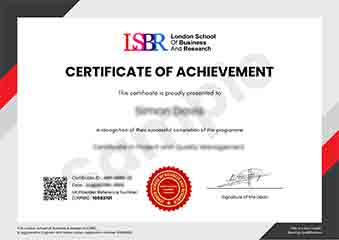
Sample Certificate
Preview the certificate you'll receive upon successful completion of this program.
Get Free Course Info
Receive detailed course information, curriculum breakdown, and career outcomes straight to your inbox.
Employer Sponsored?
Many employers cover professional development costs. Request a corporate invoice and we'll handle the rest. Bulk enrollment discounts available for teams of 3+.
Your Path to Certification
Four simple steps to your professionally recognised qualification
Enroll & Get Instant Access
Complete your enrollment and access course materials immediately
Study at Your Own Pace
Work through the modules on your schedule, from anywhere in the world
Complete Assessments
Demonstrate your knowledge through practical, real-world assessments
Receive Your Certificate
Get your official LSBR UK certificate, recognised across 180+ countries
Join Thousands Who Transformed Their Careers
Our graduates consistently report measurable career growth and professional advancement after completing their programmes.
What People Say About Us
Hear from our students about their experience with the Undergraduate Certificate in Morphological Signal Transformation Techniques at LSBR UK - Executive Education.
James Thompson
United Kingdom"The course content is incredibly thorough and well-structured, providing a solid foundation in morphological signal transformation techniques that are directly applicable to real-world scenarios. Gaining these skills has been invaluable, opening up new opportunities in my field and enhancing my ability to analyze and process complex signals effectively."
Isabella Dubois
Canada"This course has been instrumental in enhancing my ability to analyze and transform morphological signals, making me more competitive in the field of telecommunications. It has directly contributed to my recent promotion to a senior engineering role where I now lead projects involving signal processing."
Fatimah Ibrahim
Malaysia"The course structure is well-organized, providing a clear path from foundational concepts to advanced techniques in morphological signal transformation, which has significantly enhanced my understanding and practical skills in signal processing. The comprehensive content and real-world applications have been invaluable for my professional growth in this field."
Still deciding?
Join 23,000+ professionals who advanced their careers. Enroll today and start learning immediately.
Enroll NowSecure payment • Instant access • Certificate included