
Undergraduate Certificate in Predictive Modeling in Tolerance Analysis
Navigate digital disruption with predictive modeling in tolerance analysis mastery. Build resilience and adaptability in changing markets.
Undergraduate Certificate in Predictive Modeling in Tolerance Analysis
About This Course
The Undergraduate Certificate in Predictive Modeling in Tolerance Analysis is designed to equip students with the essential skills and knowledge to analyze and predict system behavior under varying conditions, focusing on the interplay between component tolerances and system performance. This program is ideal for students majoring in engineering, mathematics, or related fields, as well as professionals seeking to enhance their technical expertise in predictive modeling and tolerance analysis. It aims to bridge the gap between theoretical concepts and practical applications, preparing learners to tackle complex engineering challenges through advanced analytical techniques.
Learners will develop a comprehensive understanding of statistical methods, predictive modeling, and tolerance stacking principles, enabling them to accurately predict how design variations and manufacturing tolerances affect system performance. Key skills include the use of computational tools for data analysis, the ability to create and validate predictive models, and proficiency in interpreting and communicating the implications of tolerance analysis results. By mastering these skills, students will be able to optimize product design, reduce manufacturing costs, and enhance system reliability.
This program significantly impacts career trajectories by opening up opportunities in various industries, including automotive, aerospace, electronics, and manufacturing. Graduates are well-prepared to take on roles such as predictive modelers, tolerance analysts, and product designers, where they can apply their expertise to improve product performance, streamline production processes, and drive innovation.
What You Will Learn
Embark on a transformative journey to harness the power of data and predictive analysis with our 'Undergraduate Certificate in Predictive Modeling in Tolerance Analysis.' This specialized program equips you with advanced skills in statistical modeling, machine learning, and predictive analytics, tailored specifically for tolerance analysis in manufacturing and engineering. You will learn to apply predictive models to improve product design, reduce manufacturing costs, and enhance quality control through rigorous hands-on projects and real-world case studies.
Key topics include statistical methods for tolerance analysis, predictive modeling techniques, and software tools for data analysis. By the end of the program, you will be adept at using predictive models to forecast product performance and identify potential failures before they occur, ensuring that your designs meet stringent quality standards.
Graduates of this program are well-prepared to excel in roles such as predictive modeler, data analyst, and quality control engineer. Whether you are currently in industry looking to advance your career or a recent graduate seeking to enter the field, our certificate offers you the knowledge and skills to drive innovation and achieve success in the competitive world of predictive modeling and tolerance analysis. Join us and unlock your potential to transform data into actionable insights that drive efficiency and excellence.
Course Benefits
Industry-Aligned Curriculum
Developed with industry leaders for job-ready skills
Globally Recognised Certificate
Recognised by employers across 180+ countries
Flexible Online Learning
Study at your own pace with lifetime access
Instant Access
Start learning immediately, no application process
Constantly Updated Content
Latest industry trends and best practices
Career Advancement
87% report measurable career progression within 6 months
What This Course Covers
- Foundational Concepts: Covers the core principles and key terminology.: Statistical Foundations: Introduces probability distributions and statistical inference.
- Regression Analysis: Teaches how to build and interpret regression models.: Experimental Design: Focuses on designing experiments for data collection.
- Tolerance Stackup Analysis: Explains how to analyze and predict variations in assembly.: Optimization Techniques: Discusses methods to optimize component tolerances.
Everything You Get With This Course
Course Facts
For working engineers and technicians
No specific prerequisites required
Understand predictive modeling techniques
Apply tolerance analysis in industries
Develop skills in statistical software
Analyze system variability effectively
Ready to Advance Your Career?
Join thousands of professionals who have transformed their careers with LSBR UK
Why This Course Is Right for You
Enhanced Predictive Capabilities: The Undergraduate Certificate in Predictive Modeling in Tolerance Analysis equips professionals with advanced statistical tools and techniques for predicting system behavior under varying conditions. This proficiency is crucial in fields like manufacturing and engineering, where understanding and controlling product variability is essential. For instance, automotive engineers can use this knowledge to optimize component tolerances and predict performance issues before product launches.
Improved Problem-Solving Skills: The curriculum focuses on real-world applications, teaching students how to analyze data, identify trends, and solve complex problems using predictive models. This skill set is invaluable in industries that rely on accurate data-driven decision-making, such as finance and technology. Financial analysts, for example, can implement these models to forecast market trends and mitigate risks.
Increased Career Opportunities: Graduates of this program are well-prepared for roles that demand predictive modeling skills, such as data scientist, predictive analytics specialist, or quality engineer. The demand for such professionals is on the rise, with a growing need for organizations to leverage predictive models for strategic planning, customer behavior analysis, and operational efficiency. This certificate can significantly enhance employability by making professionals more competitive in the job market.
3-4 Weeks
Study at your own pace
Course Brochure
Download our comprehensive course brochure with all details
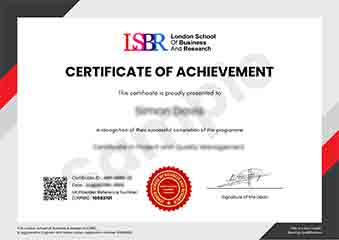
Sample Certificate
Preview the certificate you'll receive upon successful completion of this program.
Get Free Course Info
Receive detailed course information, curriculum breakdown, and career outcomes straight to your inbox.
Employer Sponsored?
Many employers cover professional development costs. Request a corporate invoice and we'll handle the rest. Bulk enrollment discounts available for teams of 3+.
How You Earn Your Certificate
Four simple steps to your professionally recognised qualification
Enroll & Get Instant Access
Complete your enrollment and access course materials immediately
Study at Your Own Pace
Work through the modules on your schedule, from anywhere in the world
Complete Assessments
Demonstrate your knowledge through practical, real-world assessments
Receive Your Certificate
Get your official LSBR UK certificate, recognised across 180+ countries
Real Results from Real Learners
Our graduates consistently report measurable career growth and professional advancement after completing their programmes.
Reviews from Our Learners
Hear from our students about their experience with the Undergraduate Certificate in Predictive Modeling in Tolerance Analysis at LSBR UK - Executive Education.
Charlotte Williams
United Kingdom"The course content is incredibly thorough and well-structured, providing a solid foundation in predictive modeling techniques that are directly applicable to real-world engineering problems. Gaining hands-on experience with these tools has significantly enhanced my ability to analyze and optimize system tolerances, a skill that is highly valuable in the industry."
Brandon Wilson
United States"This certificate program has been incredibly valuable, equipping me with the skills to analyze and predict component tolerances more accurately, which is directly applicable in my role at a manufacturing company. It has opened up new opportunities for me to take on more complex projects and contribute more effectively to product development."
Madison Davis
United States"The course structure is well-organized, providing a comprehensive overview of predictive modeling in tolerance analysis that seamlessly bridges theoretical concepts with practical applications, significantly enhancing my understanding and professional skills in the field."
Need more time to decide?
Join 23,000+ professionals who advanced their careers. Enroll today and start learning immediately.
Enroll NowSecure payment • Instant access • Certificate included